Written by Anu Jewellers Team
Reviewed by Anu & Henry, Anu Jewellers
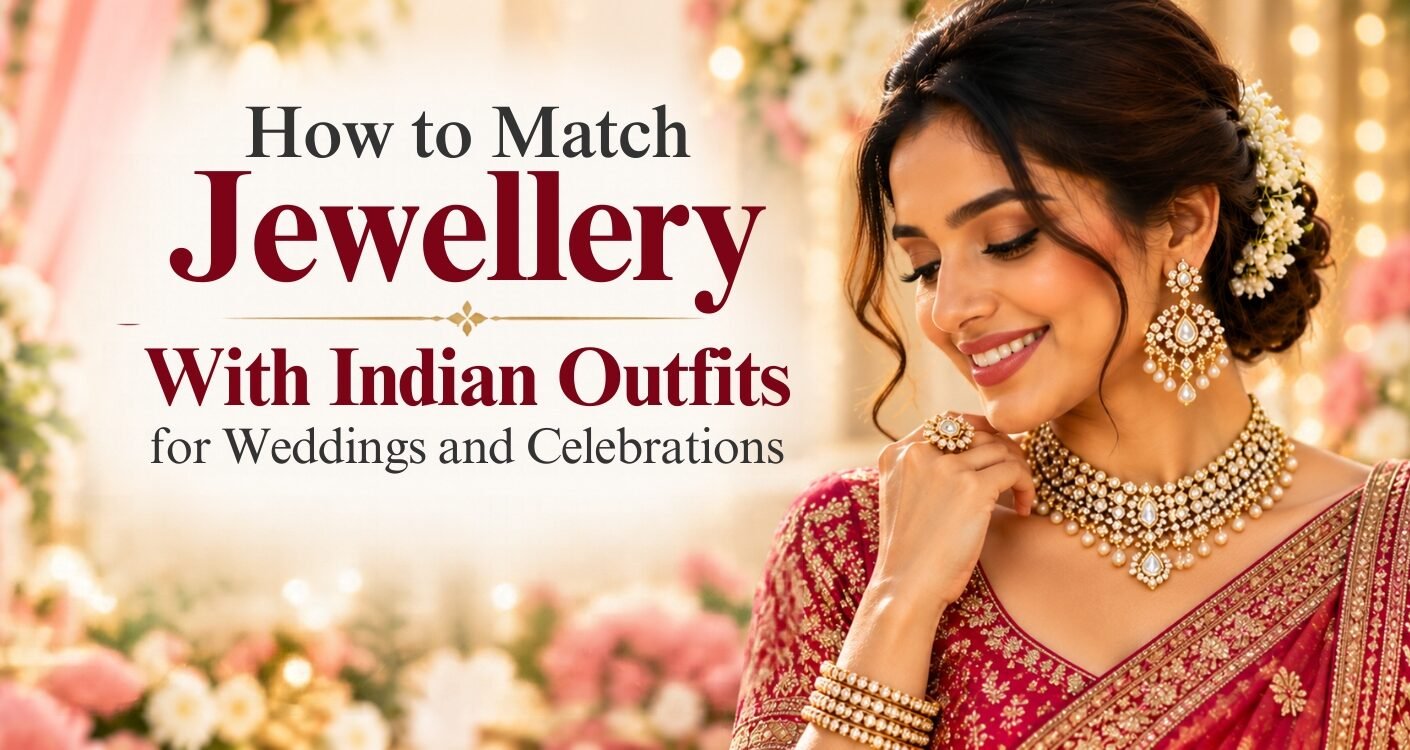
Match jewellery with Indian outfits by starting with the outfit’s fabric, embroidery, neckline and occasion. Then choose one hero jewellery piece and build around it, using metal tone, colour, scale and comfort to create a coordinated look without making every element compete.
Indian outfits already bring together colour, texture, embroidery and silhouette. Jewellery should enhance those elements rather than compete with them.
Whether you are styling a saree for a family celebration, a lehenga for a wedding, an Anarkali for a festive evening or a traditional outfit for a cultural event, the easiest approach is to work from the clothing outward.
This guide explains how to choose jewellery based on the outfit itself, including practical combinations for weddings, receptions, mehendi, festive celebrations and more.
How Do You Match Jewellery With Indian Outfits Without Overdoing It?
Match jewellery with Indian outfits by identifying the strongest detail first, then choosing complementary pieces rather than adding jewellery everywhere. Fabric weight, embroidery, neckline, colour and occasion should determine whether your look needs minimal, coordinated or statement jewellery.
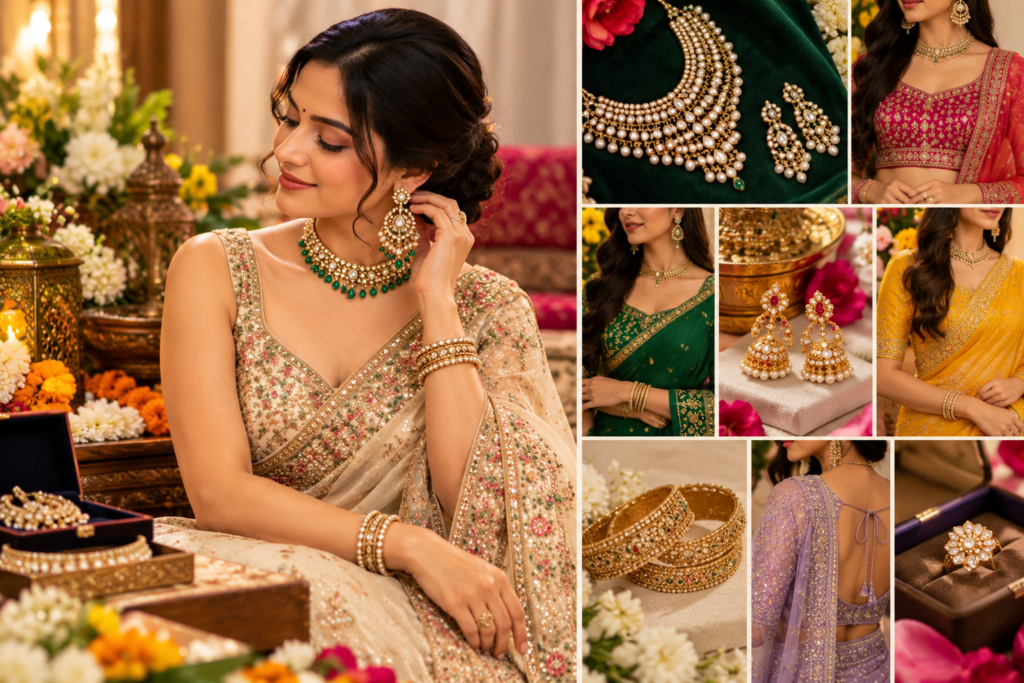
Use the Outfit-First Five-Step Method
1. Identify the outfit’s visual weight: look at embroidery, zari, sequins, embellishments and fabric texture because a heavily decorated outfit already has a strong visual presence.
2. Choose one hero area: decide whether the necklace, earrings, bangles, maang tikka or another piece should attract the most attention because one clear focal point makes the overall look easier to balance.
3. Match the jewellery scale: pair large jewellery with enough visual space around it because a wide necklace can disappear against dense embroidery while oversized earrings can compete with a detailed neckline.
4. Coordinate the colour story: repeat one colour from the border, embroidery or stonework, or deliberately introduce a complementary contrast because exact colour matching can make the jewellery disappear into the outfit.
5. Test the complete look: wear the jewellery with the actual outfit, blouse, hairstyle and dupatta because a piece that looks perfect separately can become hidden, uncomfortable or visually crowded once everything is assembled.
The Outfit-to-Jewellery Decision Matrix
| Outfit Character | Jewellery Direction | Good Starting Choices | Avoid |
| Heavy embroidery | Refined and selective | Statement earrings, slim bangles, one necklace | Multiple competing statement pieces |
| Simple outfit | More expressive | Choker, layered necklace, large jhumkas | Jewellery that is too delicate to be noticed |
| Rich silk | Traditional or structured | Gold, temple-inspired, Kundan, Polki | Very casual jewellery |
| Light cotton | Light and relaxed | Small gold earrings, fine chain, simple bangles | Heavy bridal sets |
| Detailed neckline | Shift focus elsewhere | Earrings, bangles, ring | Necklace covering the neckline |
| Minimal blouse | Use the open space | Choker, pendant, layered necklace | Leaving every jewellery area equally plain |
A practical illustrative scenario: if a red silk saree has a broad gold zari border and an embroidered blouse, the outfit already provides colour and texture. A pair of gold Jhumkas and a controlled bangle stack may create a stronger result than adding a large necklace, heavy earrings and multiple bangles together.
For Melbourne buyers looking for traditional options, Anu Jewellers’ Indian jewellery Melbourne collection includes 22K gold, bridal, Punjabi, bangles, necklaces, Jhumka earrings and other traditional designs.
How Should Jewellery Match Indian Sarees?
Saree jewellery should respond to the saree’s fabric, border, blouse neckline and formality. Rich silk and zari can support traditional gold or temple-inspired pieces, while lighter cotton or printed sarees usually look better with simpler earrings, pendants or bangles.
Kanjeevaram and Traditional Silk Sarees
Kanjeevaram sarees often have strong borders, rich colours and traditional motifs. Gold jewellery can reinforce that heritage character without needing to copy every motif.
Consider:
- traditional gold necklaces;
- Jhumka earrings;
- temple-inspired jewellery;
- gold bangles;
- a restrained necklace-and-earring combination.
If the saree already has a broad decorative border and detailed blouse, let the earrings or bangles become the stronger jewellery element.
Banarasi Sarees
Banarasi sarees can carry rich jewellery because the fabric and zari already create a formal visual language.
Kundan, Polki-inspired, gold or diamond-accented pieces can work depending on the colour and occasion. For a heavily woven Banarasi, avoid automatically adding the largest necklace available.
A shorter necklace or choker can work well when the blouse neckline leaves enough space. With a high or heavily embroidered blouse, statement earrings may create better balance.
Cotton and Handloom Sarees
Cotton sarees generally benefit from a lighter jewellery approach.
Try:
- small gold earrings;
- simple Jhumkas;
- a fine gold chain;
- one bangle;
- a small pendant;
- understated rings.
The aim is not to make everyday sarees look bridal. A small piece of gold can add polish without overwhelming the texture of cotton or handloom fabric.
Printed Sarees
Printed sarees already contain a visual pattern, so jewellery can either repeat one colour or provide a controlled contrast.
For example, a floral saree with green and pink details could use green gemstone earrings or simple yellow gold. You do not need to find jewellery containing every colour in the print.
What Jewellery Works Best With Lehengas?
Lehenga jewellery should balance the choli neckline, embroidery, dupatta and wedding function. A heavily embellished lehenga usually needs one dominant jewellery area, while a simpler lehenga can support layered necklaces, larger earrings or a more detailed bangle combination.
Heavy Bridal Lehengas
When the lehenga has extensive embroidery, zardozi, sequins or stonework, avoid creating another equally busy focal point.
A strong combination can be:
Heavy lehenga + statement necklace + controlled earrings + simple bangles.
Alternatively:
Heavy lehenga + statement earrings + lighter necklace + restrained wrist jewellery.
The important decision is where you want the eye to go first.
Minimal or Pastel Lehengas
A simpler pastel lehenga gives jewellery more room to become the focal point.
Consider:
- Kundan jewellery;
- Polki-inspired pieces;
- diamond jewellery;
- pearl accents;
- coloured gemstones;
- layered gold necklaces;
- statement earrings.
Pastel clothing can also provide a softer background for gold or diamond pieces.
Match the Choli Before Choosing the Necklace
The choli is often more important than the lehenga skirt when selecting a necklace. A deep neckline, sweetheart neckline, square neckline and high neckline create different jewellery opportunities.
Take a photograph of the full choli from the front before buying the necklace. This makes it easier to see where the jewellery will actually sit.
For bridal styling in Melbourne, Anu Jewellers’ Indian bridal jewellery Melbourne collection includes bridal necklaces, chokers, Rani Haar, bangles, Jhumkas, rings and other wedding-focused pieces.
How Do You Choose Jewellery for Salwar Suits, Anarkalis and Shararas?
Salwar suits, Anarkalis and shararas give you more flexibility because their necklines and silhouettes vary widely. Match jewellery to the outfit’s detail level, fabric weight and occasion, choosing lighter pieces for daytime looks and stronger accents for evening celebrations.
Everyday or Daytime Anarkali
Choose jewellery that complements rather than dominates.
Small Jhumkas, studs, a slim bangle or a delicate pendant can work well with a printed or lightly embroidered Anarkali.
Festive Anarkali
For a more detailed festive outfit, increase the jewellery scale gradually.
A statement Jhumka can become the hero piece, supported by a bracelet or bangle. If the neckline is open, a small necklace can be added without creating too much visual competition.
Sharara Sets
Sharara outfits often combine a detailed top, dupatta and wide trousers. Because several areas already contain movement and texture, choose jewellery that remains visible without competing with the dupatta.
A pair of statement earrings can often work better than a heavy necklace when the dupatta crosses the front of the outfit.
Salwar Suits
For a simple salwar suit, you have more freedom to use jewellery as the feature.
A gold necklace, Jhumka, bangle stack or statement ring can add interest without making the look feel excessively formal.
How Does the Neckline Change Jewellery Choice?
Neckline determines how visible a necklace will be, so choose jewellery after checking the blouse or top. Open necklines create space for chokers and pendants, while high or heavily decorated necklines often work better with earrings, bangles or a statement ring.
Deep or Open Necklines
Open necklines create a natural display area for:
- chokers;
- short necklaces;
- pendants;
- layered necklaces.
The necklace should follow the shape rather than sit awkwardly across the fabric.
High Necklines
High necklines often leave less space for a necklace.
Try:
- Jhumkas;
- chandbali-style earrings;
- statement studs;
- bangles;
- bracelets;
- rings.
The jewellery can shift attention towards the face and hands.
Square Necklines
Square necklines provide a defined geometric frame. A structured necklace or shorter pendant can echo that shape.
Avoid choosing a necklace simply because it is fashionable. Look at how much space remains between the jewellery and the neckline.
Heavily Embroidered Blouses
When the blouse itself contains detailed embroidery, let it remain visible.
A simple necklace or earrings can provide enough jewellery without covering the work you selected the blouse to showcase.
Should Jewellery Match Outfit Colour or Contrast?
Jewellery does not need to match an Indian outfit’s colour exactly. A better approach is to repeat a border or embroidery tone, use a harmonious metal, or introduce one deliberate contrast so the jewellery complements the outfit instead of disappearing into it.
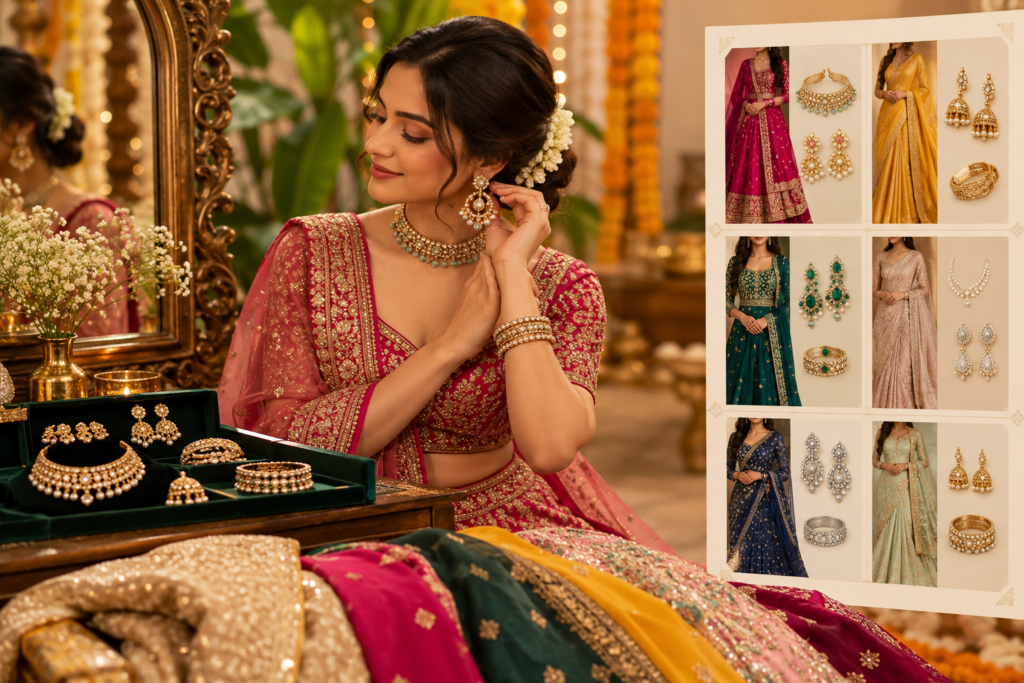
Use the Border as Your Colour Reference
For sarees, the border and pallu often provide more useful jewellery clues than the main body colour.
For example:
| Outfit Detail | Jewellery Direction |
| Red + gold border | Yellow gold, Kundan, ruby accents |
| Green + gold border | Yellow gold, emerald accents |
| Royal blue + gold | Yellow gold, diamonds or contrasting gemstones |
| Ivory + gold | Gold, pearls, diamonds |
| Pink + gold | Yellow or rose gold, diamonds or soft gemstones |
| Black + gold | Gold, diamonds or controlled gemstone colour |
| Silver embroidery | White gold, diamonds or silver-toned jewellery |
These are styling starting points, not rigid rules. Personal preference, skin tone, family tradition and the event can all change the final choice.
Use Gemstones as Controlled Contrast
A contrasting gemstone can make a simple outfit more interesting.
For example, emerald can provide contrast against red or pink, while ruby can create a strong accent against neutral or darker clothing.
The Gemological Institute of America explains that metal colour can influence how gemstones and diamonds appear, while warmer gemstone colours commonly work naturally with warmer gold tones and cooler gemstone colours with cooler metals.
Avoid Exact Matching Everywhere
A red saree, red earrings, red necklace, red bangles and red stones can make the jewellery disappear into the outfit.
Instead, repeat one colour and allow the metal or a secondary gemstone to create separation.
How Do You Match Jewellery for Different Wedding Functions?
Wedding jewellery should change with the function rather than staying identical throughout the celebration. Mehendi and daytime events can suit lighter pieces, while the ceremony and reception can support gold, Kundan, Polki, diamond or layered jewellery when the outfit calls for it.
Mehendi
Mehendi events often involve movement, sitting and socialising for extended periods.
Prioritise:
- lightweight earrings;
- simple bangles;
- colourful accents;
- comfortable pieces;
- jewellery that will not catch easily on clothing.
Floral or colourful styling can also work when the event has a more relaxed dress code.
Haldi
Haldi is another setting where comfort matters.
Avoid jewellery that is difficult to clean or likely to be damaged by products used during the ceremony. Simple earrings, lightweight bangles or pieces reserved specifically for the function can be more practical.
Sangeet
Sangeet allows more dramatic styling.
Statement earrings, a choker, layered necklace or diamond accents can work particularly well when the outfit is designed for evening lighting.
If dancing is involved, secure earrings and avoid jewellery that catches easily on the dupatta.
Wedding Ceremony
The main ceremony is where traditional jewellery can take centre stage.
Depending on the bride’s community and family traditions, this may include:
- layered necklaces;
- Kundan-inspired jewellery;
- temple-inspired jewellery;
- bridal bangles;
- Jhumkas;
- Rani Haar;
- mangalsutra;
- statement rings.
The exact combination should follow the bride’s traditions rather than assuming every Indian wedding uses the same jewellery.
Reception
Reception styling can be more contemporary.
A bride who wore traditional gold during the ceremony might choose diamond earrings, a modern necklace or a simpler bracelet for the reception.
The same principle works for wedding guests: change the jewellery’s scale and style according to the evening outfit instead of repeating the complete ceremony look.
When Should You Choose Gold, Diamond, Kundan or Temple-Inspired Jewellery?
Choose gold, diamond, Kundan, temple-inspired or contemporary jewellery according to the outfit’s visual language and the occasion. Traditional craftsmanship can reinforce a heritage look, while diamonds or clean contemporary designs can soften a modern outfit without losing an Indian connection.
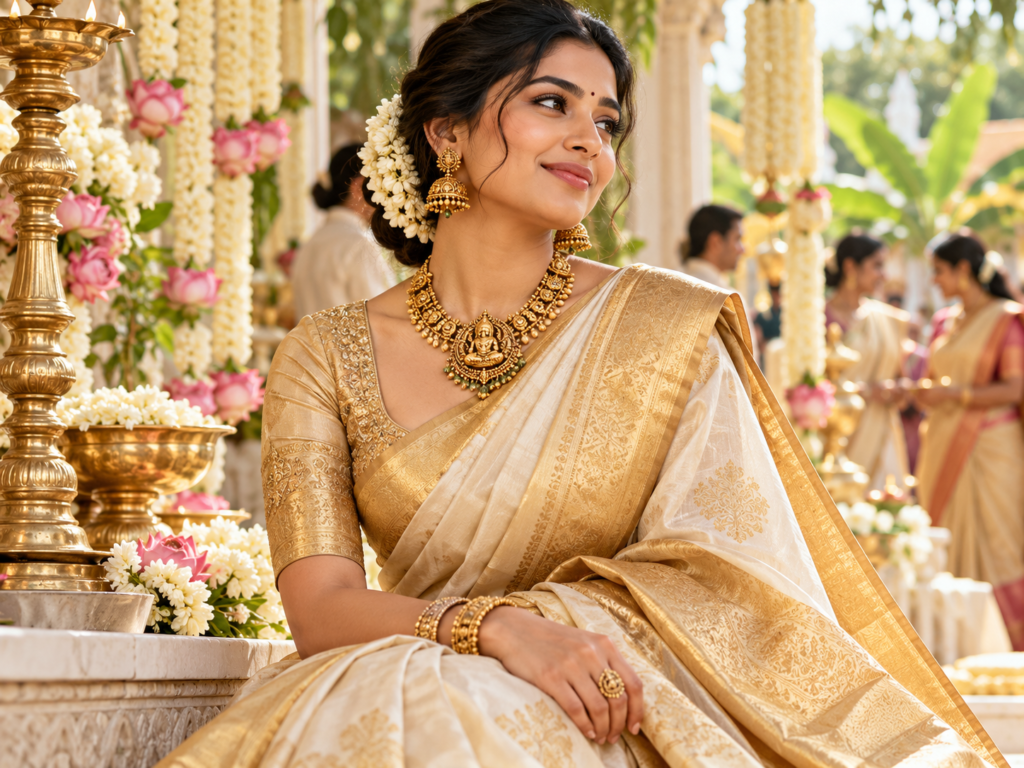
Gold Jewellery
Gold is especially versatile with Indian clothing.
The Jewellers Association of Australia explains that gold purity is expressed through caratage, with 24K representing the purest form and lower caratages balancing gold content with other metals.
The World Gold Council notes that 22K gold contains approximately 91.7% gold, while 18K contains 75% gold. Alloying also affects colour and physical properties.
For Indian outfits, yellow gold can work particularly well with:
- silk sarees;
- traditional wedding outfits;
- red, maroon and mustard clothing;
- gold zari;
- traditional embroidery;
- heritage-inspired designs.
For buyers exploring gold jewellery Melbourne options, Anu Jewellers’ Craigieburn showroom offers traditional Indian and contemporary gold jewellery for weddings, festivals, gifting and everyday wear.
Diamond Jewellery
Diamond jewellery can create a cleaner and more contemporary look.
It works especially well for:
- reception outfits;
- pastel lehengas;
- modern sarees;
- evening celebrations;
- Indo-Western outfits;
- understated bridal styling.
A diamond necklace does not need to be large to become the focal point. Sometimes smaller stones with a clean setting create a more refined result against a detailed outfit.
Kundan Jewellery
Kundan jewellery has a strong traditional association and can complement richly embroidered lehengas, sarees and wedding outfits.
Because Kundan pieces can be visually detailed, use the same hero-piece principle. A Kundan choker can lead the look while the earrings and bangles remain more restrained.
Temple-Inspired Jewellery
Temple-inspired jewellery can work particularly well with traditional silk sarees and heritage-focused wedding styling.
It is especially effective when the outfit already contains traditional motifs or a strong gold border.
Contemporary Jewellery
Contemporary jewellery gives you more freedom to create a fusion look.
Try a traditional Jhumka with a modern Anarkali, a simple gold pendant with an Indo-Western outfit or diamond earrings with a minimalist saree.
The goal is not to make every element traditional. It is to create a deliberate relationship between the outfit and jewellery.
What Should You Check Before Finalising the Look?
Before finalising the look, check the jewellery against the complete outfit in the same lighting and with the intended hairstyle and dupatta. Confirm that pieces are comfortable, secure and visible, then remove anything that competes with the outfit’s strongest detail.
The Three-Zone Balance Test
Use three visual zones:
Face: earrings, maang tikka and hair jewellery.
Neck and chest: chokers, necklaces, pendants and layered pieces.
Hands and wrists: bangles, bracelets and rings.
You do not need every zone to carry an equally strong piece.
If the face already has dramatic Jhumkas and a maang tikka, the necklace can be simpler.
If the necklace is the hero, earrings can provide support rather than competition.
If the outfit has a detailed neckline, shift the visual weight towards the ears and wrists.
Test the Look in Real Lighting
A jewellery combination can look different under showroom lighting, natural daylight and wedding-hall lighting.
For an Australian wedding, test the complete outfit in the type of lighting likely to be used at the event.
This is particularly useful for diamonds, coloured gemstones, polished gold and reflective Kundan pieces.
Check Comfort Before the Event
Wear the complete combination for at least 30 minutes.
Check whether:
- earrings feel too heavy;
- necklaces move into an uncomfortable position;
- bangles catch on embroidery;
- a maang tikka pulls at the hairstyle;
- a ring interferes with other rings;
- a dupatta catches on the jewellery.
For a bride, this test is even more important because the jewellery may be worn for several hours.
Confirm Security
Check every clasp, earring backing and fastening before leaving.
For valuable pieces, do not wait until the wedding morning to discover that a clasp is difficult to operate.
If a piece needs resizing, repair, polishing or alteration, have it professionally assessed before the event.
How Should Budget Affect Your Jewellery Choice?
Budget should determine the scale and material of the jewellery, not whether the look feels complete. Start with the outfit and hero piece, then choose purity, stones, craftsmanship and layering within your A$ budget rather than buying more pieces to fill space.
Use a Hero-Piece Budget
Instead of dividing your money equally across several pieces, decide which jewellery item matters most.
For example, an illustrative A$1,500 styling budget might prioritise one strong necklace or pair of earrings rather than five inexpensive pieces that compete visually.
An illustrative A$3,000 budget could allow greater flexibility between gold weight, gemstone detail, craftsmanship and additional supporting pieces.
These are planning examples, not current market-price averages or quotes. Actual jewellery pricing depends on gold rates, purity, weight, design, gemstones, workmanship and customisation.
Spend on the Piece You Will Notice Most
If the blouse has a beautiful neckline, prioritise the necklace.
If the outfit is heavily embroidered, invest more attention in earrings.
If the outfit is simple, a statement necklace or detailed bangle may create the visual interest.
When Should You See a Jeweller?
Professional guidance is useful when:
- you are building a complete bridal set;
- you need a specific necklace length;
- existing family jewellery needs to be matched;
- a bangle needs resizing;
- an heirloom piece needs restoration;
- stones need to be checked;
- you are commissioning custom jewellery;
- you are unsure which gold purity suits the intended use.
When buying in Australia, the ACCC explains that consumer guarantees provide automatic rights when products do not meet required standards, although these rights are different from a retailer’s voluntary change-of-mind policy. Check the seller’s specific terms before purchasing customised or altered jewellery.
Which Jewellery Combination Should You Choose?
The best way to match jewellery with Indian outfits is to let the clothing, occasion and neckline guide the jewellery rather than treating every piece as equally important. Choose one focal area, coordinate the metal and colour story, then edit anything that creates visual or physical clutter.
For brides and families in Melbourne, the final combination should also reflect cultural preferences and the practical reality of a long wedding day.
If you are comparing traditional pieces, explore Anu Jewellers’ Indian jewellery Melbourne collection in Craigieburn, including gold bangles, Jhumka earrings, necklaces, Punjabi jewellery and bridal designs.
For a more specific bridal look, the Indian bridal jewellery Melbourne collection provides options including chokers, Rani Haar, bangles, earrings and wedding necklaces.