

Written by Anu Jewellers Team
Reviewed by Anu & Henry, Anu Jewellers
How to stack gold bangles without looking overcrowded starts with one focal piece, a few complementary widths and enough space for comfortable movement. Build around your outfit and occasion, then remove anything that catches, knocks or competes for attention.
A handful of beautiful bangles does not automatically make a beautiful stack. A wide kada can disappear between several ornate pieces, while three perfectly matched slim bangles may look much stronger than seven competing designs. The difference is proportion, not simply quantity.
This guide offers practical gold bangle stacking ideas for everyday Melbourne outfits, Indian celebrations and wedding jewellery. Whether you have inherited a traditional pair or are buying your first stack in Craigieburn, the aim is to make each piece visible, comfortable and worth wearing.
How to Stack Gold Bangles Without Making Your Wrist Look Busy
To build a balanced gold bangle stack, choose one piece to lead, vary widths deliberately and check the combined weight on your wrist. Add pieces only when they create contrast or meaning, rather than repeating the same visual detail.
How Many Bangles Should You Wear?
There is no universal number. One substantial kada may be enough, while three fine pieces can create an easy layered effect. Five or more may suit an evening or wedding look when several are lightweight. The deciding factors are width, sleeve clearance, movement and family preference, not a compulsory odd-number rule.
For example, three broad bangles may occupy more visual and physical space than six narrow ones. When deciding how many bangles should you wear, compare the combined width on your arm instead of counting pieces in isolation.
The Three-Question Stack Test
Before adding another piece, ask: Can I see each design? Can I move comfortably? Can these pieces touch without damage? If the answer to any is no, remove or rearrange a bangle.
| Wearing Situation | A Useful Starting Combination | Why It Usually Works |
| Everyday office or university | Two slim bangles or one slim bangle and a fine bracelet | Less movement against a desk |
| Weekend lunch or casual outing | One medium bangle with two quieter pieces | A visible focal point without a full stack |
| Dinner or festive gathering | One wider decorative bangle with three or four slim pieces | More texture while retaining balance |
| Indian or South Asian wedding | A coordinated pair of kadas with narrower supporting bangles | Builds a ceremonial look |
| Watch wearer | Fuller stack on the opposite wrist | Helps protect the watch case and face |
For styles that can work as anchors or supporting pieces, explore Anu Jewellers’ gold bangles Melbourne collection. Compare the actual sizes and finishes before treating a product photograph as a complete stacking plan.
1. How Can You Start with One Anchor Bangle?
Start with a bangle that deserves the most attention, such as a wider kada, an engraved heirloom or a diamond-accented piece. Keep the next bangles simpler so their shape and shine frame the focal piece instead of hiding its detail.
Decide What Leads the Look
An anchor need not be the most expensive bangle. It might be a family piece with a familiar pattern or a smooth gold band that stands out because the other bangles are textured. The important point is giving the eye a clear place to settle.
Try one wide floral kada with two plain slim bangles on the same wrist. From a distance, the broad design remains visible; up close, the fine bands add movement. By contrast, three equally ornate wide kadas can obscure one another and feel heavier than intended.
For people who prefer sparkle, a diamond bangle can be the focal point, provided the surrounding pieces do not strike its stone settings. Test the actual combination gently before committing to it for a full day.
Keep the Focal Point Visible
Look in a full-length mirror with your arms relaxed, not only at a close-up of the wrist. If the central bangle disappears into a solid gold strip, take one piece away. A successful stack should still read clearly beside the rest of your outfit.
2. How Do Thin and Thick Gold Bangles Work Together?
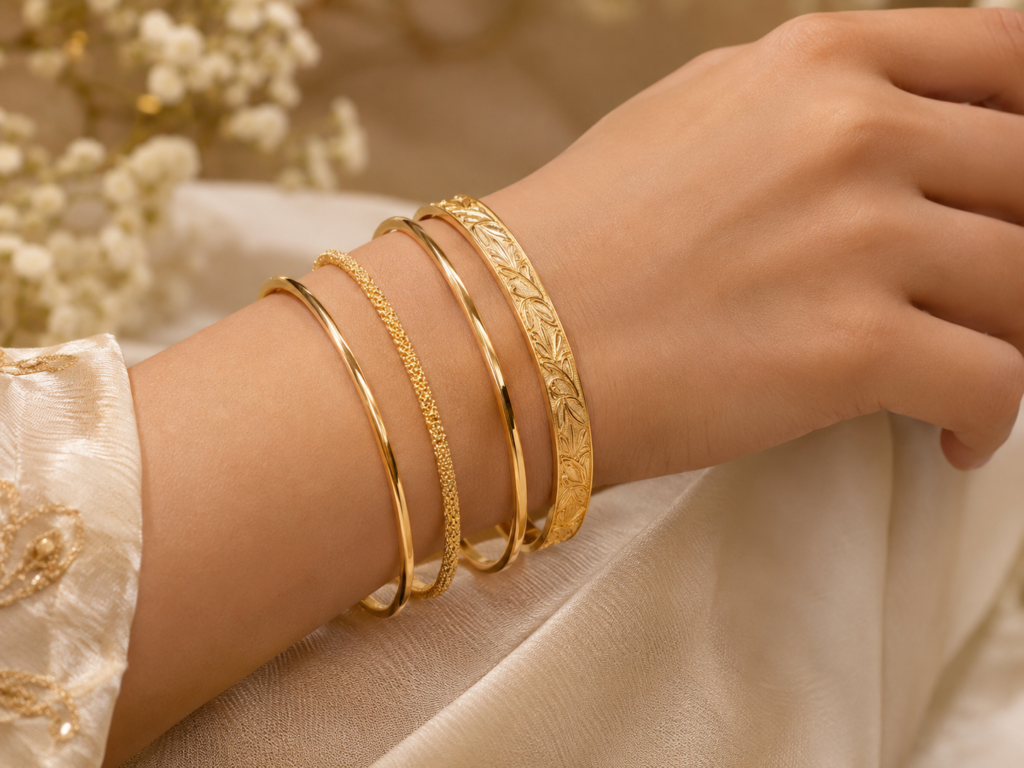
Thin bangles work as visual separators, while a thicker bangle supplies shape and presence. Put one stronger piece beside one or two slimmer designs, then assess the combined width rather than assuming an odd number of bangles will always look better.
Use Thin Bangles to Create Breathing Room
The simplest thin vs thick bangles combination is a medium-width bangle between two narrow, smooth bands. The result looks arranged without needing additional stones or colours. Thin gold bangles are particularly useful when a richly embroidered outfit or heavy necklace already provides plenty of detail.
A slim bangle is not automatically more durable because it is lightweight. Very thin or hollow designs can distort when knocked. Check construction and the intended wear pattern before treating them as everyday spacers.
Compare the Width from the Side
Stack the pieces on one wrist and turn your arm sideways. Notice whether a broad cuff traps a narrow piece, or whether one bangle rides over another. If the stack changes shape dramatically with movement, choose pieces with more compatible internal dimensions.
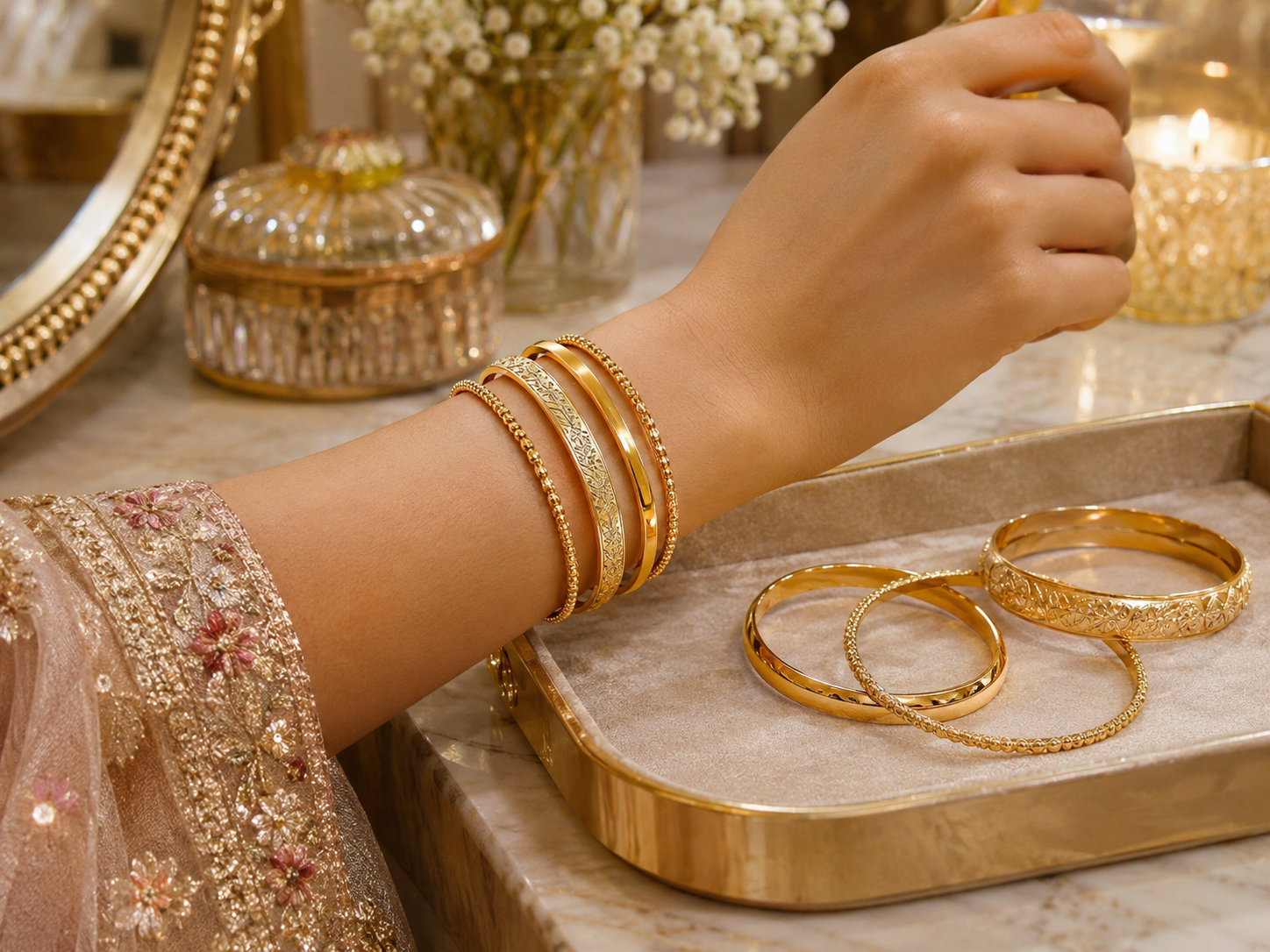
A useful shopping test is to place the planned pieces together on a padded tray, then try the same order on your wrist. The tray shows colour and texture; the wrist reveals movement, weight and fit.
3. How Can You Mix Gold Bangles with Different Finishes?
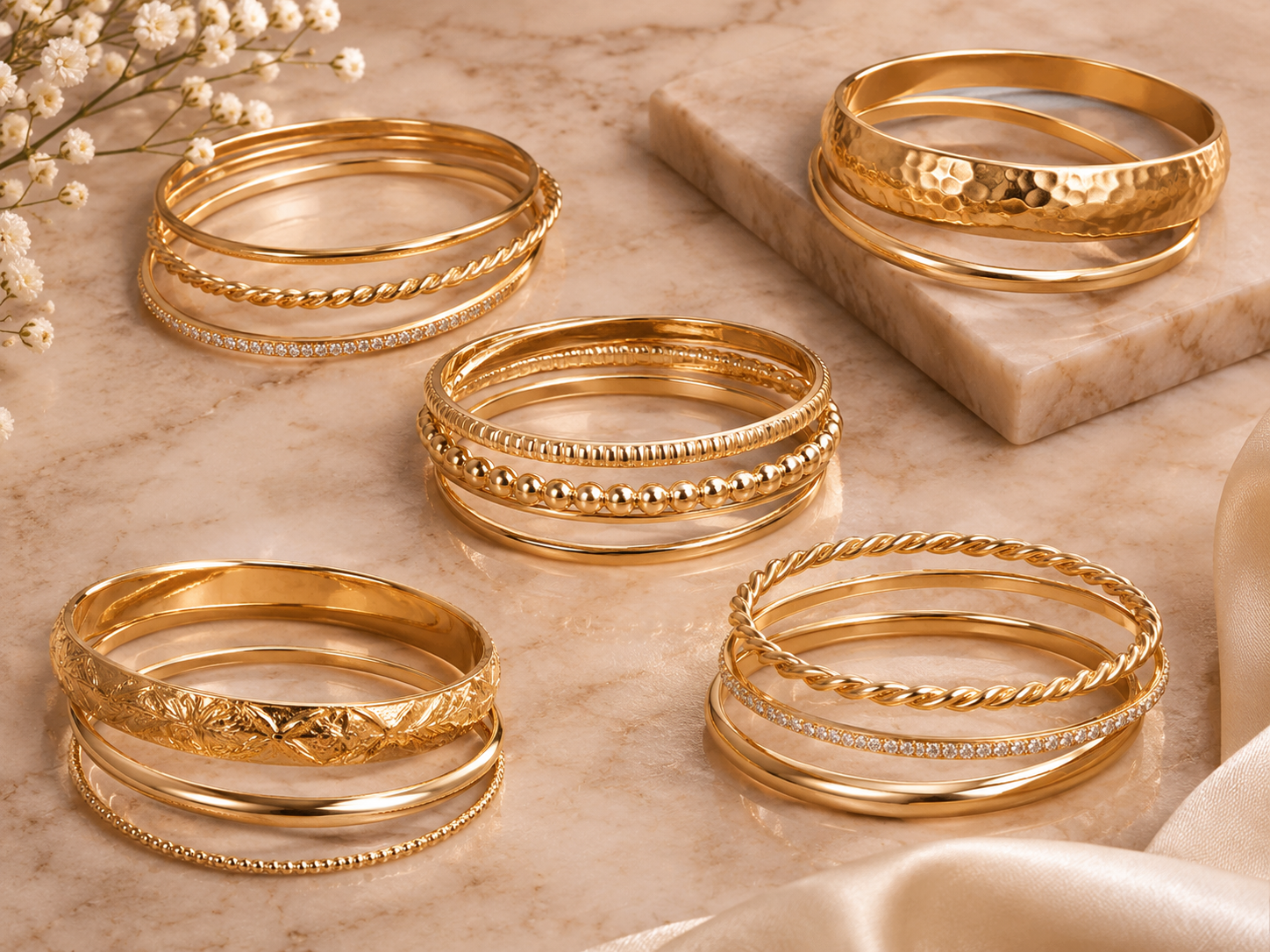
Mix finishes by combining smooth gold with one textured, engraved or lightly stone-set piece. Keep the underlying colour palette related, and avoid giving every bangle a different surface pattern. Controlled variation makes individual designs easier to appreciate at normal viewing distance.
Mix Texture, Not Competing Motifs
One polished band, one gently hammered surface and one engraved bangle offer three distinct reflections without adding extra width. If each piece carries a large floral relief, dangling charm or coloured stone, the wrist can feel crowded despite a modest piece count.
For an illustrative Melbourne dinner outfit, imagine a black silk blouse with one engraved gold bangle and two polished bands. The texture is visible against the simple clothing. Add a large stone-set cuff and several charms, however, and the jewellery begins competing with itself.
Keep smooth pieces near delicate fabrics and watch for raised edges around lace, knitwear and embroidery. Where a piece contains stones, the setting should be checked for loose claws or sharp points before stacking.
4. Can You Mix Bangles and Bracelets in One Stack?
Yes — a rigid bangle can sit beside a flexible chain bracelet when both fit securely and move without snagging. Use the bangle for structure and the bracelet for a softer line, but separate delicate links from heavy edges or exposed stones.
Let the Pieces Move Differently
Stacking gold bracelets with rigid bangles can soften a traditional wrist look. A smooth bangle with one fine link bracelet may be enough for everyday wear, while a chain bracelet and narrow stone-set style can create a dressier arrangement.
The distinction matters: a bangle usually holds its circular or oval shape; a bracelet follows the wrist through links, chain or articulated settings. If the bracelet repeatedly slips underneath a rigid piece, the clasp or links may take more friction than intended.
Browse Anu Jewellers’ gold bracelets for flexible options. Try the pieces together before deciding that two attractive individual designs will automatically work as one stack.
Keep Fragile Details Apart
According to the Jewellers Association of Australia, jewellery should be protected from activities that cause scratching or knocks, and pieces should be stored separately to avoid rubbing. The same principle is relevant when deciding whether two very different designs should sit directly beside one another.
If a hard bangle continually strikes a delicate bracelet, rearrange the order or place them on opposite wrists. Do not add a fragile chain solely to fill an empty space.
5. How Do You Stack Traditional Gold Bangles for Weddings?
For a wedding bangle stack, begin with the bride’s or wearer’s cultural preferences, outfit and existing heirlooms. Use the most meaningful pieces as the starting point, then add simpler bangles that support the full look without making long ceremonies uncomfortable.
Match the Whole Outfit, Not Only the Wrist
Traditional gold bangles may sit alongside a kada, heirloom pieces, ceremonial bangles or modern designs, depending on family tradition. Punjabi, South Indian, Nepali and other South Asian wedding customs are not interchangeable, and the number or colour of bangles may carry personal meaning.
If you are deciding how to stack gold bangles for a wedding, start with the existing heirloom or ceremonial pieces before shopping for extras.
A silk saree with heavy zari can often carry one striking pair of kadas with narrow supporting pieces. A richly embellished lehenga may already have a busy neckline and sleeve, making a simpler wrist arrangement more effective. Neither approach is a universal bridal rule.
For a broader look at culturally informed designs, explore Indian jewellery Melbourne and Anu Jewellers’ Indian bridal jewellery collection.
Build a Stack You Can Actually Wear
Use an illustrative rehearsal: wear the proposed set for at least 30 minutes before the event. Sit, stand, greet someone, handle a handbag and arrange a saree pallu or dupatta. Check whether the pieces catch, dig into the wrist or become tiring.
If a favourite heirloom looks good but creates repeated impact against newer pieces, give it more space or let it stand alone. Cultural meaning should not depend on forcing an uncomfortable combination.
6. Can You Mix Yellow, White and Rose Gold?
Yes — different gold colours can work together when one tone leads and the others provide small accents. Repeat the secondary colour elsewhere in the outfit, or choose one two-tone piece to connect the stack without introducing multiple unrelated focal points.
Choose a Dominant Metal Colour
If most of your jewellery is yellow gold, keep that tone as the main thread and introduce a narrow rose-gold or white-gold accent. This is often cleaner than splitting the stack into three equally strong blocks. Matching finishes can also connect colours that are not identical.
According to the World Gold Council, gold colours come from alloying pure gold with other metals. Different colours do not, by themselves, identify the full purity or construction of a finished piece, so check each item’s specification before buying.
Colour coordination is a styling choice; abrasion is a separate practical matter. A hard-edged setting or protruding stone can rub against a neighbouring band regardless of whether the two pieces match in colour.
7. How Do You Balance Both Wrists, Watches and Sleeves?
Balance the complete outfit by letting one wrist carry the fuller stack and keeping the other quieter when you wear a watch or detailed sleeves. If both wrists are decorated, vary their visual weight instead of trying to make every piece identical.
Make Space for a Watch
A broad metal watch next to several gold bangles can create repeated knocks against the watch case and jewellery. For everyday work, place the fuller stack on the opposite wrist or wear only one slim bangle near the watch after checking clearance.
A fitted shirt cuff also changes the equation. A stack that looks comfortable with short sleeves may bunch under a jacket or catch a delicate blouse. Try on the actual clothing while testing the jewellery; photographs taken with bare arms will not reveal every problem.
For celebrations, symmetry can be appropriate when it suits the outfit or family tradition. For a simple Melbourne work outfit, one focal wrist often feels more relaxed. Neither is a strict fashion law.
What Should You Check Before Wearing or Buying a Stack?
Check every bangle’s internal size, combined weight, surface condition and construction before treating several pieces as one outfit. A comfortable stack should move without pinching, catch neither clothing nor skin, and keep delicate clasps and stones away from repeated impacts.
The Five-Minute Try-On Process
- Lay out your chosen pieces on a soft surface: arrange the anchor first and place quieter designs beside it so you can see whether the colours, widths and motifs compete.
- Put on each bangle in the intended order: confirm that closed bangles clear the hand and hinged designs fasten completely because each mechanism has different fitting requirements.
- Move your wrist and test a sleeve for two minutes: bend your hand, hold a phone and rest your forearm on a desk to reveal knocking, pinching or snagging before longer wear.
- Remove or rearrange one problem piece: stop where every design remains visible and the stack feels secure, rather than adding another bangle to meet a target number.
Consider Gold Purity, Construction and Cost
Many buyers compare 22K gold bangles for their warm colour and cultural relevance. Others prefer 18K designs, hinged forms or a mix of inherited pieces.
The suitability of each depends on thickness, shape, metalwork and how frequently the stack is worn; purity alone is not a durability guarantee.
When working out how to stack gold bangles within a budget, prioritise pieces you will genuinely wear. Ask for the stated fineness, total weight, hollow or solid construction, stone details and an itemised price in Australian dollars.
If your illustrative budget is A$1,500, compare the actual cost of one well-made focal bangle against several slimmer pieces rather than assuming a fuller stack offers better value. This figure is an example budget, not a current market quote.
A Practical Care and Check Schedule
| When | What to Check | Why |
| Before each wear | Closures, loose stones, rough edges and comfortable fit | Prevents snagging or insecure pieces |
| After a long event | Surface marks, trapped fabric and clasp movement | Helps spot friction damage early |
| After contact with chemicals or heavy activity | Follow material-specific care advice; seek advice if damage is visible | Some cleaners and physical tasks can damage jewellery |
| During storage | Keep individual pieces separated in soft compartments | Reduces contact scratches and tangling |
| At a periodic professional check | Settings, hinges, links, repairs and polishing needs | Identifies wear that is difficult to assess at home |
According to the Gemological Institute of America, jewellery should be stored so pieces do not scratch one another, and some gemstones and settings need special care during cleaning.
The guidance is particularly relevant for stacks that include stone-set pieces, heirlooms or mixed materials.
When Should You Ask a Melbourne Jeweller for Help?
Ask a jeweller for help when bangles fit differently, contain valuable stones, have worn hinges or need to coordinate with an heirloom or wedding outfit. A professional can assess whether the proposed combination is wearable and which alterations are technically appropriate.
Bring the pieces you already own to the appointment. A clear photograph helps with colour, but the physical jewellery reveals internal diameter, thickness, wear, fastenings and how parts interact. When choosing a new bangle, confirm whether it can be resized safely and whether its construction suits the intended use.
For damaged links, loose settings or a bent bangle, consider Anu Jewellers’ jewellery repairs in Melbourne rather than attempting to reshape jewellery at home. A professional assessment is particularly important for hollow, enamelled, hinged or heavily stone-set pieces.
At Anu Jewellers in Craigieburn, buyers can compare bangle widths and designs with existing pieces or discuss a future bridal combination. Contact Anu Jewellers before visiting to confirm the relevant options and appointment arrangements.
What Does a Balanced Gold Bangle Stack Look Like?
A balanced stack gives each bangle a purpose: one focal design, complementary supporting pieces and enough room for natural movement. It can contain two pieces or several, provided the overall width, weight, outfit and cultural preferences work together.
Learning how to stack gold bangles is less about collecting a particular number and more about knowing when to stop. Begin with one favourite, compare thin and thick profiles, keep delicate designs protected and test the combination with the clothing you will actually wear.
Whether your style is minimal or ceremonial, the best stack is the one you enjoy wearing comfortably. Anu Jewellers in Craigieburn can help you compare new designs with jewellery you already own.