

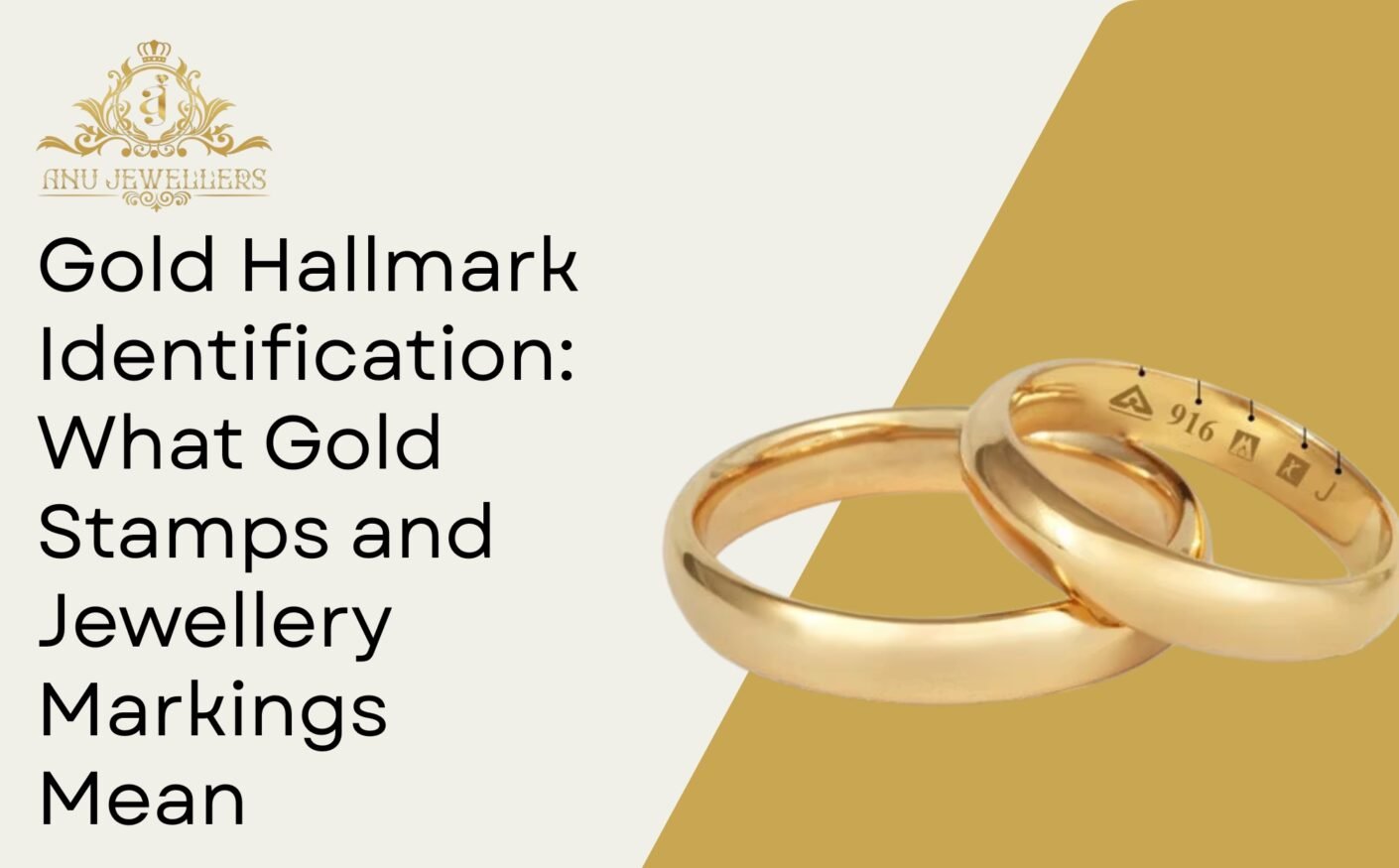
Have you noticed tiny numbers, letters, or symbols stamped inside a gold ring, on a chain clasp, or behind a pendant?
Gold hallmark identification can help you understand what those marks may indicate about a piece of jewellery. Numbers such as 375, 585, 750, 916, and 999 commonly refer to gold fineness, while letters and symbols may relate to a maker, an assay office, a certification system, or the country where the piece was marked.
However, a stamp alone does not always confirm authenticity, condition, or value. Marks may be worn, incomplete, country-specific, or difficult to interpret without looking at the full piece.
At Anu Jewellers, customers can visit our Craigieburn showroom for guidance on gold jewellery, existing pieces, repairs, and suitable next steps when markings are unclear.
Quick Answer: What Do Gold Stamps Mean?
Gold stamps often indicate how much pure gold is present in a piece of jewellery.
For example:
| Stamp | Common Meaning | Approximate Gold Content |
| 375 | 9 carat gold | 37.5% gold |
| 585 | 14 carat gold | 58.5% gold |
| 750 | 18 carat gold | 75.0% gold |
| 916 | 22 carat gold | 91.6% gold |
| 999 | 24 carat gold | Approximately 99.9% gold |
These numbers are generally expressed as parts of pure gold per thousand parts of metal. The World Gold Council identifies common fineness marks including 375 for 9 carat, 585 for 14 carat, 750 for 18 carat and 999 for 24 carat gold; 916 is widely used for 22 carat gold. (World Gold Council)
What Is a Gold Hallmark?
A gold hallmark is more specific than a simple number stamped on jewellery.
A hallmark is an official mark applied after precious metal has been tested through a recognised assaying or hallmarking process. It may identify the gold fineness, the organisation or assay office connected with the test, and, depending on the hallmarking system, additional information such as a maker or date mark.
The Bureau of Indian Standards defines hallmarking as the accurate determination and official recording of the proportionate precious metal content in an article. The State Library Victoria similarly defines a hallmark as a stamp placed on a precious metal article after testing by an official independent assay office. (Bureau of Indian Standards)
This distinction matters because not every jewellery stamp is a complete official hallmark. A piece may show a purity number, brand stamp, maker’s initials, or decorative reference without showing a full hallmarking system.
Gold Hallmarks, Gold Stamps and Gold Jewellery Markings: What Is the Difference?
These terms are often used interchangeably, but they do not always mean the same thing.
Gold Hallmark
A hallmark relates to an official testing and marking process for precious metal purity.
Gold Purity Stamp
A purity stamp usually indicates fineness or caratage, such as 750 for 18 carat gold or 916 for 22 carat gold.
Maker’s Mark
A maker’s mark may identify the jeweller, goldsmith, manufacturer, or business responsible for producing or submitting the piece.
Other Jewellery Markings
Some marks may relate to a date, a country-specific standard, a brand, a design code, a plating description, or another manufacturing detail.
When identifying gold hallmarks, it is important to consider all visible stamps together rather than relying on one number or letter alone.
Common Gold Stamp Numbers Explained
Gold stamp numbers are among the most useful markings to identify first because they often indicate purity.
375 Gold Stamp
A 375 stamp commonly indicates 9 carat gold, meaning approximately 37.5% of the metal content is gold.
This mark is commonly seen on jewellery designed to offer a balance between gold content, durability, and affordability.
585 Gold Stamp
A 585 stamp commonly indicates 14 carat gold, meaning approximately 58.5% gold.
The World Gold Council notes that although 14 carat mathematically equates to about 583 parts per thousand, many manufacturers use the slightly higher 585 fineness standard. (World Gold Council)
750 Gold Stamp
A 750 stamp commonly indicates 18 carat gold, meaning 75% gold.
This is frequently found on fine jewellery pieces, rings, earrings, necklaces, and other designs where a higher gold content is desired while retaining practical wearability.
916 Gold Stamp
A 916 stamp commonly indicates 22 carat gold, meaning approximately 91.6% gold.
This stamp is especially relevant for customers comparing traditional gold jewellery, cultural jewellery, bridal styles, bangles, chains, and higher-purity gold pieces.
999 Gold Stamp
A 999 stamp commonly indicates gold that is approximately 99.9% pure, often described as 24 carat gold.
Because very high-purity gold is softer than alloyed gold, how it is used in jewellery may differ from lower-carat pieces designed for frequent wear.
What Does 916 Mean on Gold Jewellery?
The number 916 is one of the most recognised gold jewellery markings for customers shopping for traditional and higher-purity gold designs.
A 916 stamp generally corresponds to 22 carat gold, indicating a fineness of 916 parts per thousand, or approximately 91.6% gold.
This can be especially relevant when looking at gold bangles, chains, necklaces, bridal pieces, traditional jewellery, and family gifting designs. Customers exploring high-purity gold styles can also view our gold jewellery Melbourne collection.
A 916 stamp can be useful information, but the full piece, associated markings, construction, and any professional testing or documentation should still be considered when confirming jewellery details.
What Do Letter Markings on Gold Jewellery Mean?
Letter markings on gold jewellery can be confusing because they do not all have one universal meaning.
Depending on the piece and the hallmarking system, letters may indicate:
- The maker or manufacturer
- The jeweller or sponsor responsible for the item
- An assay office or accreditation organisation
- A date letter used in certain overseas hallmarking systems
- A brand or workshop identifier
- A country-specific certification detail
For Australian customers, jewellery may have been made locally, imported from overseas, inherited through family, or purchased while travelling. That means the same style of letter mark may have a different meaning depending on where and when the jewellery was made.
The Gold and Silversmiths Guild of Australia explains that marks can convey information about the maker, the material, the date of creation and an accreditation organisation where used. (Gold & Silversmith Guild)
What Are Assay Marks for Gold?
Assay marks for gold relate to testing the precious metal content of a piece.
In a formal hallmarking system, an assay office or recognised assaying and hallmarking centre tests the metal and records or applies marks connected with the confirmed fineness.
For example, an official hallmarking system may include:
- A purity or fineness mark
- A maker’s or sponsor’s mark
- An assay office or certification mark
- A date or identification mark, depending on the system
Assay marks can be particularly helpful when identifying inherited jewellery, antique pieces, overseas jewellery, or gold items with several small symbols stamped together.
The Bureau of Indian Standards states that consumers can have jewellery tested through a BIS-recognised Assaying and Hallmarking Centre, which can issue an assay report identifying markings on the article. (Bureau of Indian Standards)
What Is the Hallmark Sign for Gold?
There is no single worldwide hallmark sign for gold.
A gold hallmark symbol depends on the country, hallmarking system, purity standard, maker information, and the organisation responsible for testing or marking the piece.
For example, one item may display a numerical fineness mark such as 750 or 916, while another may include a symbol, initials, a date letter, or a certification identifier alongside the purity mark.
The World Gold Council notes that countries have developed their own requirements and distinctive gold hallmarks and markings over time. (World Gold Council)
This is why a hallmark sign in gold jewellery should be interpreted in context rather than assumed to mean the same thing on every piece.
Foreign Gold Hallmarks: Why Overseas Jewellery Can Be Harder to Identify
Foreign gold hallmarks often need more careful interpretation because different countries use different marking and certification systems.
A piece of overseas gold jewellery may include:
- A purity number such as 585, 750, 916 or 999
- A maker’s mark
- An assay office symbol
- A date letter
- A country-specific hallmark
- A certification or identification code
For customers in Melbourne, this can be particularly relevant when identifying Indian gold jewellery, British jewellery, European pieces, Middle Eastern gold, inherited jewellery, or family items brought to Australia over time.
In India, hallmarking is administered through the Bureau of Indian Standards, which describes hallmarks as official marks used to indicate the purity or fineness of precious metal articles. (Bureau of Indian Standards)
When the origin of a piece is uncertain, it is safer to examine all markings together and seek guidance rather than relying on a single stamp.
Where to Find Gold Stamps and Markings on Jewellery
Gold jewellery markings are often very small and placed in less visible areas so they do not affect the appearance of the piece.
Common locations include:
| Jewellery Type | Where to Look for a Mark |
| Rings | Inside the band |
| Chains | Near the clasp or on a small tag beside the clasp |
| Bracelets | Near the fastening or inside the bracelet |
| Bangles | Inside the bangle or close to a hinge or clasp |
| Necklaces | On the clasp, tag, or rear of a pendant |
| Pendants | On the back or near the bail |
| Earrings | On posts, backs, hooks, or inner surfaces |
Use bright lighting and a magnifying glass if needed. Avoid scratching, filing, polishing, or damaging a piece in an attempt to expose a mark, particularly if the jewellery has family, sentimental, or resale significance.
Does a Gold Stamp Prove Jewellery Is Genuine?
A gold stamp can provide useful information, but it should not automatically be treated as proof that a piece is genuine, correctly represented, or accurately valued.
There are several reasons for this:
- A mark may be worn or only partly visible.
- A piece may carry an overseas marking system that is unfamiliar locally.
- A number may identify claimed fineness without providing full independent hallmark evidence.
- Older jewellery may have maker or date marks that require specialist interpretation.
- A piece may need professional assessment where authenticity or purity matters.
Gold hallmark identification is a useful starting point. It is not always the final answer, especially before buying, selling, exchanging, repairing, or valuing jewellery.
How to Examine Gold Jewellery Markings at Home
You can begin identifying gold jewellery markings carefully at home before seeking further guidance.
1. Clean the Surface Gently
Dust or residue can make a small stamp harder to read. Use a soft cloth rather than abrasive cleaning methods.
2. Check Common Stamp Locations
Look inside ring bands, beside chain clasps, behind pendants, inside bangles, and on earring backs or posts.
3. Use Good Light and Magnification
Small stamps can be difficult to read with the naked eye. A magnifying glass or phone camera zoom may make markings easier to view.
4. Write Down Every Visible Mark
A combination such as a number, symbol and letters may tell more than a number alone.
5. Avoid Making a Decision Based Only on a Stamp
If the piece is important, valuable, inherited, or being considered for repair or another jewellery decision, seek guidance before proceeding.
Identifying Gold Hallmarks on Indian and Traditional Jewellery
Indian and traditional gold jewellery often has particular importance for weddings, gifting, cultural celebrations, and family collections.
A piece may include high-purity markings such as 916, along with other certification or jeweller information depending on when and where it was made.
The Bureau of Indian Standards explains that its hallmarking system is intended to record precious metal content officially and protect consumers against irregular gold or silver quality. (Bureau of Indian Standards)
For customers with traditional gold pieces, it may be useful to identify markings before:
- Repairing a damaged item
- Resizing a ring or bangle
- Restoring an inherited piece
- Choosing a matching design
- Discussing exchange options where available
- Selecting new jewellery for a wedding or family occasion
Customers looking for traditional gold designs can also explore our Punjabi gold jewellery, mangalsutra, rani haar, and gold bangles collections.
What to Do If Your Gold Hallmark Is Unclear
Not every gold stamp can be confidently identified at home.
You may need guidance if:
- The markings are worn or difficult to read
- The piece has several letters or symbols
- The jewellery was purchased overseas
- You inherited the piece and do not know its history
- You are unsure whether the mark refers to purity, a maker, or another detail
- The jewellery needs repair, restoration, resizing, or cleaning
At Anu Jewellers, customers can visit our Craigieburn showroom to discuss gold jewellery and suitable next steps for existing pieces.
If your jewellery is damaged, worn, or needs restoration, you can also explore our jewellery repairs service.
Visit Anu Jewellers
Unsure what the markings on your gold jewellery mean?
Visit Anu Jewellers in Craigieburn or contact our team for guidance on gold jewellery, jewellery repairs, traditional pieces, and suitable next steps for jewellery you already own.
Faq's
What do gold stamp numbers mean?
Gold stamp numbers commonly refer to gold fineness. For example, 375 generally indicates 9 carat gold, 585 indicates 14 carat gold, 750 indicates 18 carat gold, 916 indicates 22 carat gold, and 999 indicates approximately 24 carat gold.
What is a gold hallmark?
A gold hallmark is an official mark associated with the testing and recording of precious metal purity through a recognised hallmarking or assay process. Not every purity stamp or maker’s mark is necessarily a complete official hallmark.
What is the hallmark sign for gold?
There is no single worldwide hallmark sign for gold. Symbols, numbers and letters can vary by country, assay system, maker, date and purity standard.
What do letter markings on gold jewellery mean?
Letter markings may identify a maker, manufacturer, assay office, accreditation organisation, date code, brand or country-specific system. Their meaning depends on the complete group of markings and the origin of the piece.
What are gold assay marks?
Gold assay marks relate to the testing and verification of precious metal fineness. In formal hallmarking systems, an assay office or recognised testing centre may apply or record marks connected with the tested purity of a piece.
How can I identify foreign gold hallmarks?
Start by noting every visible number, letter and symbol on the piece. Foreign gold hallmarks may use different systems depending on the country of origin, so professional guidance may be useful where the jewellery is inherited, valuable, or unclear.
Does 916 mean 22 carat gold?
Yes. A 916 fineness mark generally corresponds to 22 carat gold, meaning 916 parts per thousand are gold, or approximately 91.6% gold content.
Does a gold stamp guarantee authenticity?
No. A stamp can provide useful information, but it should not be the only basis for confirming authenticity, purity, condition or value.