

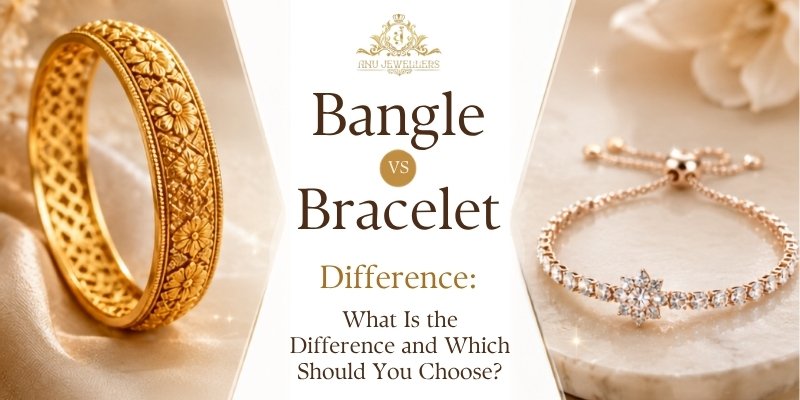
The bangle vs bracelet difference is mainly structure: a bangle is rigid and keeps its shape, while a bracelet is flexible and follows the wrist. Choose bangles for sculptural or traditional styling, and bracelets for adjustable comfort, movement and everyday versatility.
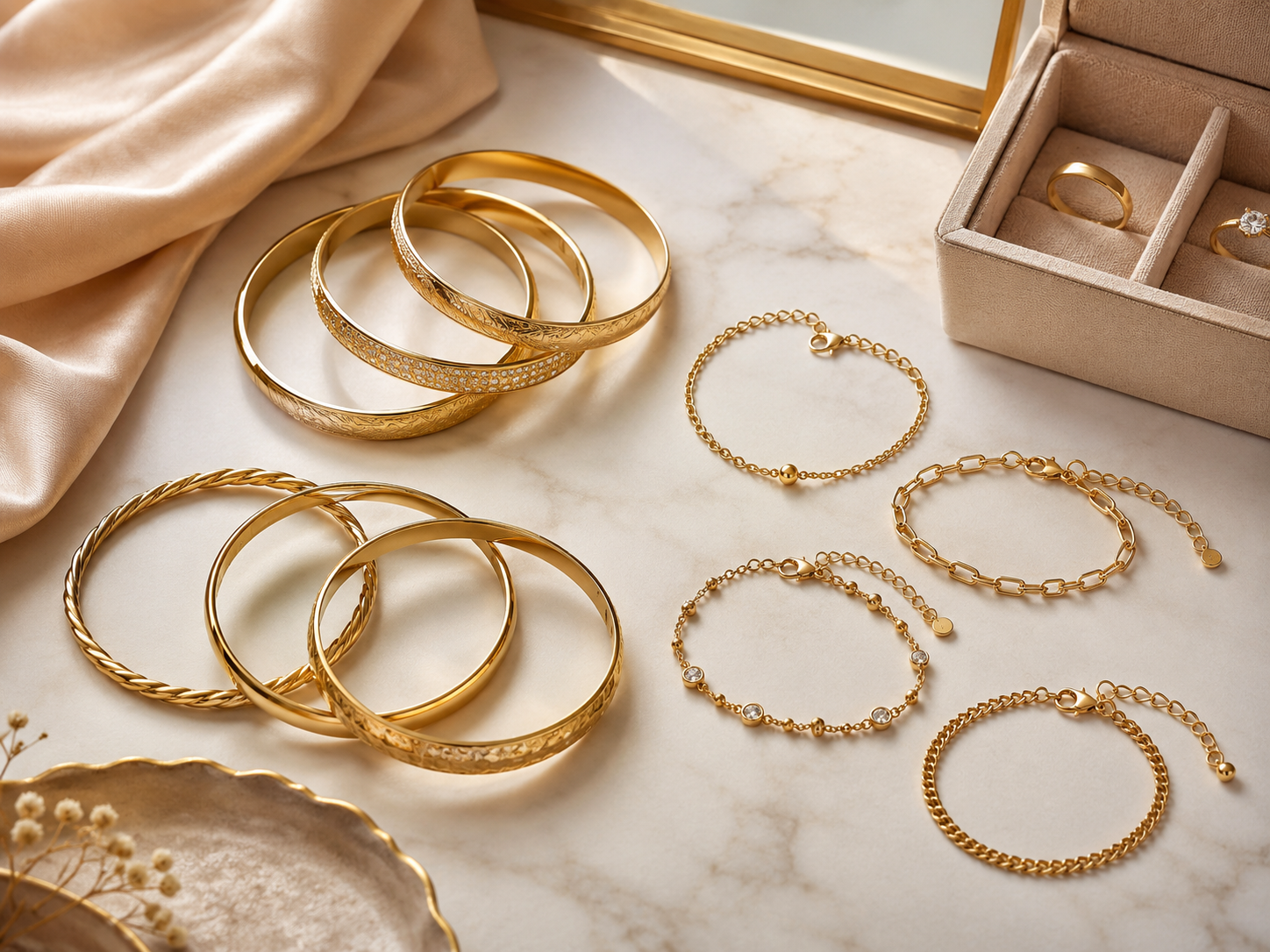
At a jewellery counter, the quickest test is simple: place the piece on a flat surface. A bangle keeps its circular or oval form; a bracelet collapses, bends or drapes because its links, chain or articulated settings are flexible.
That structural distinction affects much more than appearance. It changes how the piece is sized, how it moves, how easy it is to put on, what can wear out, and whether it suits daily work, gifting, bridal styling or a formal celebration.
Key Takeaways
- Bangles are rigid wrist ornaments; bracelets are usually flexible.
- A closed bangle is commonly sized to pass over the widest part of the hand, while a bracelet is sized around the wrist.
- Hinged bangles and cuff styles create useful exceptions to the usual rules.
- Bracelets generally offer a closer, quieter fit; bangles create more movement and visual presence.
- Traditional and modern wristwear can be mixed, provided the pieces do not rub against delicate stones, links or finishes.
- The best choice depends on fit, lifestyle, occasion, design, gold purity and personal or cultural preference.
What Is the Bangle vs Bracelet Difference?
The bangle vs bracelet difference comes down to construction. A bangle is usually a rigid, circular or oval piece that keeps its form. A bracelet is typically flexible, made from links, chain, beads or articulated settings that move with the wrist.
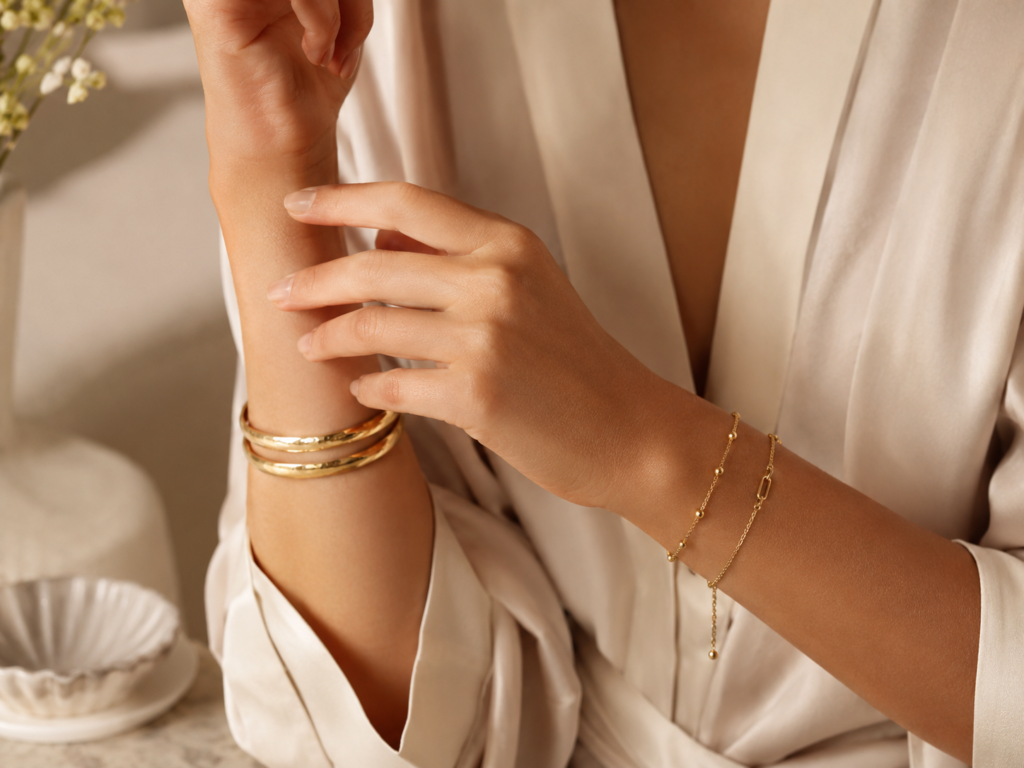
The Cambridge Dictionary defines a bangle as a ring of stiff material worn around the wrist or arm, while its bracelet definition covers jewellery worn around the wrist more broadly. That makes “bracelet” the wider category and “bangle” a specific rigid style within it.
The difference between bangle and bracelet can be seen in four practical areas:
| Feature | Bangle | Bracelet |
| Structure | Rigid; keeps a circular or oval shape | Flexible; bends or drapes around the wrist |
| Typical construction | Solid band, tubular form, hinged ring or open cuff | Chain, links, beads, articulated settings or cord |
| Common closure | No closure, hinge, box clasp or safety catch | Lobster clasp, spring ring, box clasp, toggle or adjustable slider |
| Usual sizing point | Hand width or internal diameter for closed styles | Wrist circumference plus a comfort allowance |
| Movement | Slides and rotates more freely | Follows the wrist more closely |
| Visual effect | Structured, sculptural and often prominent | Fluid, delicate or closely fitted |
| Common wear pattern | Single statement piece, pair or stack | Single piece or layered bracelet stack |
A closed bangle normally slides over the hand. A hinged bangle opens at one side and closes around the wrist. An open cuff has a gap and is usually placed over the side of the wrist rather than forced over the hand. These variations matter because two pieces may look similar in a product image while fitting very differently in person.
For traditional, bridal, festive and heirloom-inspired styling, explore Anu Jewellers’ gold bangles. For flexible chains, link styles and fitted wrist designs, compare the collection of gold bracelets for women.
The Four-Point Wristwear Test
Use this quick framework when a design is difficult to classify:
- Place it on a flat surface: a bangle holds its form, while a bracelet usually falls into a loose shape.
- Test the movement gently: a bracelet bends through links or joints; a bangle remains structurally rigid.
- Inspect the opening: a closed bangle may have no clasp, while hinged bangles and bracelets can both use fastenings.
- Identify the sizing point: a slip-on bangle must clear the hand; a bracelet is normally fitted directly to the wrist.
This test is more reliable than judging by decoration. Diamonds, gemstones, engraving, beads or charms can appear in either category.
How Do Shape, Flexibility and Fastenings Compare?
Shape, flexibility and closure provide the fastest way to identify each style. Bangles hold a fixed form and may slide over the hand or open on a hinge, while bracelets usually bend around the wrist and close with a clasp.
Closed Bangles
A closed bangle is one continuous rigid circle or oval. Because it has no opening, it must be large enough to pass over the knuckles and the widest part of the hand. Once on the wrist, it will usually have more movement than a fitted bracelet.
Closed bangles work well when you want:
- a clean, uninterrupted design;
- a traditional pair or stack;
- a piece without a working clasp;
- a strong circular silhouette.
The trade-off is sizing. A bangle that is too small will not pass over the hand, while one that is too large may slide too far down the hand or feel insecure.
Hinged Bangles
A hinged bangle keeps the structured look of a bangle but opens for easier wear. It may use a box clasp, tongue clasp, push-button release or safety catch. This is useful for people whose wrist is much smaller than the widest part of the hand.
Hinged designs can also support detailed stone settings because the piece sits closer to the wrist. The hinge and fastening should be checked periodically, especially if the bangle is worn often.
Cuffs
A cuff is rigid but has an opening. Some retailers group cuffs with bangles; others describe them as cuff bracelets. The important point is not the label but the construction. A fine-jewellery cuff should be fitted correctly rather than repeatedly bent open and closed, which can weaken the metal over time.
Chain, Link and Tennis Bracelets
Bracelets use movement as part of their design. Chain and link bracelets flex between components. Tennis bracelets use a line of articulated stone settings so the piece can curve around the wrist. Charm and bead bracelets may also use flexible chain, wire, cord or elastic construction.
A bracelet’s comfort depends on more than length. Link shape, clasp size, stone setting height and overall weight can determine whether it catches on sleeves, rotates or feels balanced.
Which Feels More Comfortable for Everyday Wear?
Bracelets often feel softer and more controlled for everyday wear because they follow the wrist and can be sized closely. Bangles create more movement and presence, but the right internal diameter and weight are essential for comfortable, secure wear.
A person working at a desk may prefer a light bracelet that sits close to the wrist and does not tap against the keyboard. Someone who likes visible movement, layering and a traditional silhouette may prefer one or two slim bangles instead.
The practical contrast becomes especially noticeable during long wear. When choosing a bangle or bracelet for everyday wear, consider these factors:
| Daily-Wear Factor | Bangle | Bracelet |
| Keyboard or desk use | May tap against hard surfaces | Usually sits closer, depending on charm or setting |
| Movement and sound | More noticeable | Usually quieter |
| Putting it on | Easy if slip-on size is correct; hinged styles vary | May require clasp control or one-handed fastening |
| Catching on sleeves | Wide or stone-set designs may catch | Chains, charms and raised settings may catch |
| Maintenance points | Surface, hinge and safety catch | Links, clasp, jump rings and settings |
| Best daily-wear approach | One lightweight, correctly sized piece | Secure clasp, balanced length and smooth links |
Neither category is automatically better for daily wear. A heavy bracelet with weak links can be less practical than a smooth, well-sized bangle. A loose bangle with raised stones can be more vulnerable to impact than a close-fitting chain bracelet.
For frequent wear, check how the piece behaves during the movements you make every day. Bend the wrist, put on a jacket, use a phone and rest the hand on a table. A piece that looks perfect but repeatedly turns, pinches or catches is unlikely to become a comfortable favourite.
How Should a Bangle or Bracelet Fit?
A bangle should pass over the widest part of your hand without forcing, then sit loosely enough to move without slipping off. A bracelet should rest around the wrist with a small comfort allowance while keeping its clasp and decorative section secure.
When customers ask, “How should a bangle fit?”, the answer depends first on whether it is closed, hinged or open.
How to Measure for a Closed Bangle
- Bring your thumb and little finger together: this creates the narrowest safe hand position for testing a slip-on bangle.
- Wrap a soft measuring tape around the widest part of the hand: record the measurement in millimetres so it can be compared with the jeweller’s sizing system.
- Check the internal diameter as well as the labelled size: different sellers may use diameter, circumference or regional bangle-size conventions.
- Test the movement after the bangle is on: it should pass the hand without painful force but should not slide off during normal downward movement.
Do not choose a closed bangle using wrist circumference alone. The wrist may be slim, but the bangle still needs to clear the knuckles.
How to Measure for a Bracelet
- Wrap a soft tape around the wrist bone: keep it comfortably close without pulling the tape tight.
- Add an allowance suited to the design: a delicate chain may need less extra room than a thick link, bead or rigid-edged bracelet.
- Check where the centrepiece sits: a stone-set or decorative section should not constantly rotate underneath the wrist.
- Test the clasp and safety features: the bracelet should close fully without pinching skin or leaving excessive slack.
A close fit is not the same as a tight fit. You should be able to move the wrist naturally without pressure marks, pinching or strain on the clasp.
What About Hinged Bangles?
Hinged bangles are fitted around the wrist rather than sized only to pass over the hand. The internal oval should sit securely without pressing into the wrist bone. Check that the hinge moves smoothly, the clasp engages fully and any safety catch lies flat.
When buying online or as a gift, ask for internal diameter, internal circumference, opening dimensions and total weight. A generic “small, medium or large” label may not provide enough information for an accurate fit.
Which Works Better for Weddings, Gifts and Daily Styling?
Choose according to the occasion, outfit and how often the jewellery will be worn. Bangles suit traditional, bridal and statement styling, while bracelets work especially well for everyday outfits, refined gifts and designs that need a closer, more adjustable fit.
For Indian and South Asian Weddings
Bangles often create a stronger traditional wrist profile and can be coordinated with a bridal set, saree, lehenga, salwar suit or family jewellery. The exact style, colour, number and cultural meaning can vary significantly across Indian, Punjabi, Nepali, Pakistani and other South Asian families.
A modern bride may pair traditional bangles with a single flexible diamond or gold bracelet. Another may prefer a clean hinged bangle that can be worn again after the wedding. The right decision should respect family preference while still considering comfort, outfit details and future use.
Customers comparing traditional pieces can also explore Anu Jewellers’ broader Indian jewellery collection and diamond bangles for bridal or celebration styling.
For Everyday Wear
Choose a bracelet when you want a closer fit, subtle movement or easy pairing with a watch. Choose a lightweight bangle when you prefer a clean, structured line and do not mind a little wrist movement.
For work, commuting and regular wear, smoother surfaces are usually easier to manage than sharp edges, heavy charms or high stone settings. Consider whether the piece will be exposed to desks, bags, children, tools or frequent handwashing.
For Gifting
A bracelet may be easier to size when the recipient’s wrist measurement is known. A hinged bangle can also be a practical gift because it does not need to pass over the hand, but its internal dimensions still matter.
For a surprise, collect clues from a piece the recipient already wears. Measure the inside diameter of a comfortable bangle or the end-to-end wearable length of a bracelet, excluding decorative extensions where appropriate.
Anu Jewellers’ jewellery gifts guide can help buyers compare bangles, bracelets, rings, necklaces and other options for anniversaries, birthdays and family milestones.
Quick Occasion Guide
| Occasion or Need | Usually Choose | Why |
| Traditional wedding styling | Bangle or coordinated bangle stack | Strong cultural and visual presence |
| Modern bridal styling | Hinged bangle, diamond bangle or bracelet | Structured sparkle with easier repeat wear |
| Daily office wear | Lightweight bracelet or slim bangle | Lower bulk and easier outfit pairing |
| Anniversary gift | Bracelet, hinged bangle or custom piece | Personal, wearable and suitable for engraving or stones |
| Festival or family celebration | Gold bangles or mixed wrist stack | Works with traditional and fusion outfits |
| Minimal everyday style | Single plain bangle or fine chain bracelet | Clean silhouette without over-layering |
| Unknown hand size | Adjustable bracelet, subject to design | Avoids relying on closed-bangle hand clearance |
| Heirloom redesign | Custom bangle or bracelet | Can reflect the original piece while improving wearability |
Can You Wear Bangles and Bracelets Together?
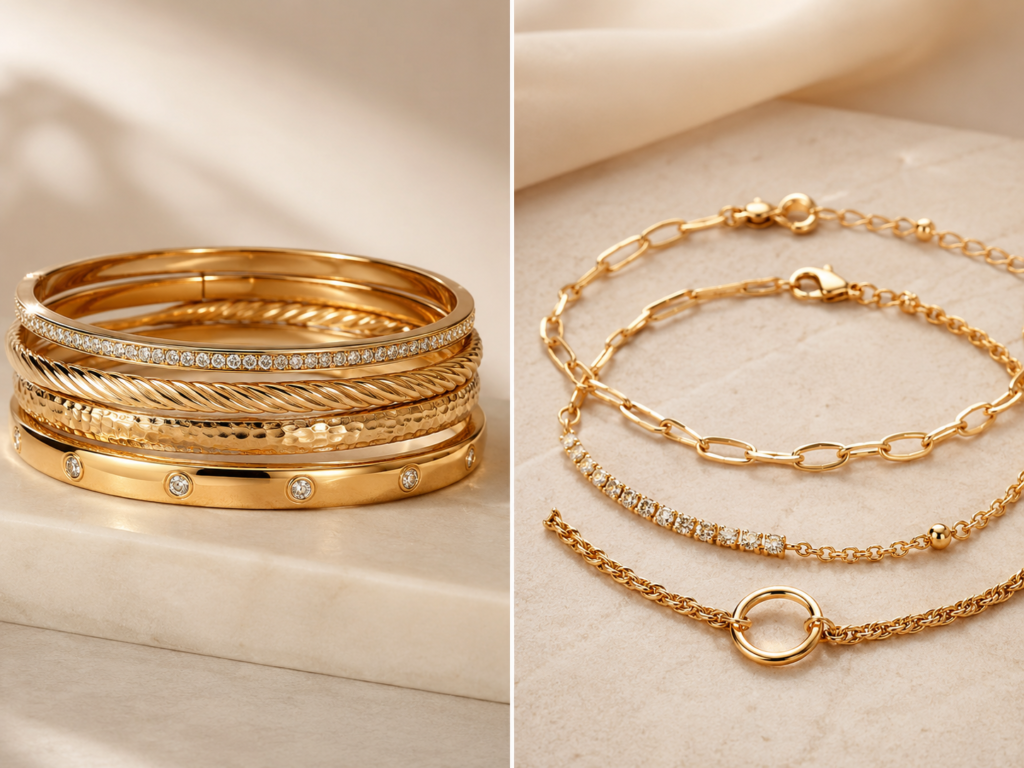
Yes, bangles and bracelets can be worn together when the stack has a clear focal point. Combine one structured bangle with one or two flexible bracelets, then balance width, texture and movement so the pieces complement rather than damage each other.
Start with the most valuable or visually important piece. Build around it rather than giving every item equal weight.
A Simple Three-Piece Formula
- Anchor: one smooth bangle, hinged diamond bangle or meaningful heirloom piece.
- Texture: one fine chain, link or beaded bracelet.
- Finish: one narrow complementary piece that repeats a metal tone, motif or stone colour.
Keep space between delicate stone settings and heavy rigid pieces. Repeated contact can scratch polished surfaces, loosen settings or wear fine links. If two pieces collide sharply whenever you move, wear them on separate wrists.
Mixing metal colours can work when the combination looks intentional. Repeat each tone at least once elsewhere in the outfit, or use one two-tone piece to connect yellow, white and rose-gold elements.
For a traditional outfit, you can use multiple bangles with one bracelet as the central detail. For a contemporary outfit, reverse the balance: use one bangle to frame a finer bracelet stack.
Which Gold Purity and Design Should You Choose?
Gold purity should match the design and intended wear, not simply the highest number available. Higher-karat gold offers richer colour and greater gold content, while lower-karat alloys generally provide extra hardness for detailed, stone-set or frequently worn wrist jewellery.
According to the Jewellers Association of Australia, carat or karat indicates gold purity, with 24K representing the purest gold and lower caratages balancing gold content with durability. The Gemological Institute of America explains that pure gold is commonly alloyed with metals such as copper and zinc to improve hardness and create different colours.
In Australia, you may see “ct” used for gold fineness, while international product information may use “K”. Do not confuse gold karat with diamond carat, which measures gemstone weight rather than metal purity; GIA explains the distinction.
Match Purity to the Piece
- Traditional high-gold-content bangles: chosen for rich colour, cultural styling and gold content, but design thickness and wear habits still affect durability.
- Stone-set bangles and bracelets: may use an alloy selected to support detailed settings and repeated wear.
- Fine chain bracelets: need strong links and secure joins because flexibility concentrates wear at moving points.
- Hinged bangles: depend on the engineering of the hinge, clasp and safety catch as much as the gold purity.
- Daily-wear pieces: benefit from smooth surfaces, practical weight and a design suited to your routine.
Ask the jeweller to explain the stated purity, item weight, stones, fastening, warranty, aftercare and whether the piece is suitable for the way you intend to wear it. The best gold choice is a complete design decision, not a number considered in isolation.
When Should You Ask a Jeweller for Sizing, Repair or Customisation?
Ask a jeweller for help when the size is uncertain, the piece contains stones, a hinge or clasp feels weak, or an heirloom needs alteration. Professional assessment can prevent damage and determine whether resizing, repair, polishing or customisation is appropriate.
Seek assistance when:
- a closed bangle no longer passes over the hand;
- a bracelet repeatedly turns, falls too low or strains at the clasp;
- a hinged bangle clicks, gaps or fails to lock securely;
- links look stretched, flattened or uneven;
- stones move, rattle or catch on fabric;
- an heirloom piece needs resizing without losing engraving or detail;
- two pieces in a stack are damaging each other;
- you want to convert old jewellery into a more wearable design.
Not every bangle can be resized safely. Hollow construction, enamel, extensive stone setting, patterned surfaces and complex hinges may limit the available options. Likewise, shortening a bracelet can change the symmetry or positioning of its central design.
For routine care, follow Anu Jewellers’ guide on how to clean gold jewellery at home. Stop home cleaning if a stone is loose, the metal is damaged or the piece contains delicate materials that require specialist care.
Which Should You Choose?
Choose a bangle when you want structure, tradition, visible presence or a stackable silhouette. Choose a bracelet when you prefer flexibility, a closer fit and easier everyday movement. The best option is the one that suits your wrist, routine and occasion.
The final bangle vs bracelet difference is practical as well as visual. A well-chosen bangle should move comfortably without feeling insecure. A well-chosen bracelet should follow the wrist without pinching, twisting excessively or placing strain on its clasp.
Try both types with the movements, clothing and jewellery you actually wear. When fit, construction and lifestyle are considered together, either option can become a meaningful daily piece, a bridal highlight or a lasting gift.
Customers in Craigieburn and Melbourne’s northern suburbs can contact Anu Jewellers for help comparing sizes, gold styles, custom options and jewellery aftercare.