


For most adults, 0.50–1.00 total carat weight about 0.25–0.50 carat or 4.1–5.1 mm per ear offers a balanced everyday look. Choose smaller studs for subtle comfort and larger stones for stronger sparkle, depending on earlobe size, setting and routine.
The answer to what size diamond stud earrings for everyday wear depends on more than carat weight. Earlobe size, diamond diameter, setting height, hairstyle, work routine and budget all affect whether a pair looks balanced and feels comfortable after several hours.
A small, well-cut pair can appear brighter and more refined than larger diamonds with weak light performance. A visually impressive pair can also be inconvenient if the settings tilt forward, catch on headphones or feel heavy by the end of the day. This guide helps you choose by appearance and real use, not by the number on a product label alone.
Written by Anu Jewellers Editorial Team
Reviewed by Henry Sedha, Anu Jewellers
What Size Diamond Stud Earrings for Everyday Wear Should You Choose?
Most adults find a pair totalling one carat versatile, with each round diamond weighing about half a carat and measuring roughly 5.1 mm. Choose smaller for subtle sparkle or larger when you want a bolder everyday look.
The range is a starting point, not a rule. “Everyday” means something different to an office worker, a parent caring for young children, a healthcare worker, a tradesperson, a frequent traveller or someone who wears jewellery mainly for social and cultural events.
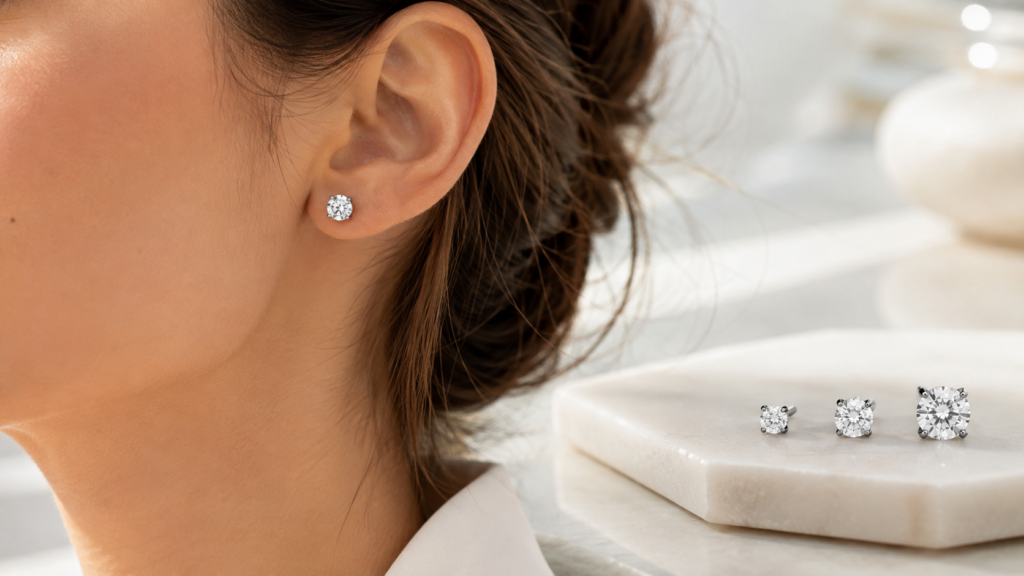
Use this three-level framework before comparing individual pairs:
| Everyday Look | Approximate Total Carat Weight | Approximate Round Diameter per Ear | Best Suited To |
| Subtle | 0.20–0.40 cttw | About 3.0–3.8 mm | Small lobes, second piercings, minimal jewellery and active routines |
| Classic | 0.50–1.00 cttw | About 4.1–5.1 mm | Work, weekends, gifting and one-pair wardrobes |
| Noticeable | 1.25–1.50 cttw | About 5.5–5.8 mm | Buyers who want visible sparkle without an oversized look |
| Bold | 2.00 cttw and above | About 6.5 mm and above | Strong jewellery style, larger lobes and statement daily wear |
These millimetre measurements are approximate for well-proportioned round brilliant diamonds. Fancy shapes, cut proportions and individual stones can face up differently at the same carat weight.
Best Diamond Stud Size by Buyer Type
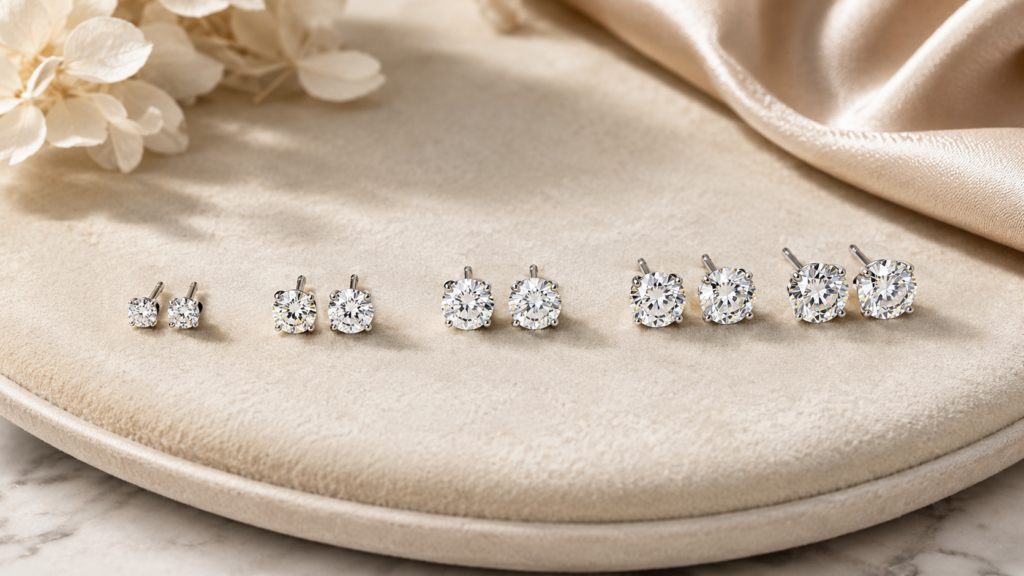
| Buyer Type | Suggested Size | Why It Works |
| First-time buyer | 0.50–1.00 cttw | Versatile enough for work, weekends and special occasions |
| Gift for wife or partner | 0.75–1.00 cttw | Noticeable sparkle without becoming difficult to wear |
| Office daily wear | 0.50–0.75 cttw | Refined, professional and easy to pair with most outfits |
| Small earlobes | 0.20–0.50 cttw | Lighter visual coverage with less risk of overpowering the lobe |
| Statement daily wear | 1.25–1.50 cttw | Stronger presence while remaining practical for many wearers |
| Men’s diamond studs | 3–5 mm, or larger for bold styling | Works across understated, classic and statement looks |
Not sure which size suits your ears? Visit Anu Jewellers in Craigieburn to compare the diamond stud earrings Australia collection in person and get help choosing a comfortable everyday pair.
The Everyday Stud Balance Test
Before deciding, judge the pair against five practical questions:
- Check the visible diameter in millimetres: this shows how much space the diamond occupies on the lobe more clearly than carat weight alone.
- View the studs from the front and side: a pair should sit upright rather than drooping, tilting or exposing too much of the post.
- Wear them with your usual hair and clothing: long hair, scarves, dupattas, collars and head coverings can change how large the studs appear and how often they catch.
- Test your normal equipment: place headphones, a helmet strap, glasses or a phone against the ear because high settings can become uncomfortable.
- Keep them on for at least 15 minutes: immediate comfort does not always reveal pressure, post length or weight imbalance.
This test is more useful than choosing the most common carat weight without seeing how the pair sits on the wearer.
How Do Diamond Stud Earring Sizes Compare in Carats and Millimetres?
Diamond stud earring sizes should be compared using total carat weight, weight per ear and face-up diameter. A one-carat-total pair usually contains two diamonds of approximately 0.50 carats each, with round stones measuring close to 5.1 mm across.
Carat is a unit of weight, while millimetres describe visible dimensions. According to the Gemological Institute of America, one metric carat equals 200 milligrams, and carat weight should not be confused with physical size.
| Total Carat Weight for Pair | Approximate Weight per Ear | Approximate Round Diameter per Ear | Visual Impression |
| 0.20 cttw | 0.10 ct | 3.0 mm | Very discreet |
| 0.25 cttw | 0.125 ct | 3.2 mm | Fine and subtle |
| 0.50 cttw | 0.25 ct | 4.1 mm | Small classic stud |
| 0.75 cttw | 0.375 ct | 4.6 mm | Noticeable but restrained |
| 1.00 cttw | 0.50 ct | 5.1 mm | Versatile everyday presence |
| 1.25 cttw | 0.625 ct | 5.5 mm | Stronger visual impact |
| 1.50 cttw | 0.75 ct | 5.8–5.9 mm | Bold everyday look |
| 2.00 cttw | 1.00 ct | 6.4–6.5 mm | Statement size |
| 3.00 cttw | 1.50 ct | About 7.3 mm | Prominent and high-impact |
Treat the table as a visual guide rather than a grading certificate. Two 0.50-carat round diamonds can have slightly different diameters because their depth, girdle and overall proportions differ.
Why Retail Labels Cause Confusion
A listing described as “1 carat diamond studs” may mean one carat across the pair, but shoppers sometimes read it as one carat in each ear. Confirm these three details before comparing prices:
- total carat weight for the pair;
- individual carat weight of each diamond;
- minimum or actual millimetre dimensions.
A pair should also be matched for visual diameter, colour and clarity. Tiny differences in weight matter less than obvious differences in face-up appearance.
Why Can Two Equal-Carat Diamonds Look Different in Size?
Two diamonds with equal carat weight can look different because carat measures mass, not face-up spread. A deeper stone can hide more weight below the setting, while a well-proportioned diamond may show a broader, brighter outline when viewed from the front.
According to the Gemological Institute of America’s diamond cut guidance, proportions influence how a diamond interacts with light. Cut quality affects brightness, fire and scintillation, so a larger diameter does not automatically create a more attractive stud.
Compare Spread and Light Performance Together
A very shallow diamond may look broad but can lose light performance. A very deep diamond may carry weight where you cannot see it. The goal is not the maximum possible diameter; it is a balanced stone that faces up well and returns light attractively.
When comparing a pair, ask for:
- the millimetre dimensions of both stones;
- cut grade for round brilliant diamonds where applicable;
- colour and clarity grades;
- whether the stones are natural or laboratory-grown;
- an independent grading report for significant purchases;
- photographs or video in normal lighting, not only under display lights.
According to GIA’s overview of diamond quality factors, the 4Cs colour, clarity, cut and carat weight work together to describe a diamond. Prioritising carat alone can therefore produce a larger number without the visual quality you expected.
Shape Changes the Face-Up Look
Round diamonds provide the easiest size comparison because diameter is measured across a near-circular outline. Oval, pear, marquise, emerald and cushion cuts use length and width, and some elongated shapes can look larger from the front at the same weight.

Shape also changes styling. Round studs feel balanced and traditional. Princess cuts create a sharper geometric look. Ovals and pears add visible length, while cushion cuts offer a softer outline. Choose the shape first, then compare dimensions within that shape rather than using a round-diamond chart as an exact conversion.
How Do Earlobes, Hair and Daily Routine Affect the Best Size?
Earlobe size, piercing position, hairstyle and routine can make the same studs look restrained on one person and oversized on another. The best pair should cover the intended area without pulling the piercing downward, touching the ear edge or catching repeatedly.
Earlobe and Piercing Position
A centred piercing with enough tissue below it can support a wider range of stud sizes. A low piercing may make larger diamonds appear close to the lobe edge, while a high piercing can leave more visible space below the stone.
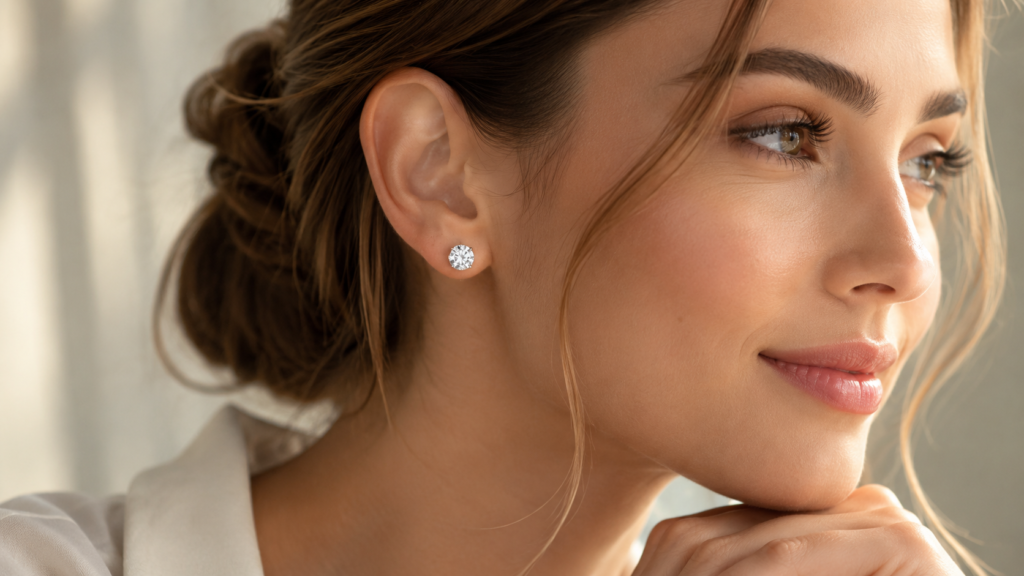
Small lobes often suit 3–5 mm studs, although personal preference still matters. Larger lobes can carry 5–6.5 mm stones without the same visual dominance. Weight and setting height should be considered alongside diameter because a light-looking pair can still tilt if the post and back are poorly balanced.
Anu Jewellers’ guide to choosing diamond earrings for your face shape provides a separate styling perspective. Use that guide for shape and proportion, while using this article to decide everyday stud diameter and weight.
Hair, Clothing and Cultural Styling
Short hair or an updo exposes the entire stud, making a 5 mm diamond appear more prominent. Long or thick hair can soften the visual effect, which may lead some wearers to prefer a slightly larger diameter.
For Indian and South Asian styling, consider whether the studs will be worn alone, with a chain, with bridal or festive jewellery, or as a calm everyday alternative to jhumkas and drops. A 4–5 mm pair can work across office clothing, sarees, kurtas and casual outfits without competing heavily with a necklace.
Work and Activity
Choose a lower-profile design when your routine involves:
- frequent phone or headset use;
- helmets, masks or protective equipment;
- young children who may pull jewellery;
- sport, gym training or active work;
- scarves, dupattas or high collars;
- regular travel and sleeping away from home.
Larger studs can still be worn daily, but they need secure backs, balanced settings and a realistic plan for removal during high-impact activity.
Which Setting and Earring Back Are Best for Everyday Studs?
For everyday studs, choose a setting that protects the diamond without hiding too much light and a back that stays secure without creating pressure. Four-prong, bezel and low-profile basket settings work well, while friction or screw backs suit different comfort priorities.
Compare Common Settings
| Setting | Everyday Advantage | Trade-Off | Best Fit |
| Four-prong basket | Open appearance and easy cleaning access | Exposed edges can catch if prongs are raised | Classic round or princess studs |
| Three-prong martini | Minimal metal and a low visual profile | Pointed base may press into some piercings | Wearers who want the diamond to sit close |
| Bezel | Smooth rim protects the edge and reduces snagging | More metal can make the diamond look visually different | Active routines and modern styling |
| Halo | Creates a larger overall look using smaller stones | More settings require inspection and cleaning | Buyers wanting presence at a controlled centre-stone size |
| Low basket | Supports the stone and can reduce forward tilt | Design quality varies by post and back placement | Medium to larger daily studs |
A secure, well-finished setting matters more than the label alone. Run a clean, soft cloth gently over the stud. Repeated snagging can signal a raised or rough prong that needs inspection.
Compare Common Earring Backs
| Back Type | Benefit | Limitation | Practical Use |
| Friction or butterfly back | Quick to put on and widely used | Can loosen over time and needs periodic replacement | Small to medium everyday studs |
| Screw back | Threaded closure provides added security | Slower to fit and may be uncomfortable if overtightened | Valuable or larger studs |
| Guardian or locking back | Locks onto the post and can support heavier settings | Bulkier and may require two-handed removal | Larger studs or buyers prioritising security |
| Large comfort back | Broad surface can help keep the stud upright | More visible behind small lobes | Studs that tilt forward |
| Clip-on fitting | No piercing required | Pressure and positioning must be adjusted correctly | Non-pierced ears |
A larger backing can improve posture when a stud droops, but it cannot correct every fit issue. Post placement, lobe anatomy and setting weight may still require a different design.
How Should You Choose Studs for Work, Men and Ear Stacks?
Choose 3–5 mm studs for understated workwear, second piercings and minimal styling; choose 5–6.5 mm for a stronger single-stud look. Men and women can use the same size framework, adjusting diameter, metal and setting to personal style.
Professional and Office Wear
A 0.25–0.75 total carat pair often creates a discreet look, while 1.00 total carat weight is a classic choice when more sparkle is welcome. Workplace rules, uniforms, client-facing roles and headset use should guide the final decision.
A bezel or low basket can reduce catching. Smooth yellow-gold, white-gold or platinum-toned settings can be coordinated with watches, rings and eyewear rather than treated as an isolated purchase.
Diamond Stud Earrings for Men
Diamond studs for men do not require a separate sizing system. A 3–4 mm stud looks restrained, 4–5 mm feels classic, and 5.5 mm or larger creates a stronger statement. One-ear styling, paired studs and black or colourless stones all depend on personal preference rather than gender rules.
For an illustrative example, a man who wears a plain gold chain and business shirts may find a 4.1 mm round bezel stud easier to integrate than a high-set 6.5 mm stone. Someone with a bold streetwear style may prefer the reverse.
Ear Stacks and Second Piercings
Scale the largest stud to the main lobe piercing and reduce the diameter as the stack moves upward. A practical arrangement might use:
- 4.5–5.1 mm in the main piercing;
- 2.5–3.2 mm in the second piercing;
- a tiny diamond, plain gold stud or huggie above it.
Leave enough space between settings so they do not rub. The ideal spacing depends on the position of each piercing, so try the complete arrangement rather than buying each piece independently.
How Do You Choose Diamond Studs as a Gift?
Choose gift studs by confirming the recipient’s usual metal colour, preferred scale, piercing type and routine. When uncertain, 0.50–1.00 total carat weight in a classic low-profile setting is versatile, but check exchange terms and custom-order limits first.
Reduce the Risk Before Buying
- Photograph earrings they already wear: this shows preferred diameter, metal colour, setting style and whether the recipient chooses subtle or bold jewellery.
- Measure a favourite stud beside a ruler: an approximate millimetre reference is more useful than guessing a carat weight from appearance.
- Confirm pierced or non-pierced ears: this prevents buying posts when clip-on diamond earrings are required.
- Check lifestyle and fastening preference: some wearers value quick friction backs, while others prefer the added security of screw or locking backs.
- Read exchange and alteration terms before payment: engraved, custom, resized or special-order jewellery may have different conditions.
According to the Australian Competition and Consumer Commission, consumer guarantees provide remedies when goods fail to meet legal requirements. They do not create an automatic change-of-mind right, so the retailer’s gift-exchange policy matters when size or style is uncertain.
For birthdays and family milestones, explore jewellery gifts for women. For a partner or spouse, the anniversary jewellery gifts guide can help compare earrings with rings, chains, bracelets and bangles.
Natural or Laboratory-Grown Diamonds
Both natural and laboratory-grown diamonds can provide the optical and physical properties associated with diamond. The choice affects origin, price, rarity and long-term personal preference rather than creating a different visible size at the same shape, carat and proportions.
Ask how the stones are described on the invoice and whether an independent report is supplied. A recipient who has a strong preference should be consulted rather than surprised.
How Much Should You Budget for Diamond Studs in Australia?
Set an Australian-dollar budget after choosing the visual diameter, then balance cut, colour, clarity, origin, metal and setting within it. Prices vary substantially, so use budget bands to define priorities rather than expecting a fixed carat weight at one price.
The bands below are planning tools, not product-price promises. Market conditions, natural or laboratory-grown origin, grading, metal, setting and matched-pair quality can move the final price significantly.
| Illustrative Budget Band | Main Decision Priority | Sensible Questions |
| Under A$1,000 | Decide between a smaller natural pair, laboratory-grown pair or alternative design | What are the actual dimensions, origin and setting metal? |
| A$1,000–A$3,000 | Balance classic everyday diameter with cut and matching | Is more value coming from visible size or stronger quality grades? |
| A$3,000–A$7,500 | Compare larger natural diamonds, premium matching or higher specifications | Are independent reports included, and do both stones face up evenly? |
| Above A$7,500 | Consider substantial natural diamonds, bespoke settings or heirloom-level specifications | What documentation, insurance valuation and long-term service are included? |
When deciding what size diamond stud earrings for everyday wear, do not spend the entire budget on carat weight and leave too little for cut, secure settings or matched appearance. A slightly smaller, brighter and better-balanced pair is often more satisfying in daily use.
For a wider comparison of materials and designs, explore diamond jewellery Melbourne buyers can view through Anu Jewellers and ask for the dimensions and specifications of the exact pair being considered.
How Should Diamond Stud Earrings Worn Every Day Be Maintained?
Everyday diamond studs should be checked briefly before each wear, cleaned gently when residue reduces sparkle and professionally inspected when posts, backs or settings feel different. Remove them before sleeping, swimming, high-impact exercise and activities involving chemicals or heavy snagging.
A Practical Care Frequency Guide
| Frequency | Action | Reason |
| Before each wear | Check that the back grips, the post is straight and the stone does not move | Small changes can reveal wear before an earring is lost |
| Weekly or as needed | Wipe the settings and posts with a clean, soft cloth | Skin products and residue collect quickly on daily jewellery |
| Every few weeks | Clean only with a method suitable for the metal, diamond and setting | Oils beneath the stone reduce brightness |
| After a snag or impact | Stop wearing the earring and inspect the prongs, post and back | Continued use can worsen hidden damage |
| Periodically | Arrange professional inspection based on wear frequency and jeweller advice | Prongs, backs and soldered points can loosen gradually |
Follow Anu Jewellers’ guide on how to clean diamond jewellery for home-care steps. Do not use harsh chemicals, abrasive brushes or ultrasonic cleaning without confirming that the complete piece, not only the diamond, is suitable.
Use a professional jewellery repair service when a post bends, a back slips, a prong catches or a diamond moves. Replacing a worn back early is simpler than trying to recover a lost stud.
Why Choose Anu Jewellers for Diamond Stud Earrings in Australia?
Anu Jewellers is based in Craigieburn and helps customers across Melbourne compare diamond stud sizes, settings, backs and designs in person. Showroom guidance makes it easier to assess comfort, posture and sparkle before choosing earrings for daily wear or gifting.
Customers can compare subtle, classic and statement designs rather than relying only on online photos or carat labels. Seeing different diameters on the ear makes it easier to understand whether a pair suits the wearer’s earlobe size, piercing position, hairstyle and usual jewellery.
The team can also help buyers compare:
- total carat weight and weight per ear;
- visible millimetre diameter;
- natural and laboratory-grown diamonds;
- yellow-gold and white-metal settings;
- friction, screw and locking backs;
- gifting, care and long-term repair considerations.
Anu Jewellers serves customers from its Craigieburn showroom and supports buyers across Melbourne and Australia. For customers still deciding what size diamond stud earrings for everyday wear will suit them best, an in-person comparison can make diameter, posture and comfort easier to judge. Contact Anu Jewellers to arrange guidance.
Which Everyday Diamond Stud Size Should You Buy?
A pair totalling one carat is a versatile first choice. Select smaller studs for discreet comfort or larger diamonds for stronger presence, then confirm diameter, setting posture, back security and comfort before treating any general range as automatically right.
The most reliable answer to what size diamond stud earrings for everyday wear is the pair that looks proportionate, stays upright and works with the wearer’s routine. Use carat weight to compare value, millimetres to compare visible size and an on-ear trial to confirm comfort.
Visit Anu Jewellers in Craigieburn to compare diamond stud earring sizes in person and get help with dimensions, settings, backs, natural or laboratory-grown diamonds and gifting options.