How to choose gold earrings starts with the occasion, wearing time, gold purity, size, weight and fastening. Pick lightweight studs or small hoops for daily wear, balanced statement pieces for festivals, and secure, comfortable designs that complement your wedding outfit.
A pair can look perfect in a display yet feel uncomfortable after an hour. Large drops may pull on the lobe, a weak backing can loosen during a crowded celebration, and an intricate setting can catch on a dupatta, veil or styled hair.
The right choice balances beauty with real wear. This guide explains how to compare gold earrings for work, gifting, festivals and Indian or South Asian weddings, with practical checks for comfort, purity, construction, sensitive ears and long-term care.
How Do You Choose Gold Earrings for Any Occasion?
How to choose gold earrings becomes easier when you assess five factors in order: occasion, wearing time, outfit, comfort and construction. This sequence prevents a common mistake buying for visual impact first, then discovering the pair is too heavy or impractical.
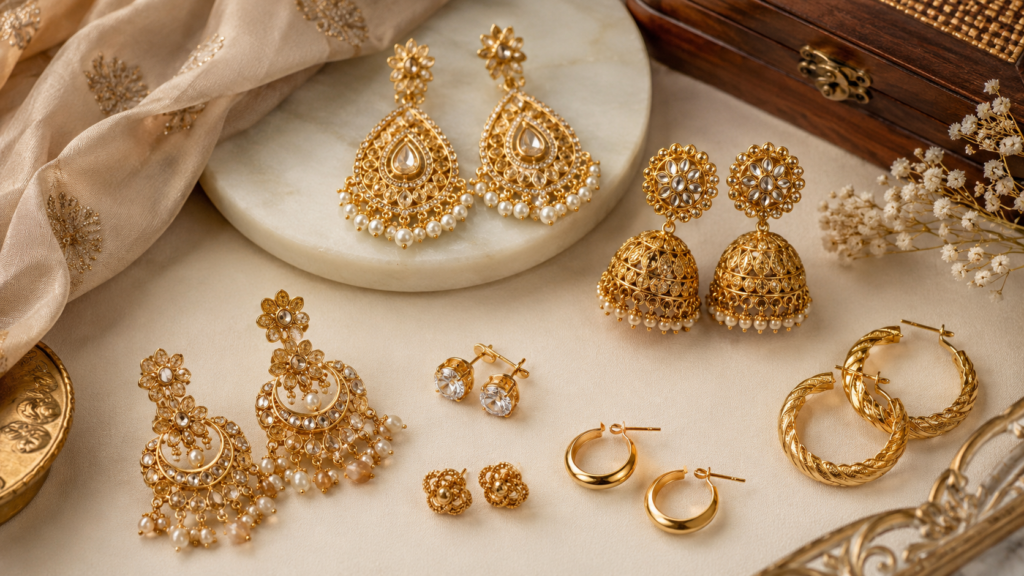
Use the occasion as a filter rather than a strict rule. A polished stud may suit an intimate wedding, while a lightweight jhumka can work for dinner or a festival. The best pair fits the wearer and the event, not a generic style label.
The Occasion–Comfort–Construction Framework
| Buying Situation | Prioritise | Suitable Starting Styles | Watch For |
| Daily work or errands | Low weight, smooth profile, secure fastening | Studs, huggies, small hoops | Posts that press, clasps that catch, excessive movement |
| Wedding ceremony | Outfit coordination, balanced scale, secure support | Jhumkas, drops, chandeliers, diamond earrings | Heavy weight, weak backings, conflict with necklace or veil |
| Festival or family celebration | Colour, movement, cultural styling, comfort | Jhumkas, hoops, drops, celebration earrings | Sharp details, tangled hair, loose decorative parts |
| Formal evening event | Refined sparkle and visible proportion | Diamond studs, drops, medium hoops | Overly busy pairing with necklace or dress |
| Gift | Recipient’s usual style, metal preference, practical fastening | Studs, small hoops, versatile drops | Unknown piercing type, sensitive ears, non-returnable customisation |
| Multiple piercings | Graduated size and secure fit | Studs, huggies, mini hoops | Overcrowding, rubbing and mismatched post lengths |
Use a Five-Step Showroom Test
- Define the longest wearing period: a ten-hour wedding requires lighter, better-balanced earrings than a two-hour dinner.
- Put on both earrings together: the combined weight and symmetry can feel different from testing only one side.
- Move your head through normal angles: turn, look down and tilt gently to check pulling, swinging and contact with the neck.
- Test the planned hairstyle or fabric: bring an outfit photo, veil sample or dupatta edge because hooks and fine chains can catch.
- Check the fastening twice: close, open and close it again so you understand how securely it works without relying on a salesperson.
For a broad comparison of traditional and contemporary gold earrings Australia buyers can explore, Anu Jewellers offers hoop, jhumka, celebration and diamond earring collections through its Craigieburn showroom.
Which Gold Earrings Are Best for Daily Wear?
Gold earrings for daily wear should be lightweight, smooth, secure and easy to coordinate with different outfits. Studs, huggies and small hoops are dependable starting points because they sit close to the ear and create less movement during work, travel and errands.
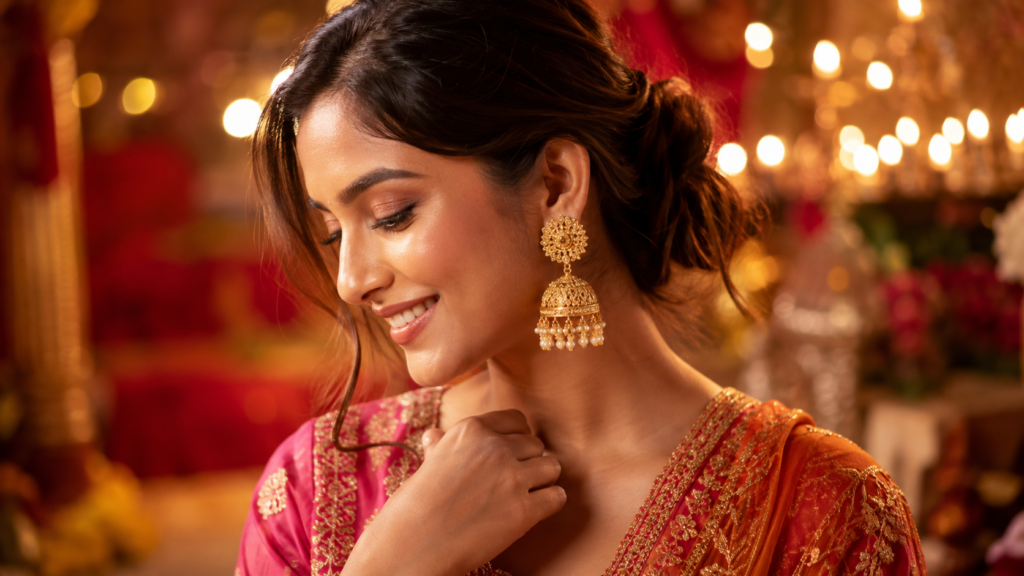
Daily wear does not mean sleeping, showering or exercising in the same pair continuously. Even well-made earrings collect skin oils, hair products and residue around posts and backings. Regular removal also lets you inspect the piercing and fastening.
Compare Everyday Earring Styles
| Style | Daily-Wear Strength | Possible Drawback | Best Suited To |
| Gold studs | Close fit, minimal movement, easy styling | Tight backs can press behind the lobe | Office, commuting and understated outfits |
| Huggies | Compact hoop shape with little snagging | Internal diameter must suit the lobe | Modern everyday styling and ear stacks |
| Small hoops | More visible than studs while remaining versatile | Thin hoops can distort if handled roughly | Work-to-evening wear |
| Sleepers | Continuous profile without a separate loose back | Very small closures can be fiddly | Simple, low-profile wear |
| Small jhumkas | Traditional character with manageable scale | Movement may still catch on scarves or hair | Fusion outfits and cultural daily styling |
| Diamond studs | Polished sparkle with a practical silhouette | Settings and backs need inspection | Daily luxury and gifting |
A practical everyday pair should pass the phone-and-clothing test. Hold a phone to your ear, put on a cardigan or scarf, and brush your hair back. Repeated clicking, catching or pressure usually becomes more annoying over a full day.
Anu Jewellers’ gold hoop earrings include compact, medium and statement sizes, allowing buyers to compare diameter, thickness and fastening before deciding what feels practical.
What Makes an Earring Comfortable All Day?
Comfort comes from total weight, weight distribution, post length, backing shape and how the design sits against the lobe. Two pairs with the same total weight can feel different if one concentrates that weight at the front.
Look for:
- a smooth post with no rough soldering;
- enough post length for the lobe without excessive projection;
- a backing that supports the earring without pinching;
- balanced left and right earrings;
- no sharp corners against the neck or jaw;
- a clasp that closes fully without force.
If an earring begins pulling the piercing downward during a short fitting, it is unlikely to improve after several hours.
How Should You Choose Gold Earrings for Weddings?
Choose wedding earrings by coordinating four elements: necklace, neckline, hairstyle and outfit detail. The earrings should remain visible without competing with every other piece. Comfort and fastening security are especially important because bridal and family celebrations often continue for many hours.
Indian and South Asian wedding jewellery differs across families, regions and ceremonies. Punjabi, South Indian, Gujarati, Nepali, Pakistani and contemporary fusion looks may use very different earring shapes and combinations. Personal and family preference should guide the final styling.
Coordinate Earrings With the Necklace
When the necklace is wide, layered or heavily detailed, earrings usually look more balanced when they repeat one motif without matching its full scale. When the neckline is open and the necklace is minimal, longer drops or jhumkas can carry more visual weight.
| Necklace Choice | Earring Direction | Reason |
| Heavy choker | Medium jhumka or structured drop | Keeps the face framed without crowding the neck |
| Long rani haar | Stud, cluster or medium drop | Prevents two long vertical elements from competing |
| No necklace | Statement jhumka, chandelier or long drop | Allows the earrings to become the focal point |
| Fine chain or pendant | Hoop, diamond drop or compact jhumka | Adds presence while preserving a lighter look |
| Layered bridal set | Coordinated earring from the set | Repeats motifs and metal tone consistently |
Anu Jewellers’ gold jhumka earrings include traditional and contemporary designs for weddings, festivals and coordinated jewellery sets.
Test the Hairstyle Before the Wedding
An open hairstyle can hide smaller earrings and tangle with fine drops. A low bun or sleek updo reveals the complete design but may increase contact with decorative hair chains, veils or dupattas.
Take a side-profile photograph during the trial. Check whether the earring sits straight, whether the backing shows, and whether the design is visible from the angles used in photographs and ceremonies.
Use Support for Heavy Earrings Carefully
Some bridal styles use support chains or ear chains to distribute visual and physical load. The attachment point should be comfortable and secure without pulling the hair or changing the earring’s angle.
Do not rely on adhesive support products without checking skin compatibility and understanding how they interact with the fastening. The safest solution is still an earring whose weight suits the wearer’s lobe and expected wearing time.
Plan for the Entire Wedding Day
A pair worn for a ceremony, photographs, reception and travel may remain on for eight to twelve hours. Test it during sitting, walking, dancing and outfit changes. Consider keeping a lighter backup pair that coordinates with the same jewellery set.
Which Gold Earrings Work Best for Festivals?
Gold earrings for festivals can use more movement, colour and traditional detail than everyday styles, but they still need secure fastenings and manageable weight. Choose a pair that complements the outfit while remaining comfortable through prayers, meals, travel and family celebrations.
Festivals such as Diwali, Navratri, Eid, Vaisakhi and family pujas may call for different jewellery moods. A large jhumka can suit a lehenga or saree, while a medium hoop or gold-and-diamond drop may work better with an Indo-western outfit.
Match the Earring to the Outfit Detail
| Outfit Detail | Earring Approach |
| Heavy embroidered neckline | Medium earrings with a clear shape |
| Simple kurta or saree | Statement jhumka, chandelier or long drop |
| Mirror work or colourful embroidery | Gold earrings with a controlled stone or bead accent |
| High-neck blouse | Stud, cluster, hoop or short drop |
| Open neckline | Longer drop or wider jhumka |
| Indo-western outfit | Hoop, huggie, geometric drop or refined jhumka |
Avoid matching every colour in the outfit. Choose one dominant metal and repeat one supporting colour or motif. This keeps the earrings visible without making the overall look feel overly coordinated.
Anu Jewellers’ celebration earrings include designs suited to weddings, festivals, parties and family occasions.
Create a Festival-to-Dinner Transition
A versatile festive pair should work after the main ceremony too. Medium jhumkas, refined drops and diamond-accented hoops often transition more easily than very large chandeliers. Remove one heavier necklace or hair accessory later so the earrings can remain the focus.
An illustrative example is a wearer attending a daytime puja followed by dinner. A medium 22K jhumka can complement traditional clothing during the ceremony, then work with a simpler shawl or Indo-western outfit in the evening without changing the entire jewellery look.
What Gold Purity Is Best for Earrings?
The best gold purity for earrings depends on colour preference, design complexity and frequency of wear. Higher-carat gold contains more gold and has a richer colour, while lower-carat alloys are generally harder. Construction and craftsmanship still determine how well earrings perform.
According to the Jewellers Association of Australia, carat or karat describes gold purity. According to the Gemological Institute of America, 18K gold is 75 per cent gold, while alloying metals influence hardness and colour.
| Gold Purity | Approximate Gold Content | Typical Earring Use | Practical Consideration |
| 24K / 999 | About 99.9% | Selected ceremonial or highly traditional pieces | Very soft for many detailed or frequently handled designs |
| 22K / 916 | About 91.6% | Traditional jhumkas, wedding and festival earrings | Rich colour; thickness and construction need careful assessment |
| 18K / 750 | 75% | Diamond earrings, hoops and frequent-wear fine jewellery | Strong balance of gold content, colour and practical hardness |
| 14K / 585 | About 58.5% | Everyday styles where available | Greater alloy content and generally higher hardness |
| 9K / 375 | 37.5% | Affordable Australian everyday jewellery | Lighter gold colour and higher proportion of alloy metals |
Do not judge durability through purity alone. A well-proportioned 22K stud may be more practical than an extremely thin hollow earring in a harder alloy. Hinges, posts, soldered joins, stone settings and total weight all affect performance.
What About Sensitive Ears?
According to DermNet, most jewellery allergy is associated with metals such as nickel and cobalt used in alloys or base metals, and the earlobes are a common reaction site. Ask what metal touches the piercing, including the post and backing.

“Gold-coloured” does not necessarily mean solid gold. Check whether the pair is solid gold, gold plated, gold filled, vermeil or made from another material with a gold finish. If you have a known metal allergy, request the full material composition and seek medical advice for recurring reactions.
Do not continue wearing earrings through itching, redness, blistering, discharge or persistent pain. Remove the pair and obtain appropriate professional advice rather than assuming the reaction will settle through continued wear.
How Do Size, Weight and Fastenings Affect Comfort?
Size creates visual impact, but weight and balance determine comfort. Large earrings are not always heavy, and small solid designs are not always light. Compare dimensions, total pair weight, post position and fastening support rather than relying on photographs alone.
Choose Size by Movement and Setting
Small earrings generally interfere less with phones, collars and hair. Medium styles offer more presence without the movement of long drops. Large earrings create stronger visual framing but need careful weight distribution and secure support.
| Size or Profile | Visual Effect | Practical Use |
| Stud or cluster | Close, polished and controlled | Daily wear, work and layered ear styling |
| Huggie or mini hoop | Modern outline with little movement | Daily wear and multiple piercings |
| Medium hoop | Clear face-framing shape | Day-to-evening styling |
| Short drop | Movement without extreme length | Festivals, dinners and gifting |
| Jhumka | Traditional volume and movement | Weddings, festivals and cultural occasions |
| Long chandelier | Maximum statement and vertical line | Shorter formal wear periods and photography-led looks |
Compare Common Earring Fastenings
- Push back: quick to use, but the backing must grip the post securely.
- Screw back: offers controlled fastening, although small threads may be slower to operate.
- Hinged hoop clasp: closes into the hoop and should click or lock cleanly.
- Lever back: supports drop styles and offers a closed fastening behind the lobe.
- Fish hook: easy for drops, but a stopper may improve security.
- Clip-on: useful without piercings, provided pressure remains comfortable.
Never force a clasp that feels misaligned. A fastening should close smoothly and remain secure through gentle movement. Repeated loosening, uneven pressure or visible bending deserves professional assessment.
Why Pair Weight Matters
Ask for the weight of the pair, not only one earring. Also check whether decorative stones, beads or detachable elements are included in the stated figure. For heavier styles, compare how the weight is distributed rather than using a universal gram limit, because lobe shape and piercing position differ.
How Do Face Shape, Hairstyle and Neckline Affect the Choice?
Face shape can guide proportions, but it should not become a restrictive rule. Use earrings to create contrast or repeat a preferred line, then check the result with your hairstyle, glasses, neckline and other jewellery. Comfort and confidence remain more important.
Common styling principles include:
- round faces often gain definition from angular studs or vertical drops;
- longer faces may prefer wider hoops, clusters or shorter drops;
- square jawlines can be balanced with curved hoops and rounded forms;
- heart-shaped faces often suit teardrops and designs that widen lower down;
- oval faces can usually carry a wide range of shapes.
These are visual starting points, not tests you must pass. A wearer who loves large hoops should not abandon them because of a face-shape chart.
Coordinate With Hair and Glasses
Short hair and updos reveal the complete earring, including its backing and side profile. Long loose hair can hide fine studs and catch on hooks or textured surfaces. Glasses add another visible frame near the face, so heavily detailed earrings may look better when the eyewear is simple.
Coordinate With the Neckline
High necklines usually benefit from studs, hoops or shorter drops that do not compete with fabric. Open necklines can support longer earrings or stronger movement. When wearing a detailed necklace, repeat one motif or stone colour rather than matching every component.
For refined sparkle that works with modern wedding and evening styling, Anu Jewellers’ diamond earrings include studs, drops and gold-and-diamond combinations.
What Quality Checks Should You Make Before Buying?
Before buying, inspect the earrings under normal light and check the posts, clasps, joins, edges, stones, symmetry and written product details. A careful physical check helps reveal rough workmanship, insecure settings or construction issues that may not appear in styled photographs.
Complete a Two-Minute Inspection
- Check both earrings side by side: compare symmetry, length, colour and the direction of patterns or stones.
- Run a fingertip around non-sharp areas: smooth finishing reduces snagging and irritation, but avoid pressing directly on delicate settings.
- Open and close every clasp: the mechanism should align and secure without excessive force or looseness.
- Inspect soldered joins and posts: look for cracks, roughness, visible gaps or uneven alignment.
- Check stones and attachments: ask the jeweller to assess any movement, clicking or uneven setting.
- Confirm the written description: purity, weight, stones, construction and any treatment should match what has been explained.
When learning how to choose gold earrings, the written invoice matters as much as the display. It should identify the item clearly and record relevant purity, weight and stone details rather than using a vague description.
Understand Australian Consumer Rights
According to the Australian Competition and Consumer Commission, products sold in Australia must meet consumer guarantees, including acceptable quality and matching their description. These rights are separate from voluntary warranties.
Change-of-mind policies can differ, especially for pierced earrings because of hygiene policies and for customised pieces. Confirm the store’s exchange conditions before paying, but remember that a retailer’s policy cannot remove rights that apply to faulty or misdescribed goods.
For loose settings, bent posts, damaged clasps or inherited pairs, Anu Jewellers provides professional jewellery repairs from its Craigieburn showroom.
How Much Should You Budget and When Is Professional Help Useful?
Set an Australian-dollar budget after deciding the occasion, purity and construction. Price can reflect gold weight, craftsmanship, stones, fastening complexity and brand services. Professional guidance is worthwhile when the earrings are heavy, valuable, custom, inherited or intended for a coordinated bridal set.
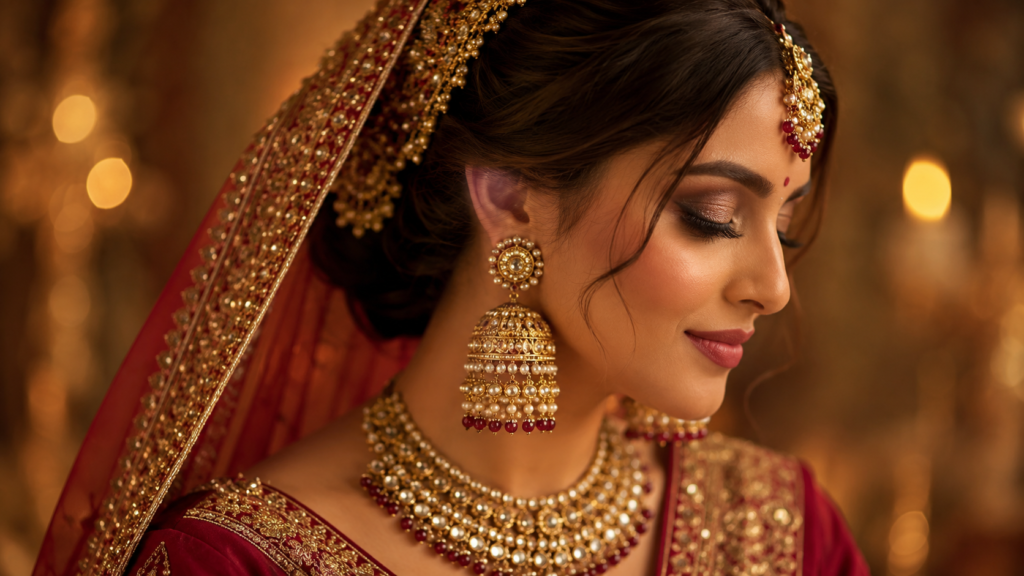
The ranges below are planning categories rather than price promises because gold rates, weight, gemstone specifications and workmanship vary.
| Budget Priority | What to Compare |
| Lower-cost everyday pair | Exact material, post composition, fastening quality and return conditions |
| Solid-gold daily earrings | Purity, pair weight, construction, comfort and repairability |
| Wedding or festival pair | Workmanship, support, stone security, matching jewellery and wearing time |
| Diamond earrings | Natural or laboratory-grown origin, 4Cs information, setting and documentation |
| Custom or heirloom design | Design approval, material assessment, timeline, alteration limits and aftercare |
Ask a Jeweller for Help When
- the wearer has a known metal sensitivity;
- a wedding pair must match an existing necklace or bridal set;
- a heavy design needs support or fastening modification;
- the post position causes the earring to tilt;
- a stone, pearl or decorative part moves;
- an inherited pair needs cleaning, repair or conversion;
- one earring is missing and you want to explore remaking it;
- the pair is being purchased remotely and dimensions are difficult to judge.
A showroom fitting can prevent an expensive mismatch. Bring outfit photos, the intended necklace and any earrings that already feel comfortable so the jeweller can compare scale, post style and weight.
Which Pair Should You Choose?
Choose the pair that remains comfortable, secure and visually balanced after the first impression. Daily earrings should disappear into your routine, festival earrings should move confidently without constant adjustment, and wedding earrings should complete the whole look rather than compete with it.
Knowing how to choose gold earrings means looking beyond design alone. Compare purity, construction, pair weight, post and backing, outfit coordination and aftercare before paying. The right earrings should feel as considered after several hours as they looked in the display.
Visit Anu Jewellers in Craigieburn to compare hoop, jhumka, celebration and diamond earrings with personalised guidance for daily wear, gifting, festivals and weddings across Melbourne’s northern suburbs.