By Anu Jeweller Team, Melbourne gold, diamond and Indian jewellery specialists
Published: 14 August 2026
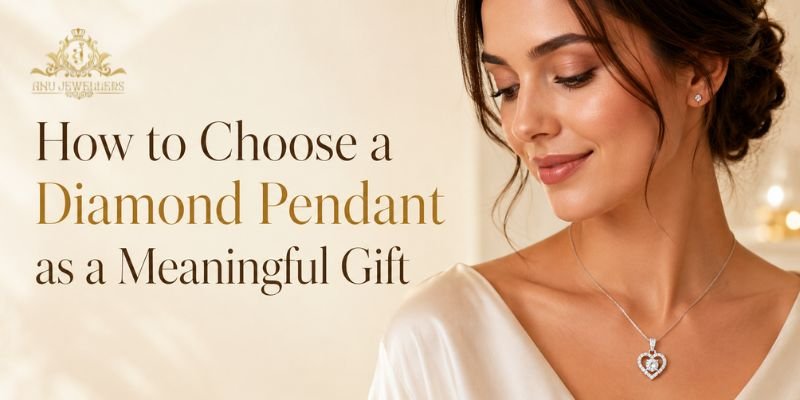
How to choose a diamond pendant begins with the recipient, not the diamond alone. Match the pendant’s style, stone, setting, metal and chain to their daily habits, existing jewellery and the meaning of the occasion before comparing price or carat weight.
A diamond pendant is often easier to gift than a ring because you do not need an exact finger size. That does not make the decision automatic. A pendant can still feel too formal, sit at the wrong length, turn over on the chain or look disconnected from everything the recipient normally wears.
The most meaningful choice usually combines two qualities: it feels personal when opened, and it remains practical after the celebration. This guide explains how to compare diamond pendant gift ideas for birthdays, anniversaries, weddings, graduations, family milestones and culturally important occasions in Australia.
How to Choose a Diamond Pendant for the Person Receiving It
Choose the recipient before choosing the jewellery. Their usual metal colour, preferred design scale, neckline, routine and cultural preferences provide more reliable guidance than trends. A successful pendant should look familiar enough to wear while still feeling special as a gift.
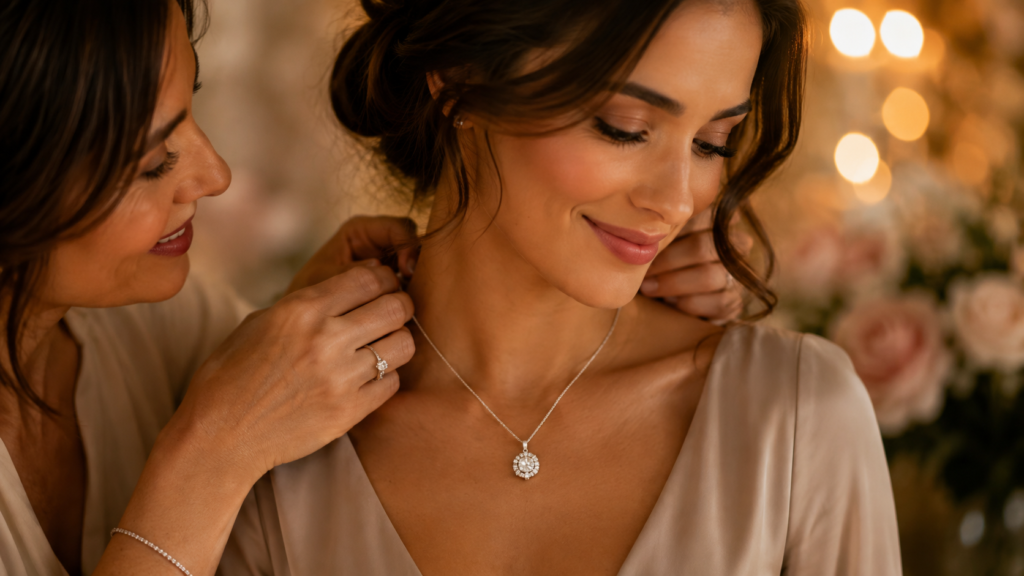
Use the Recipient–Routine–Meaning–Fit Framework
| Decision | What to Observe | Why It Matters |
| Recipient | Jewellery they wear repeatedly, not pieces stored away | Reveals their real taste in metal, scale and decoration |
| Routine | Work, childcare, travel, formal events and cultural occasions | Determines how low-profile, strong and versatile the piece should be |
| Meaning | Relationship, milestone, symbol, date or family story | Makes the pendant personal without overcomplicating the design |
| Fit | Preferred necklace length, necklines and layering habits | Helps the pendant sit where the recipient will enjoy wearing it |
| Budget | A comfortable maximum in Australian dollars | Keeps the decision focused on suitability rather than pressure |
Complete a Five-Minute Jewellery Audit
- Photograph three necklaces they wear most: repeated choices reveal whether they prefer yellow, white or rose-coloured metal, minimal designs or stronger statement pieces.
- Measure one comfortable necklace end to end: an existing wearable length is more useful than assuming that a standard chain will sit identically on every person.
- Check their common necklines: open collars, crew necks, saree blouses, kurtas, dresses and high-neck outfits all position a pendant differently.
- Notice whether they layer jewellery: a pendant intended for layering needs a different length and scale from a necklace worn alone.
- Identifying one meaningful idea: a birthstone, initial, heart, religious symbol, family motif or milestone may guide the design without requiring an overly literal gift.
When the recipient’s style is unclear, choose restraint. A clean solitaire, bezel-set diamond or small cluster usually adapts more easily than an elaborate symbolic design. Anu Jewellers’ jewellery gifts page can help you compare pendants with other gift categories before committing.
Lower-Risk and Higher-Risk Surprise Choices
| Gift Situation | Lower-Risk Direction | Higher-Risk Direction |
| You know their metal preference but not their size | Pendant with adjustable chain | Ring or closed bangle |
| They wear minimal jewellery | Small solitaire or bezel pendant | Large halo or heavily symbolic piece |
| They mix traditional and modern outfits | Refined gold-and-diamond pendant | Design tied to only one outfit |
| They already layer necklaces | Distinct chain length and compact pendant | Pendant that sits directly on an existing necklace |
| You are unsure about symbolism | Geometric, solitaire or floral design | Religious, astrological or marital symbol chosen without consultation |
Which Diamond Pendant Style Feels Most Meaningful?
The most meaningful style connects the design to the recipient without sacrificing wearability. Solitaire, halo, heart, initial, floral, religious and custom pendants communicate different ideas, but the best gift is the one whose symbolism the recipient will recognise and comfortably wear.
Solitaire Pendants
A solitaire places one diamond at the centre of the design. It suits recipients who prefer simplicity, regular wear and jewellery that works with many outfits. A prong-set solitaire shows more of the diamond, while a bezel creates a smoother outline and stronger visual frame.
Solitaire pendants can mark almost any occasion because the meaning comes from the giver and the milestone rather than a fixed symbol. They are especially useful when you want the gift to remain relevant beyond a wedding, anniversary or graduation.
Halo and Cluster Pendants
A halo surrounds a centre diamond with smaller stones, while a cluster groups several diamonds into one composition. Both can create a more visible sparkle across the pendant’s face.
Choose these designs for someone who enjoys detail and a stronger jewellery presence. Check the back and outer edges carefully. A complicated setting may catch fine fabric, hair or embroidery more readily than a smooth solitaire.
Heart, Infinity and Journey Designs
These styles communicate romance, continuity or shared history directly. They can suit anniversaries, Valentine’s Day and relationship milestones, but they are not automatically more meaningful than a simple design.
A recipient who avoids obvious romantic symbols may prefer a discreet pendant engraved with a private date. Meaning works best when it reflects their personality rather than the giver’s assumptions.
Initial, Birthstone and Family Pendants
An initial or birthstone can represent the recipient, a partner, children or another family connection. A diamond may remain the focal point while a coloured gemstone or engraved detail carries the personal story.
For Indian and South Asian families, gifting may also connect to weddings, religious milestones and family traditions. Confirm the intended symbolism with the wearer or a close family member because preferences vary significantly between communities and individuals.
Custom and Heirloom Pendants
Custom design is valuable when an existing diamond, family gold or specific symbol needs to be incorporated. The jeweller should first assess whether an heirloom stone is suitable for resetting and whether the proposed design protects it appropriately.
Customers comparing a ready-made or custom diamond pendant Australia option can discuss occasion, scale, diamond type, metal and long-term wearability with Anu Jewellers before finalising the design.
Which Diamond Shape Should You Choose for a Pendant?
Choose a diamond shape by matching its visual character to the recipient’s style and the pendant’s setting. Round diamonds feel classic, ovals and pears appear elongated, princess cuts look modern, while emerald cuts create broad flashes rather than brilliant-style sparkle.
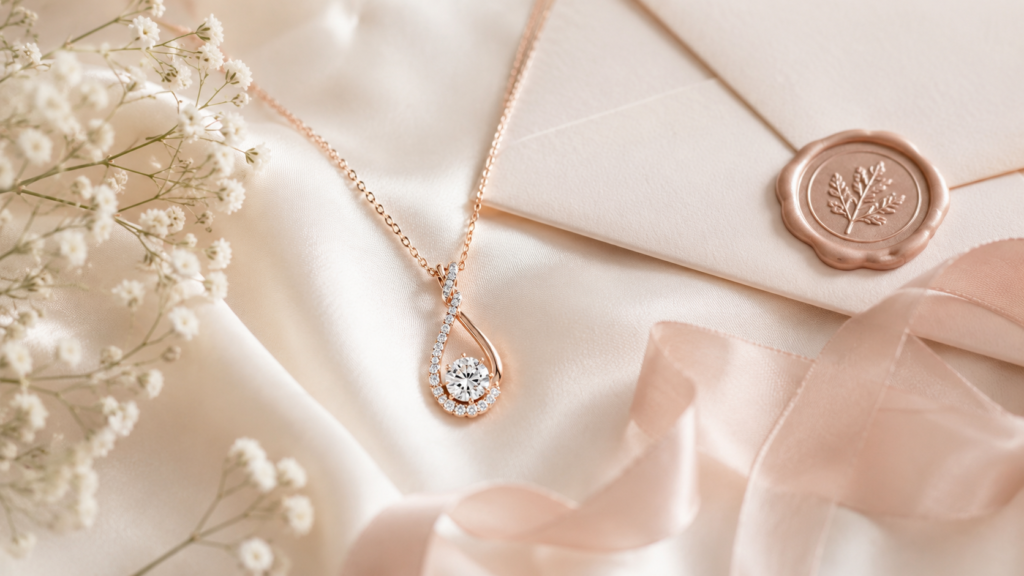
Shape means the diamond’s outline; cut quality describes how well its facets interact with light. Keeping those terms separate makes comparison easier.
| Diamond Shape | Visual Character | Gift Direction | Setting Consideration |
| Round | Balanced, bright and familiar | Versatile first diamond pendant | Works with prong, bezel, halo and cluster styles |
| Oval | Soft, elongated and contemporary | Classic gift with a distinctive outline | Check symmetry and whether the stone sits vertically or east–west |
| Pear | Romantic, tapered and directional | Anniversary, wedding or expressive gift | Pointed end needs protection |
| Princess | Square, crisp and modern | Recipient who likes geometric jewellery | Corners should be protected by the setting |
| Emerald | Architectural with broad flashes | Understated, refined or vintage-inspired style | Open facets make clarity characteristics easier to notice |
| Cushion | Soft square with rounded corners | Romantic or vintage-influenced gift | Can look delicate as a solitaire or fuller in a halo |
| Marquise | Long, dramatic and sculptural | Statement-oriented recipient | Both pointed ends require protection |
| Heart | Directly romantic and symbolic | Relationship milestone when the wearer likes the motif | Symmetry is essential to the finished look |
Match Shape to Existing Jewellery
If the recipient’s engagement ring or everyday earrings use round diamonds, a round pendant creates a coordinated look. Choosing another shape can also be intentional: an oval or pear pendant may add variety while maintaining a soft overall style.
Do not assume the pendant must match every other diamond. Coordination can come from metal colour, setting style or design scale rather than identical shapes.
Compare Millimetre Dimensions as Well as Carat Weight
Carat measures weight, not face-up width or length. Two diamonds with the same carat weight can look different in size because their shapes and proportions distribute weight differently.
Ask for the diamond’s dimensions in millimetres and view the complete pendant from a normal conversational distance. A small, well-proportioned diamond in a balanced setting may have more presence than a heavier stone whose weight is less visible from the front.
How Should You Compare Diamond Quality for a Pendant?
Compare diamond quality through the 4Cs cut, colour, clarity and carat weight while considering how the stone looks in its finished setting. For most gifts, visible beauty, secure construction and clear documentation matter more than chasing the highest grade in every category.
According to the Gemological Institute of America, the 4Cs provide a global standard for communicating diamond quality. Use them as a comparison framework, not as four independent targets that must all be maximised.
Prioritise Cut and Overall Appearance
Cut influences how a round brilliant diamond returns light and displays brightness, fire and sparkle. A higher carat weight does not compensate for poor light performance.
View the pendant under more than one lighting condition where possible. Jewellery-store spotlights can make almost any diamond look lively. Natural daylight or ordinary indoor light provides another useful view.
Choose Colour in Context
Diamond colour is graded on the D-to-Z scale for colourless to light yellow or brown diamonds. Small differences between neighbouring grades can be subtle, especially once the stone is mounted.
Yellow or rose gold can create a warm overall appearance, while white gold places the diamond against a cooler frame. Compare the complete pendant rather than judging a loose grade in isolation.
Look for Eye-Clean Clarity
Clarity describes inclusions and blemishes. A pendant is normally viewed from farther away than a ring, so paying for a very high clarity grade may not create a visible benefit for every buyer.
Ask to see the diamond without magnification first. Then use the report or magnified view to understand what is present and whether any characteristic affects transparency, durability or appearance.
Select Carat Weight After Scale and Budget
One metric carat equals 0.2 grams. Carat is a weight measurement; it does not guarantee a particular face-up size or level of sparkle.
Decide whether the pendant should be a subtle everyday point of light or a visible statement. Then compare carat weight, dimensions, setting and chain together.
Confirm Natural or Laboratory-Grown Origin
Natural and laboratory-grown diamonds should be clearly identified so the buyer understands what is being purchased. Ask the seller to state the diamond type on the invoice and explain the supplied report.
GIA’s laboratory-grown diamond services use distinct assessments and inscriptions to differentiate laboratory-grown diamonds from natural-diamond reports. Verify any report number through the issuing laboratory’s official checking service.
Which Setting and Metal Are Best for a Diamond Pendant?
Choose a setting that balances light exposure, edge protection and everyday practicality, then select a metal that suits the recipient’s colour preference and skin sensitivity. Prongs maximise visibility, bezels create smoother protection, and halos add scale and sparkle.
Compare Common Pendant Settings
| Setting | Main Advantage | Main Trade-Off | Often Suits |
| Prong | Exposes more of the diamond | Prongs need inspection and can catch | Classic solitaire gifts |
| Bezel | Smooth metal rim protects the edge | Covers more of the diamond outline | Everyday wear and active routines |
| Halo | Adds visible sparkle around a centre stone | More small settings require care | Celebration and statement gifts |
| Cluster | Creates a larger decorative face | Individual stones and joins need checking | Floral, geometric and value-conscious designs |
| Channel or bar detail | Clean lines with protected stones | Repairs can be more specialised | Modern and architectural designs |
Look at the pendant from the side and back. The setting should hold the stone securely, sit comfortably against the chest and avoid sharp unfinished areas. Check whether the pendant tends to flip over when the chain moves.
Yellow Gold
Yellow gold creates warmth and can coordinate naturally with traditional Indian and South Asian jewellery collections. It suits recipients who already wear yellow-gold chains, bangles, earrings or wedding jewellery.
White Gold
White gold creates a bright, cool-toned frame around a colourless or near-colourless diamond. Ask whether the piece is rhodium plated and what ongoing refinishing may be needed as the surface wears.
Rose Gold
Rose gold brings a soft pink tone that can make a pendant feel contemporary or romantic. It works best when the recipient already enjoys warm or mixed-metal jewellery.
Understand Gold Purity
According to the Jewellers Association of Australia, carat or karat indicates gold purity, with 24K representing pure gold and lower caratages combining gold with other metals. Purity, alloy, construction and thickness all influence how the finished pendant and chain perform.
Ask for the metal purity of both pendant and chain. They do not always have to match, but the difference should be disclosed and understood.
What Chain Length and Strength Should You Choose?
Choose chain length according to the recipient’s neck, neckline and layering habits, then match chain strength to the pendant’s weight. The bail, links and clasp should work together so the pendant hangs correctly without overwhelming or endangering the chain.
A “standard” chain length does not sit identically on every person. Neck circumference, shoulder width, clothing and pendant dimensions change the final position.
| Approximate Length | Typical Position | Practical Use |
| 40 cm | Near the base of the neck on many adults | Open necklines and short layering |
| 45 cm | Around the collarbone on many adults | Common everyday pendant position |
| 50 cm | Below the collarbone | High necklines, layering and broader necks |
| 55 cm | Upper chest | More relaxed styling or larger pendants |
| 60 cm and longer | Mid-chest or lower | Statement styling over clothing |
These positions are only guides. Measure a necklace the recipient already wears or test a piece of string at several lengths.
Match Chain Weight to the Pendant
A very fine chain can make a substantial pendant feel unstable. An oversized chain can dominate a delicate diamond and prevent it from sitting naturally.
Ask the jeweller whether the chain is intended to support the pendant’s weight and whether the links are solid or hollow. Anu Jewellers’ gold chains collection includes chain styles designed for pendant support, with options to discuss length, thickness and proportion.
Inspect the Bail
The bail is the loop or component connecting the pendant to the chain. It must be wide enough for the chain and clasp to pass through if the pendant is removable.
Check whether the bail is fixed, hinged or integrated into the design. A tiny bail can limit future chain changes, while an oversized bail may distract from a small pendant.
Check the Clasp and Adjustment Points
A secure lobster clasp or other well-made fastening should close cleanly without gaps. An adjustable chain with several fastening points can make a gift more versatile across necklines.
The jump rings and end components deserve the same attention as the main chain. A strong-looking chain is only as secure as its smallest connecting part.
Which Diamond Pendant Gift Ideas Suit Different Occasions?
Diamond pendant gift ideas should connect the occasion to the recipient rather than relying on a generic symbol. A solitaire suits many milestones, while initials, birthstones, hearts, religious motifs, custom designs and heirloom resets can make specific events more personal.
| Occasion | Suitable Direction | Personal Detail to Consider |
| Anniversary | Solitaire, heart, infinity or journey design | Wedding date, shared location or number of years |
| Birthday | Birthstone-and-diamond or initial pendant | Birth month, name or personal colour preference |
| Wedding gift | Refined pendant for ceremony and later wear | Neckline, bridal jewellery and future versatility |
| Graduation | Small solitaire, star or geometric design | Course, achievement date or next chapter |
| Mother’s Day | Family birthstones, initials or custom motif | Children, grandchildren or family story |
| Religious milestone | Cross, Om, Khanda or another relevant symbol | Recipient’s beliefs and preferred level of visibility |
| New baby or family milestone | Parent-and-child motif or birthstone design | Initial, birth date or family gemstone |
| Self-gift | Signature solitaire or distinctive shape | Daily wardrobe and long-term personal style |
Anniversary and Romantic Gifts
A heart or infinity design communicates romance clearly, while a solitaire offers a quieter expression that may be worn more often. An engraving on the back can make a minimal pendant personal without changing its front appearance.
Wedding and Bridal Gifts
A bridal pendant should coordinate with the wedding outfit and existing jewellery without being limited to one day. Bring photographs of the neckline, earrings and other necklace layers to the appointment.
For Indian and South Asian weddings, consider whether the pendant will be worn alone, with a mangalsutra, or as part of a layered bridal look. Family traditions differ, so the bride’s preferences should remain central.
Gifts for Men
Diamond pendants are not limited to women. Men may prefer a geometric, religious, dog-tag, initial or minimal bezel-set design on a stronger chain. Scale, chain width and how the pendant sits over or under clothing become especially important.
Gifts for Children and Younger Recipients
Choose age-appropriate construction, modest scale and a secure chain. Jewellery worn by a child requires adult supervision and may be better kept as a milestone piece until the recipient is old enough to care for it safely.
How Much Should You Budget for a Diamond Pendant in Australia?
Set a comfortable Australian-dollar budget for the complete necklace, including diamond, setting, chain, custom work and documentation. Prices vary widely, so compare written specifications rather than assuming a larger pendant or higher total price automatically represents better quality.
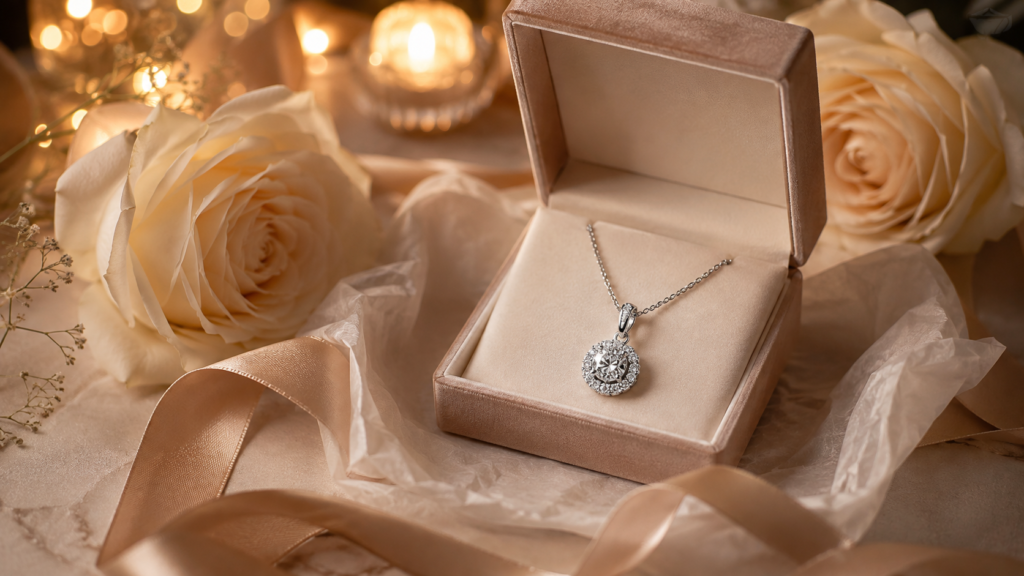
The following bands are planning examples, not current market quotes:
| Illustrative Budget | Likely Focus | Questions to Ask |
| Under A$1,000 | Small diamond, cluster, laboratory-grown option or simple gold setting | Is the chain included? What are the diamond and metal details? |
| A$1,000–A$3,000 | Solitaire, halo or customisable pendant with stronger specifications | What is the diamond type, report status and total carat weight? |
| A$3,000–A$7,500 | Larger natural diamond, premium setting or detailed custom piece | Is the chain proportionate and is valuation documentation supplied? |
| Above A$7,500 | Significant diamond, complex bespoke design or heirloom-level purchase | What insurance, appraisal and long-term servicing should be arranged? |
A cluster pendant may provide a larger decorative look for a given budget, while a solitaire concentrates the budget in one centre diamond. A laboratory-grown diamond may provide a different size-to-budget option, but the origin must be clearly disclosed and acceptable to the recipient.
Do not spend the entire budget on the stone and treat the chain as an afterthought. A secure, proportionate chain is part of the gift’s safety and wearability.
What Should You Check Before Buying a Diamond Pendant?
Before buying, confirm the diamond description, metal purity, setting, chain, clasp, documentation, return policy and aftercare in writing. Examine the complete necklace under ordinary light and make sure personalisation does not remove options you may need if the gift is unsuitable.
Use This Final Buying Checklist
| Check | Confirmed? |
| The style matches jewellery the recipient already wears | ☐ |
| The diamond is identified as natural or laboratory-grown | ☐ |
| The 4Cs or relevant quality details are documented | ☐ |
| The metal purity is stated for both pendant and chain | ☐ |
| The setting has no loose stones, sharp edges or obvious gaps | ☐ |
| The chain is strong enough for the pendant | ☐ |
| The bail allows the intended chain to move freely | ☐ |
| The clasp closes securely and adjustment points are understood | ☐ |
| The necklace length has been checked against the recipient’s preference | ☐ |
| Return, exchange, engraving and custom-order conditions are clear | ☐ |
| The invoice records the important specifications | ☐ |
| Cleaning, inspection, repair and insurance needs are understood | ☐ |
Understand Returns Before Personalising
According to the Australian Competition and Consumer Commission, businesses do not have to provide a refund simply because a customer changes their mind, although a retailer may offer its own change-of-mind policy.
Ask whether engraved, customised, altered or worn jewellery can be exchanged. Consumer-guarantee rights for faulty or misdescribed products are separate from a retailer’s voluntary change-of-mind rules.
Inspect the Gift in Ordinary Light
Check that the pendant hangs face-forward, the chain does not twist and the clasp feels secure. View the diamond from a normal distance rather than only under magnification.
When learning how to choose a diamond pendant, this whole-piece inspection is as important as comparing the diamond grade. The recipient wears the complete necklace, not a laboratory report by itself.
Plan Long-Term Care
Diamonds attract oils and residue that can reduce visible sparkle. Put jewellery on after perfume, cosmetics and hair products, then store it separately to reduce tangling and scratching.
Use Anu Jewellers’ guide to clean and care for diamond jewellery for routine maintenance. If the bail, setting, chain or clasp feels unstable, arrange professional jewellery repairs rather than continuing to wear the piece.
Which Diamond Pendant Should You Choose?
Choose the pendant that best balances personal meaning, everyday wearability and transparent quality information. A modest solitaire on the right chain can be more successful than an elaborate design that conflicts with the recipient’s taste, wardrobe or comfort.
The final decision on how to choose a diamond pendant should answer four questions: Will they understand its meaning? Will they wear it? Is the complete necklace secure? Do you understand exactly what you are buying?
Visit Anu Jewellers in Craigieburn or contact the team for personalised help comparing diamond shapes, pendant styles, metals, chains and meaningful gift options for customers across Melbourne and Australia.