

By Anu Jewellers Team, Melbourne gold, diamond and Indian jewellery specialists
Published: 17 August 2026
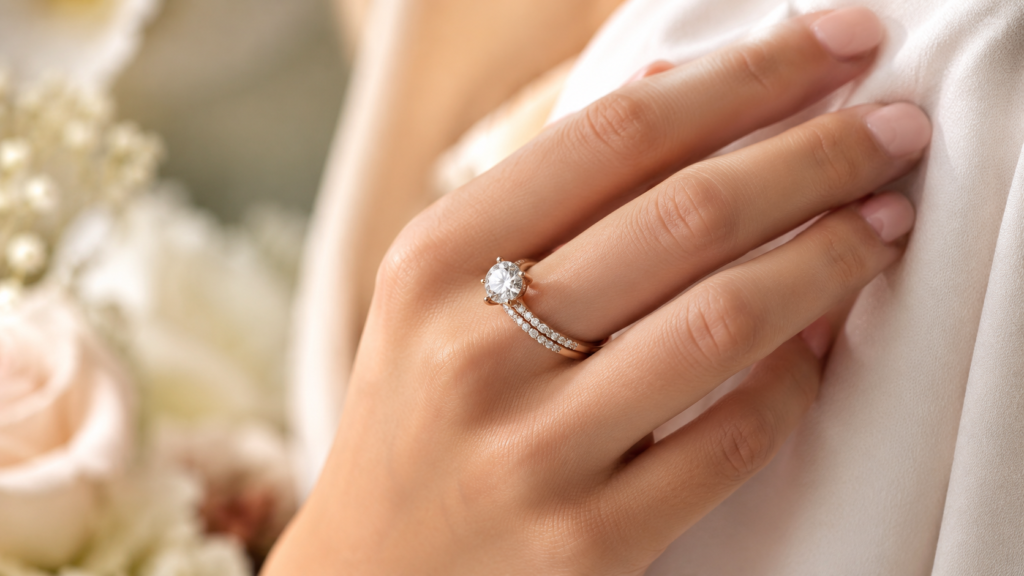
How to match wedding rings with engagement rings begins with fit, not colour. Check the engagement ring from the side, choose a straight or shaped band that clears its setting, then balance metal, width, sparkle, comfort and future maintenance.
A matching wedding band with engagement ring should look intentional from above, sit safely from the side and feel comfortable during normal hand movement. Two rings can share the same metal and still be a poor pair if their settings rub, the combined width feels tight or the wedding band cannot sit where you want it.
The most reliable approach is to bring the actual engagement ring to the appointment. Photographs show style, but they rarely reveal basket width, setting height, contact points or the exact gap a wedding band will create.
How to Match Wedding Rings with Engagement Rings in Practice
Start with the engagement ring’s side profile, setting height and outer shape. These features determine whether a straight band can sit beside it or whether a curved, notched, chevron or custom-fitted wedding band will create a safer, more balanced pairing.
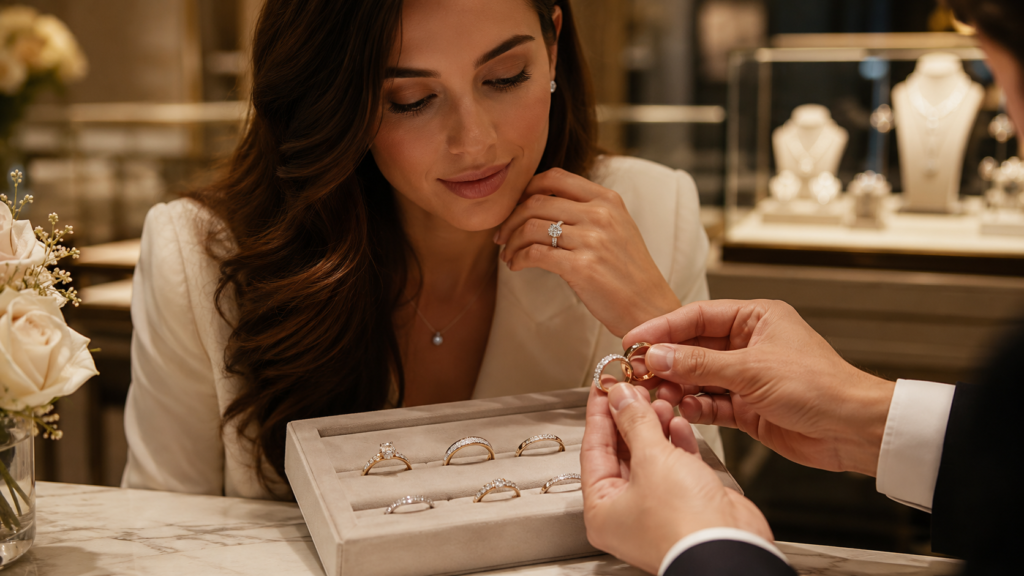
The engagement ring is the fixed reference point because it was usually chosen first. Look beyond the centre stone and inspect the complete construction:
- the height of the centre setting;
- the width of the basket or bezel;
- whether a halo extends beyond the shank;
- the position of side stones and claws;
- the band’s width, thickness and profile;
- any engraved, milgrain or textured edges;
- the space available beside the setting.
A high-set solitaire often leaves enough clearance for a straight band. A low basket may block that band before the two rings meet. Halo, cluster and three-stone settings can create similar fitting challenges even when they look slim from above.
Use the Side-View First Framework
| Side-View Question | What It Reveals | Likely Direction |
| Does the centre setting rise above the band? | Whether a straight wedding band can pass underneath | Try a straight band first |
| Does the basket reach the finger? | Whether the setting blocks a flush fit | Try a curved or contoured band |
| Do side stones project outward? | Where metal or diamonds may make contact | Consider a fitted or notched band |
| Is the shank split, twisted or unusually wide? | How the complete stack will balance | Compare narrow straight and custom bands |
| Are claws exposed near the band? | Whether rubbing may affect the setting | Ask for a contact-point inspection |
| Will the engagement ring be worn every day? | Whether the band must also look complete alone | Test both the paired and separate appearance |
Bring the ring you will actually wear, not a similar showroom model. Small differences in stone size, basket construction or previous resizing can change the fit.
Couples still choosing the first ring can compare styles through Anu Jewellers’ engagement ring buying guide before planning the future band.
Does the Wedding Band Need to Sit Flush?
No. A wedding band does not need to sit completely flush with an engagement ring. A close fit creates a seamless bridal-set look, while a small intentional gap can preserve independent wear, reduce awkward pressure and suit low-profile settings.
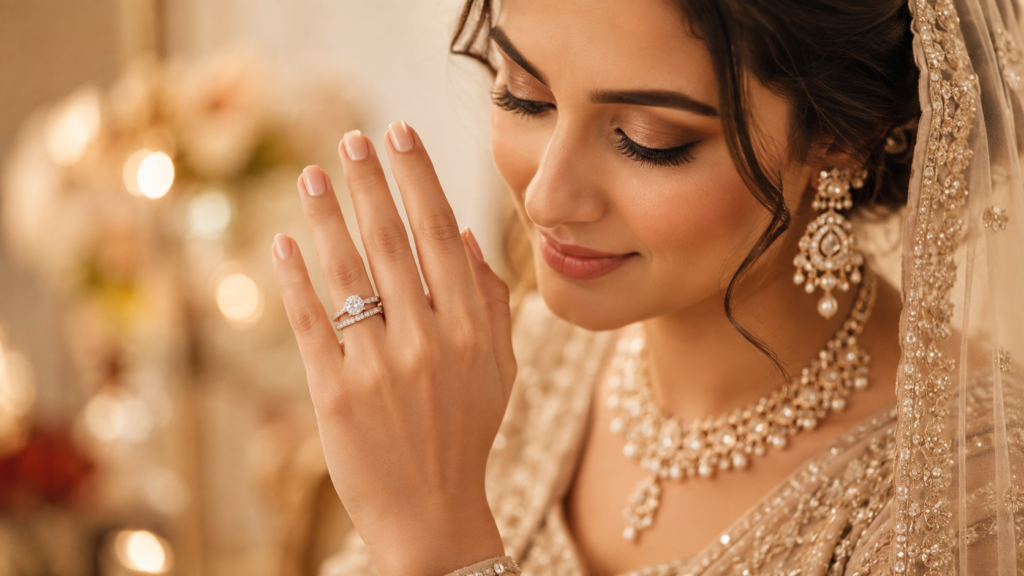
A flush fit means the edges of the two rings sit directly beside each other with little or no visible space. Many people prefer that appearance, but it is not a technical requirement.
A small gap can be the better choice when:
- the engagement ring has a low basket;
- a straight band looks more attractive when worn alone;
- a shaped band would create an extreme curve;
- the gap appears even rather than accidental;
- the rings remain stable and comfortable;
- the contact points are safer with slight separation.
Do not judge the gap only in a close-up photograph. Look at the hand from normal viewing distance, bend the fingers and test whether the rings remain aligned. An even gap can appear deliberate; a band forced against a low setting may tilt, rub or feel uncomfortable.
According to the Gemological Institute of America’s ring-stacking guide, proportion, fit and long-term maintenance are central to building a comfortable stack. The visual goal should never override the way the rings wear together.
Which Wedding Band Shape Fits Each Engagement Ring Style?
Choose band shape according to setting clearance and outline. Straight bands suit many raised solitaires, while curved, contoured and notched bands accommodate low baskets, halos or side stones. Chevron bands can frame pointed stones, and irregular settings may need custom fitting.
| Engagement Ring Style | Band to Try First | Main Check |
| High-set solitaire | Straight plain or diamond band | Clearance beneath the centre setting |
| Low-set solitaire | Gently curved or contoured band | Gap beside the basket |
| Halo ring | Curved, notched or fitted band | Whether the halo projects beyond the shank |
| Three-stone ring | Contoured or narrow custom band | Contact with side stones and claws |
| Cathedral setting | Straight or gently curved band | Height of the shoulders and gallery |
| Bezel-set ring | Straight or contoured band | How low and wide the bezel sits |
| Pear or marquise ring | Chevron, V-shaped or curved band | Alignment with the pointed centre shape |
| Vintage or engraved ring | Plain, engraved or custom band | Whether details rub or become hidden |
| Split-shank ring | Narrow straight or fitted band | Total width and visual balance |
| Cluster or irregular ring | Custom-contoured band | Uneven edges and stone protection |
Straight Bands
A straight wedding band is versatile, easy to understand visually and usually looks complete when worn alone. It also leaves more options for adding a straight anniversary ring later. Its limitation is clearance beside low or wide engagement-ring settings.
Curved and Contoured Bands
A curved band follows the outline of the engagement ring. Gentle curves can look balanced independently, while deep contours may appear specifically made for one ring. Remove the engagement ring during the appointment and decide whether the wedding band still feels wearable by itself.
Notched Bands
A notched band has a defined indentation for one projecting part of the engagement ring. It can produce a very close fit, but the notch may become obvious when the band is worn alone or if the engagement ring is resized later.
Chevron and V-Shaped Bands
A chevron creates space around a pear, marquise, kite or angular setting and can add purposeful geometry. Check that the point centres under the engagement ring and does not press into the neighbouring finger.
Browse Anu Jewellers’ wedding rings collection with the engagement ring in hand so straight, curved and diamond-set options can be compared against the actual setting.
Should Both Rings Use the Same Metal?
The rings may use the same metal for a uniform colour and maintenance pattern, but they do not have to. Mixed metals can look deliberate when colour, finish, karat, hardness and contact points are considered together rather than selected independently.
Matching yellow gold with yellow gold or platinum with platinum creates a continuous appearance. It can also make refinishing and colour maintenance easier to coordinate. However, a white-gold engagement ring beside a yellow- or rose-gold band can connect the stack with jewellery worn for cultural events or everyday styling.
According to the Jewellers Association of Australia, carat or karat describes gold purity, while alloying changes colour and working properties. Therefore, two rings described simply as “gold” may differ in purity, tone and wear behaviour.
The GIA ring-stacking guide also notes that softer gold can wear faster when placed directly beside harder platinum. Mixed-metal stacks are still possible, but a jeweller should assess repeated contact rather than assuming every combination will age identically.
Compare More Than Colour
Ask about:
- exact metal and gold purity;
- polished, matte, brushed or hammered finish;
- rhodium-plating requirements for white gold;
- relative hardness and likely contact wear;
- resizing and repair options;
- whether one ring can mark the other;
- how the stack coordinates with jewellery worn regularly.
A two-tone band can bridge metal colours without making the combination look accidental. Another solution is to repeat one visual element such as the same polish, diamond shape or edge profile across otherwise different metals.
How Should Width, Profile and Sparkle Be Balanced?
Balance the complete stack rather than matching measurements automatically. Similar widths create continuity, a narrow band keeps the engagement ring dominant, and a wider band adds presence. Profile, thickness and diamond coverage must also feel proportionate from the side.
Band width is measured across the finger, while thickness describes how far the ring rises from the skin. Two rings can both be 2 millimetres wide yet look mismatched if one is flat and fine while the other is thick and domed.
Use these practical directions:
- Pair a detailed halo or three-stone ring with a restrained band when you want the centre setting to remain dominant.
- Add a diamond or textured band beside a plain solitaire when you want more detail across the finger.
- Echo milgrain, engraving or stone shapes when a coordinated vintage appearance matters.
- Contrast a polished ring with a matte band only when the finish difference is deliberate.
- Check the total width before adding a full or half-eternity band.
A 2 mm engagement ring and 2 mm wedding band create roughly 4 mm of metal across the finger before any gap is included. That number is not a sizing rule, but it explains why two individually comfortable rings can feel tighter as a stack.
When comparing diamond coverage, inspect whether wedding-band stones face the engagement-ring claws or side stones. More sparkle is not automatically better if exposed diamond edges repeatedly contact delicate metal.
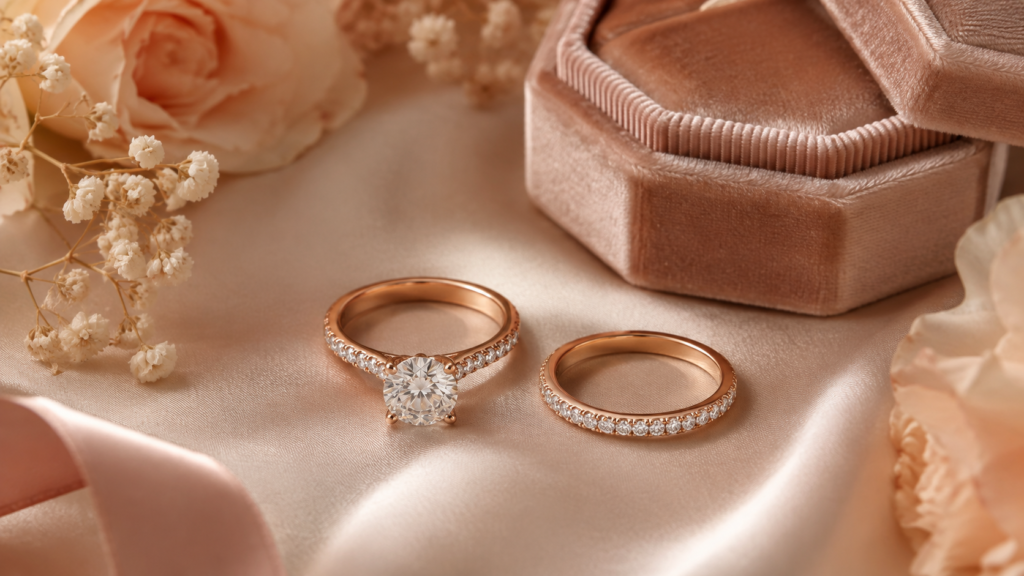
Anu Jewellers’ engagement rings and diamond bands can be compared by width, setting height and stone placement rather than appearance alone.
How Do You Test Comfort and Prevent Ring Damage?
Test both rings together through normal hand movements and inspect every contact point from above, below and the side. The stack should not pinch, restrict circulation, rotate excessively or place diamond edges, claws or raised metal against vulnerable parts of either ring.
Complete the Seven-Step Wear Test
- Close and open your hand ten times: this reveals pinching, pressure and whether the stack restricts normal finger movement.
- Hold a phone and a cup for one minute each: everyday grip exposes uncomfortable edges that a quick showroom pose can hide.
- Check neighbouring fingers: wide or angular bands can press into the fingers beside the ring stack.
- Rotate the hand palm-up and palm-down: watch for spinning, tilting or one ring repeatedly riding over the other.
- Inspect the underside under bright light: hidden contact often develops near claws, galleries and exposed diamond edges.
- Remove the engagement ring: confirm that the wedding band remains comfortable and visually acceptable when worn alone.
- Repeat the test after several minutes: warmth can make the finger feel fuller and reveal a stack that was sized too tightly.
Common contact risks include:
- diamonds rubbing against engagement-ring claws;
- milgrain edges wearing against polished metal;
- raised galleries striking the wedding band;
- a hard metal edge cutting into a softer ring;
- two loose rings moving independently and colliding;
- a fitted band pressing upward against the centre setting.
The goal is not to prevent all contact many stacked rings touch. The goal is to avoid contact that concentrates pressure on a delicate setting or creates accelerated wear.
When Should the Ring Pair Be Checked?
| Check Point | What to Inspect |
| Before purchase | Fit, comfort, clearance and all contact points |
| After final sizing | Alignment, spinning and pressure between the rings |
| During the first weeks of regular wear | New scratches, rubbing, tilting or skin pressure |
| After a hard knock or snag | Claws, stones, solder joins and ring shape |
| After either ring is resized or repaired | The complete fit and alignment of both pieces |
| At the jeweller’s recommended service interval | Settings, wear points, finish and cleaning needs |
For ongoing care, bring both pieces when arranging jewellery repairs so the fitted relationship can be checked after resizing, polishing, claw work or stone replacement.
Should You Plan for Sizing and Future Stacking?
Yes. Plan sizing, resizing limits and possible future bands before finalising the pair. Wider stacks can feel tighter, eternity or heavily set bands may be difficult to resize, and a deeply contoured design can restrict how an anniversary ring is added later.
Each ring does not automatically need the same labelled size. Finger shape, band width, interior profile and the number of stacked rings can change how the combination feels. Professional sizing is especially important for wide bands, large knuckles and full-eternity designs.
Use Anu Jewellers’ guide on how to measure ring size at home as a starting point, then confirm the final size in person before ordering a fitted or non-resizable band.
Future Stack Planning Table
| Future Plan | Decide Now |
| Add an anniversary band later | Leave visual and physical room for a third ring |
| Wear the wedding band alone for work | Avoid a contour that looks incomplete by itself |
| Resize after pregnancy or weight change | Ask how far each design can realistically be altered |
| Replace or reset the engagement ring later | Avoid an extreme custom notch unless the current setting is permanent |
| Add an heirloom band | Compare metal contact, width and maintenance requirements |
| Solder the rings together | Discuss independent wear, resizing and repair consequences first |
Do not order a custom band around an engagement ring that already feels loose or tight. Correct the engagement-ring size first because later resizing can change how the two pieces align.
How Can Indian and South Asian Couples Coordinate Their Rings?
Coordinate the ring stack with the wearer’s lifestyle while allowing wedding-day jewellery to follow family and cultural preferences. The engagement and wedding rings need not match every yellow-gold bridal piece, but they should feel intentional beside jewellery worn regularly after the celebrations.
For Indian and South Asian families, ring selection may occur around a proposal, roka, engagement ceremony, civil wedding or larger multi-day celebration. Family opinions can be meaningful, but the couple will usually wear the rings far longer than the ceremony lasts.
Practical approaches include:
- matching yellow-gold bands in different widths;
- a white-gold engagement ring with a fine yellow-gold wedding band;
- identical engravings on otherwise different ring designs;
- a diamond band for one partner and a plain band for the other;
- a shared finish or edge detail across men’s and women’s rings;
- everyday rings that contrast with heavier ceremonial jewellery.
A bride may wear substantial 22K yellow-gold jewellery with a lehenga or saree while choosing an 18K white-gold ring stack for office and daily use. Another may use a yellow-gold wedding band to connect a white-metal engagement ring with the gold jewellery she wears at family functions.
Couples comparing coordinated options can also explore men’s wedding rings and discuss shared metals, engraving or finishes without forcing both partners into identical widths.
When Is a Custom Wedding Band Worth It?
Custom design is worthwhile when a standard band cannot clear the engagement-ring setting, important details need to align precisely or the pair must incorporate an heirloom, unusual stone layout or personal motif. The existing ring should be correctly sized before design begins.
Knowing how to match wedding rings with engagement rings also means recognising when a ready-made band cannot provide safe clearance. A custom band can follow a halo, cluster, low basket or asymmetric outline more accurately and can repeat engraving, milgrain, diamond shapes or a cultural motif in a controlled way.
Before approving custom work, ask:
- Will the wedding band still look balanced alone?
- What happens if the engagement ring is resized?
- Can the custom band itself be resized?
- Will stones or edges touch between the rings?
- Is a wax, resin or digital model available for review?
- Which specifications will appear on the written order?
- What changes are possible after production starts?
- How should both rings be maintained as a pair?
According to the ACCC, consumer guarantees apply automatically to goods and services sold in Australia. These rights are separate from voluntary warranties, but custom-order and change-of-mind terms should still be read and recorded before work begins.
Allow enough time for design, approval, production and adjustments rather than leaving a fitted wedding band until the final weeks before the ceremony.
Which Pair Should You Choose?
Choose the pair that clears the setting safely, feels comfortable as a complete stack and reflects the wearer’s style. A perfect visual match is less important than intentional proportions, manageable contact, realistic maintenance and the freedom to wear each ring as intended.
The final decision should pass five tests:
| Final Test | Pass Condition |
| Fit | The band sits where intended without forcing the engagement ring aside |
| Contact | No vulnerable claw, stone edge or setting carries repeated pressure |
| Comfort | The combined width feels secure without pinching or restricting movement |
| Versatility | The wedding band works acceptably alone if that matters to the wearer |
| Future use | Resizing, repairs and additional bands have been considered |
Learning how to match wedding rings with engagement rings is not about making every detail identical. It is about creating two pieces that look deliberate, wear safely and remain practical after the wedding day.
Bring your engagement ring to Anu Jewellers in Craigieburn to compare straight, curved, plain and diamond bands in person. Customers from Craigieburn, Epping, Roxburgh Park, Mickleham, Greenvale, Wollert and Melbourne’s northern suburbs can contact Anu Jewellers for personalised ring-pairing guidance.