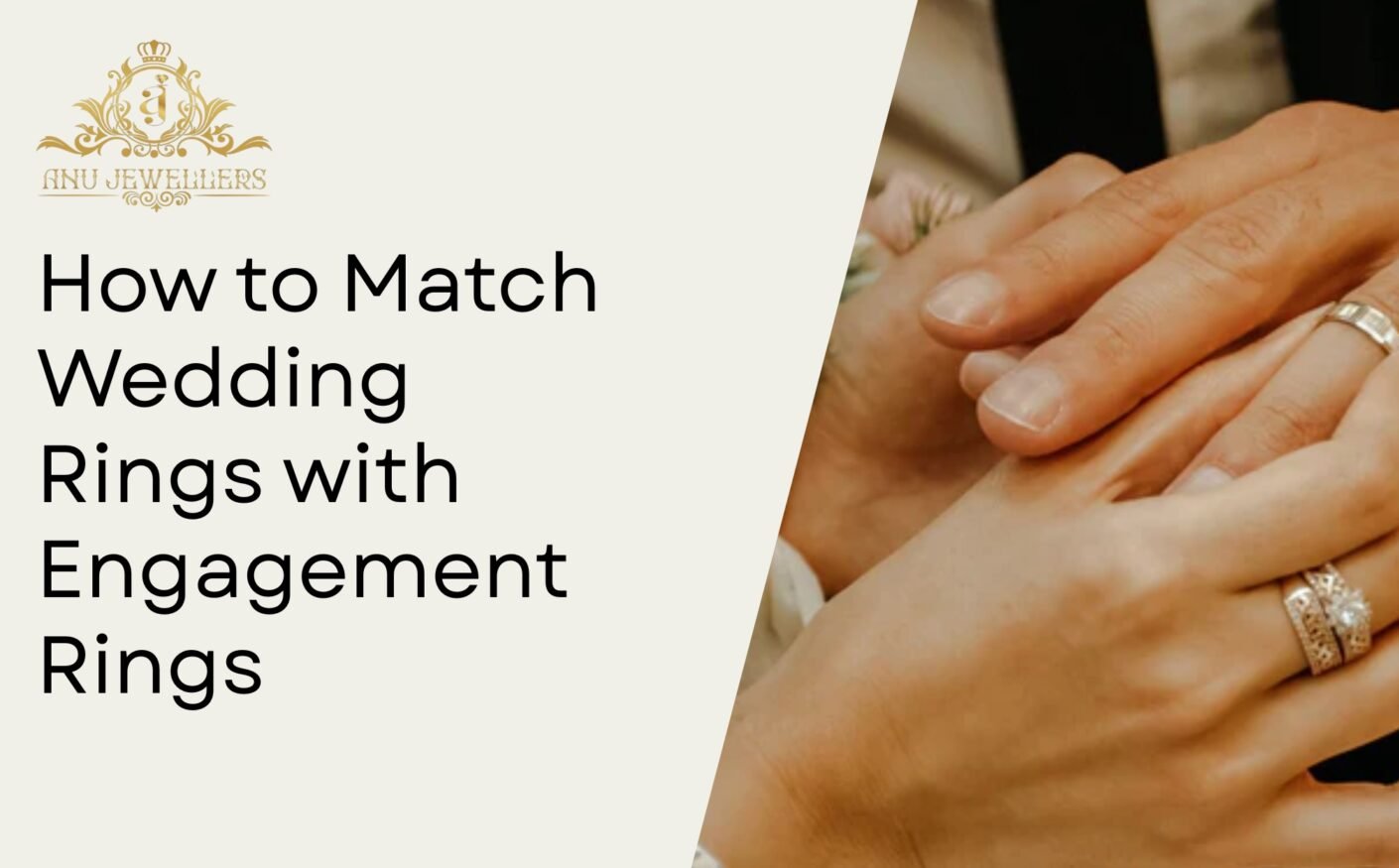
Matching a wedding ring with an engagement ring is not only about choosing the same metal or adding more diamonds. The two rings need to look balanced, sit comfortably and work together during everyday hand movement.
The best way to learn how to match wedding rings with engagement rings is to examine the engagement ring from both the top and the side. A straight wedding band may sit neatly beside a raised setting, while a low halo or three-stone ring may need a curved or fitted band.
You should also check where the rings touch, how wide the complete stack feels and whether both pieces can be resized or maintained later.
This guide explains how to compare wedding ring styles, metal colours, band widths, setting clearance and long-term comfort before choosing your pair.
How Do You Match a Wedding Ring with an Engagement Ring?
How do you choose a wedding ring to match an engagement ring? Start by examining the engagement ring from the side, not just the top. The setting height, basket width and any halo or side stones determine which wedding band shapes will actually fit. Then compare band shape, metal colour, width and contact points. Bring the actual engagement ring when shopping rather than relying on photographs.
Check these points before deciding:
| Decision | Question to Ask |
| Fit | Can the wedding band sit beside the engagement-ring setting? |
| Shape | Does the ring need a straight, curved or fitted band? |
| Style | Should the rings match, coordinate or contrast? |
| Metal | Do you want the same colour and finish? |
| Width | Is the complete stack comfortable? |
| Contact | Do stones, claws or metal edges touch? |
| Future use | Could an anniversary band be added later? |
| Resizing | Can both rings be adjusted if necessary? |
When matching wedding and engagement rings, the goal is not to make every detail identical. The goal is to create a combination that feels intentional and comfortable.
A plain wedding band can work beautifully with a detailed halo ring. A diamond band can add sparkle to a simple solitaire. Mixed metals can also look balanced when the widths and profiles coordinate.
For a full guide on choosing the right engagement ring in the first place, read our [engagement ring buying guide].
Start by Examining the Engagement Ring from the Side
Many buyers look at rings only from above. The top view shows the overall design, but the side view reveals whether a wedding band can actually sit beside the setting.
Look at:
- How high the centre stone sits
- Whether the basket projects outward
- Whether a halo extends beyond the band
- Whether side stones block the space beside the ring
- How much room exists beneath the setting
- Where the wedding ring is likely to touch
Consider two solitaire engagement rings that look almost identical from above.
The first has a raised setting with enough space underneath for a straight wedding band. The second has a low basket that reaches almost to the finger. A straight band beside the second ring may leave a noticeable gap.
Neither design is wrong. They simply need different wedding-band solutions.
Bring the actual engagement ring when shopping for the wedding band. Photographs cannot show the exact height, proportions or contact points clearly enough.
Should Your Wedding Ring Match or Contrast with Your Engagement Ring?
There are three main styling approaches.
A matching pair
A matching pair may use:
- The same metal colour
- Similar band widths
- Similar stone setting styles
- The same polished or matte finish
This creates a consistent, bridal-set appearance.
A complementary pair
Complementary rings share some visual elements without being identical.
For example, a plain polished band can balance a detailed [diamond jewellery] engagement ring. A fine diamond band can add sparkle beside a simple solitaire without competing with the centre stone.
A contrasting pair
Some couples deliberately mix:
- Yellow and white gold
- Plain and diamond-set bands
- Vintage and modern details
- Different textures or widths
Contrast can still look coordinated when it is clearly intentional.
For example, a bride may wear a white-gold engagement ring but choose a fine yellow-gold wedding band to connect the stack with the yellow-gold jewellery she wears regularly.
The rings do not need to look as though they came from the same set. They need to look as though they belong to the same wearer.
Do Wedding Rings Have to Match the Engagement Ring?
No. Wedding rings do not have to match the engagement ring exactly. The two rings should look intentional together, but that does not mean identical metal, width or style.
Many couples choose rings that complement rather than copy each other. A plain polished band can balance a detailed diamond engagement ring. A yellow-gold wedding band can work beside a white-gold engagement ring when the widths and profiles are considered carefully.
The rings need to sit comfortably, clear the engagement-ring setting and feel balanced when worn together. Beyond those practical requirements, the styling is a personal choice.
Understanding [what is fine jewellery] can also help when comparing metals and materials especially when deciding whether to mix yellow gold, white gold or platinum across the two rings.
Straight, Curved, Notched or Custom-Fitted Wedding Band?
The right wedding-band shape depends on the space beside the engagement-ring setting.
| Wedding Band Shape | Often Suits | What to Check |
| Straight band | Raised solitaires and open settings | Whether it clears the centre basket |
| Curved or contoured band | Low settings, halos and three-stone rings | Whether the curve follows the engagement ring closely |
| Notched band | Rings with one specific projecting section | Whether it works when worn alone |
| Chevron or V-shaped band | Pear, marquise or angular designs | Whether the point aligns with the centre stone |
| Custom-fitted band | Cluster, vintage or irregular settings | Future resizing and independent wear |
Straight wedding bands
Straight bands are versatile and often look complete when worn alone. They can also make it easier to add another straight anniversary band later.
Their main limitation is clearance. If the engagement-ring setting sits low, a straight band may leave a gap.
Curved wedding bands
A curved band follows the outline of the engagement ring. It can create a closer fit around a halo, cluster or low-set centre stone.
Before choosing one, remove the engagement ring and look at the curved band by itself. Some gentle curves still look balanced alone, while deeper contours may appear clearly designed for one particular engagement ring.
Notched and fitted bands
A notched band includes a specific indentation that fits around the engagement-ring setting.
This can create a very close fit, but it may offer less flexibility if the engagement ring is resized, replaced or worn less often in the future.
Custom wedding bands
Custom fitting may be useful when the engagement ring has an unusual outline, side stones or detailed metalwork.
The engagement ring should fit correctly before a custom band is created around it. Altering the engagement ring later may change how closely the two rings align.
Wedding Band Options for Different Engagement Ring Settings
Different engagement-ring settings create different fitting challenges.
| Engagement Ring Style | Wedding Band to Try First | What to Check |
| High-set solitaire | Straight band | Clearance under the centre setting |
| Low-set solitaire | Curved or contoured band | Gap beside the basket |
| Halo ring | Curved, notched or fitted band | Whether the halo extends past the shank |
| Three-stone ring | Contoured or custom band | Clearance around side stones |
| Cathedral setting | Straight or gently curved band | Side-profile height |
| Bezel setting | Straight or contoured band | How low the bezel sits |
| Cluster ring | Curved or custom-fitted band | Irregular outer edges |
| Vintage-inspired ring | Plain, engraved or fitted band | Whether details are hidden |
| Split-shank ring | Narrow straight or custom band | Total width on the finger |
| Coloured gemstone ring | Plain or diamond band | Visual balance around the centre stone |
This table is a starting point, not a rule. Two halo rings can have very different setting heights, so the exact engagement ring must be tested with the band.
Does the Wedding Band Need to Sit Flush?
A flush fit means the wedding band sits directly beside the engagement ring with little or no visible gap.
Many buyers like this appearance, but it is not compulsory.
A small gap may be suitable when:
- The wearer likes the visual separation
- A straight band is preferred for independent wear
- The engagement-ring setting naturally blocks a close fit
- The rings remain comfortable and do not interfere
- The gap appears intentional
For example, a low halo ring may create a small space beside a straight wedding band. The wearer could select a contoured band for a closer fit, but she may prefer the straight band because it looks more complete when worn on its own.
The best option depends on how the rings will be worn after the wedding, not only how they appear in a close-up photograph.
Check Where the Two Rings Touch
Two rings can look well matched while still making unsuitable contact underneath or along the sides.
Possible contact points include:
- The outer edges of both bands
- Engagement-ring claws
- Side stones
- Diamond settings on the wedding band
- Raised galleries
- Milgrain or engraved edges
- Exposed gemstone edges
Ask the jeweller to inspect the pair from the side and underneath.
The important question is not whether the rings touch at all. Many stacked rings will have some contact. The question is whether the contact point is appropriate for regular wear or likely to place pressure on a delicate setting.
For example, a diamond-set wedding band may sit directly against the claws holding an engagement-ring side stone. That combination should be assessed carefully rather than chosen only because the diamonds line up from above.
How to Choose Wedding Rings for Comfort and Daily Wear
Learning how to match wedding ring with engagement ring for daily comfort means testing the full stack, not only the band by itself.
Wear both rings for several minutes and perform normal hand movements.
Try this practical test:
- Open and close your hand
- Hold your phone
- Pick up a cup
- Carry a handbag handle
- Check the space between neighbouring fingers
- Notice whether one ring spins
- Look at the stack from the side
- Remove the engagement ring and wear the wedding band alone
Two rings may also feel tighter than one because the total width around the finger has increased.
A narrow engagement ring and narrow wedding band may each feel comfortable alone, but the combined stack can feel different. If a future anniversary band is added, the total width increases again.
Comfort should be tested before sizing decisions are finalised. For guidance on getting ring measurements right before ordering, read our guide on [how to measure ring size at home].
Match Band Width, Thickness and Profile
Band width is the measurement across the top of the ring. Thickness refers to how much the ring rises from the finger.
Both influence how the pair looks and feels.
Similar widths
Similar band widths create a coordinated appearance and can make the rings feel like a set.
Narrow wedding band
A narrow wedding band allows the engagement ring to remain visually dominant. It can work well beside a detailed centre setting.
Wider wedding band
A wider band creates a stronger visual presence. It may suit a simple engagement ring, but the complete stack should be checked for finger comfort.
Ring profile
Profiles can be rounded, flat, domed, knife-edge or softly bevelled.
Compare the rings from the side. A thick, rounded wedding band may look noticeably different beside a very fine, flat engagement-ring shank even when both have the same width.
For example, a 2 mm engagement ring and a 2 mm wedding band create approximately 4 mm of combined width before any gap is considered. Adding a third ring later changes the feel again.
Plain, Diamond or Gemstone Wedding Band?
The choice depends on how much detail you want in the complete stack.
Plain wedding band
A plain band can balance a detailed engagement ring and is often easy to wear independently.
It also has fewer stone settings to clean and inspect. For tips on keeping [diamond jewellery] clean between visits, read our guide on [how to clean diamond jewellery at home].
Diamond wedding band
A diamond band adds sparkle across the finger and can complement a solitaire or simple centre setting.
Check whether the wedding-band diamonds touch the engagement-ring claws, basket or side stones.
Pavé and eternity designs may also have resizing limitations, so ask before purchasing.
Gemstone wedding band
A gemstone band can add colour, symbolism or contrast.
Because gemstones vary in their care and durability requirements, ask whether the chosen stones suit the wearer’s expected routine.
| Buyer Preference | Band to Consider |
| Simple and traditional | Plain polished band |
| More sparkle | Diamond or pavé band |
| Visible contrast | Mixed-metal or textured band |
| Personal colour | Gemstone band |
| Flexible independent wear | Straight plain band |
| Very close fit | Contoured or custom-fitted band |
Should Both Rings Be the Same Metal?
No. Matching metals create a consistent appearance, but mixed-metal ring stacks can also look intentional.
When comparing metals, consider colour, finish, maintenance, wear pattern, resizing possibilities and how the rings coordinate with everyday [gold jewellery].
A bride may wear elaborate yellow-gold [Indian bridal jewellery] during wedding functions but choose a white-gold engagement ring and wedding band for everyday wear.
Alternatively, she may keep the white-gold engagement ring and add a yellow-gold wedding band to reflect the jewellery she wears with sarees, salwar suits or family celebrations.
The daily ring stack does not need to match every piece worn during the wedding.
When comparing wedding rings in Australia, ask about the exact metal, finish, care requirements and future alteration options rather than choosing by colour alone.
Will the Wedding Band Look Good When Worn Alone?
This question matters for anyone who may remove the engagement ring during work, travel, exercise or certain daily activities.
A straight wedding band usually looks complete when worn by itself. A curved or notched band may appear more specialised.
Before buying, remove the engagement ring and check:
- Whether the wedding band still looks balanced
- Whether the curve feels too noticeable
- Whether it needs to face one direction
- Whether it feels comfortable alone
- Whether it could work with another ring later
A deeply contoured band may fit perfectly around a halo engagement ring but look unusual on its own. A gentler curve may provide a compromise between close fit and flexibility.
Neither choice is automatically better. The right choice depends on how often the wedding band will be worn without the engagement ring.
Can Both Rings Be Resized Later?
Resizing possibilities should be discussed before choosing the wedding band.
| Ring Design | Resizing Consideration |
| Plain band | Often more straightforward to assess |
| Pavé band | Stone placement may limit adjustment |
| Full eternity band | Frequently difficult or limited to resize |
| Engraved band | Pattern may be interrupted |
| Custom contoured band | Fit may change if the engagement ring is resized |
| Mixed-metal band | May require specialised work |
| Heirloom ring | Existing wear and repairs need inspection |
Do not assume both rings should be made in the same size. Band width, finger shape and design can affect how each ring feels.
If a custom wedding band is being shaped around the engagement ring, have the engagement ring’s size checked first. Making the fitted band around an engagement ring that is already too loose can create alignment problems later.
If either ring needs resizing or repair after the wedding, [jewellery repairs in Melbourne] can help with professional assessment and alteration.
How to Match Multiple Rings with an Engagement Ring
When building a ring stack beyond the wedding band, the same principles apply: check setting clearance, compare finished widths and test the complete combination while wearing the intended outfit.
The engagement ring usually stays as the visual anchor. Additional rings whether a wedding band, anniversary ring or fashion band should be chosen in relation to it rather than independently.
Before adding a third ring, check that the combined width still feels comfortable and that no new ring places pressure on existing claws, settings or stone edges.
You do not need to choose the third ring now, but it is helpful to leave room for the possibility.
Consider:
- Whether the third ring would sit above or below the engagement ring
- Whether another curved band would be needed
- Whether the complete stack would become too wide
- Whether matching metals are important
- Whether symmetry is preferred
- Whether the wedding band can be worn with the anniversary band alone
Possible future stacks include:
- Engagement ring with one straight wedding band
- Engagement ring between two matching curved bands
- Mixed-metal stack with a straight anniversary band
- Wedding band and anniversary ring worn without the engagement ring
For example, a deeply fitted wedding band may work perfectly in a two-ring set but make it harder to add a straight third band. Thinking ahead helps avoid that limitation.
Matching Rings for Indian and South Asian Weddings
For many Indian and South Asian couples, ring shopping may be part of a proposal, roka, formal engagement or larger wedding celebration.
Family members may be involved in selecting the rings, but the couple will usually wear them long after the ceremony. Daily comfort and personal style should therefore remain important.
Couples may choose:
- Identical wedding bands
- Coordinated bands in different widths
- Matching metal colours with different finishes
- A diamond band for one partner and a plain band for the other
- Men’s and women’s rings that share one design detail
- Mixed-metal rings that coordinate with existing jewellery
Consider a couple who wants matching yellow-gold wedding bands. The bride already has a white-gold engagement ring. The combination can still look deliberate if the band width and profile suit the engagement ring.
Another bride may wear heavy yellow-gold [Indian bridal jewellery] during the wedding but choose a simple white-gold bridal ring stack for work and daily use.
The rings should support the couple’s life after the wedding, not only match the ceremonial jewellery worn on one day.
What Should You Bring to a Wedding-Ring Appointment?
Bring the actual engagement ring whenever possible.
Also bring:
- Any available ring documentation
- Photos of wedding-band styles you like
- Examples of jewellery worn regularly
- Your wedding date
- Ideas about future anniversary bands
- Questions about resizing
- Your partner’s ring if coordinated bands are being considered
The engagement ring itself is the most important item because the jeweller needs to examine its height, shape, width and setting construction.
A photograph may show the design, but it cannot confirm whether a band will clear the basket or touch a claw.
Long-Term Care for Matching Wedding and Engagement Rings
The two rings should be inspected as a pair because the way they sit together may affect ongoing care.
Ask about:
- Contact points between the rings
- Claw and stone inspections
- Cleaning methods for both pieces
- Resizing limitations
- Refinishing requirements
- Repairs to small stones
- Whether one alteration could affect the matched fit
Some couples ask whether the rings should be permanently joined. This may reduce independent movement, but it can also affect future resizing and prevent the rings from being worn separately.
It should be assessed as an individual option, not treated as the default solution.
If one ring needs repair or resizing later, bring both pieces so the matched fit can be checked again. Our guide on [how to clean diamond jewellery at home] also covers how to care for ring settings between professional inspections.
Common Ring-Matching Mistakes to Avoid
Common mistakes when learning how to match wedding ring with engagement ring include:
- Looking only at the rings from above
- Assuming every solitaire suits a straight band
- Believing a flush fit is compulsory
- Choosing by metal colour alone
- Ignoring contact between stones and claws
- Shopping without the actual engagement ring
- Forgetting the total stack width
- Not checking the wedding band alone
- Ordering a fitted band before correcting the engagement-ring size
- Ignoring resizing limitations
- Forgetting future anniversary-ring plans
- Matching the rings only to wedding-day jewellery
Most of these problems can be avoided by trying the rings together and asking practical questions before ordering. For a broader guide on what questions to ask before any jewellery purchase, read our post on [how to choose a jewellery store].
Final Wedding and Engagement Ring Matching Checklist
Use this guide to how to match wedding ring with engagement ring as a final check before deciding:
- The band clears the engagement-ring setting
- The gap or flush fit looks intentional
- Contact points have been checked
- The widths and profiles feel balanced
- The complete stack is comfortable
- The rings stay in position during normal movement
- The wedding band looks acceptable alone
- Resizing limitations are understood
- Future stacking has been considered
- Metal and maintenance requirements are clear
- Repair and alteration policies have been explained
The best match is not necessarily the pair that sits closest together. It is the pair that combines appearance, comfort and long-term practicality.
Explore Wedding Rings at Anu Jewellers in Craigieburn
Anu Jewellers in Craigieburn helps couples and families compare wedding bands with existing engagement rings.
Bring your engagement ring to the showroom to explore straight, curved, plain and diamond wedding bands and assess how each option fits from the top and side.
Customers from Craigieburn, Epping, Roxburgh Park, Mickleham, Greenvale, Wollert and nearby suburbs can also explore [gold jewellery], [diamond jewellery], [Indian bridal jewellery] and men’s jewellery for wedding celebrations.
The team can help you consider ring shape, width, setting clearance, sizing and ongoing jewellery care before you choose.
Ready to Find the Right Match?
Bring your engagement ring to Anu Jewellers in Craigieburn to compare wedding bands in person straight, curved, plain and diamond options for every setting style. Whether you are preparing for a proposal, roka or wedding celebration, our team can help you find a combination that works for your occasion and everyday life.
Faq's
How to match a wedding rings with an engagement rings?
Examine the engagement rings from the side to check setting height, basket width and any halo or side stones. Then compare band shape, metal colour, width, contact points and comfort. Bring the actual engagement ring when shopping photographs cannot confirm whether a band will clear the setting or touch a claw.
How do you choose a wedding ring to match an engagement ring?
Start with the engagement ring’s side profile. The setting height and shape determine which band styles will actually fit. Then consider whether you want a matching, complementary or contrasting pair, and test the complete stack for comfort before finalising the size.
Do wedding rings have to match the engagement ring?
No. Wedding rings do not have to match the engagement ring exactly. They should look intentional together, but that does not mean identical metal, width or style. A plain band can complement a detailed diamond ring. A yellow-gold wedding band can work beside a white-gold engagement ring when widths and profiles are chosen carefully.
How to match multiple rings with an engagement ring?
Use the engagement ring as the visual anchor and choose each additional ring in relation to it. Check that new rings clear the setting, do not place pressure on existing claws or stones and that the total stack width feels comfortable. Test the complete combination while wearing the intended outfit.
Does the wedding band need to sit flush against the engagement ring?
No. A small gap can look intentional and may be more practical when a straight band is preferred for independent wear. The more important consideration is that the rings do not interfere with each other’s settings or place pressure on claws and stones.
What wedding band suits a low-set engagement ring?
A curved, contoured, notched or custom-fitted wedding band may work, depending on the shape and position of the setting. Bring the engagement ring to compare options in person rather than choosing from photographs.
Can I mix gold colours in my bridal ring stack?
Yes. Yellow, white and rose gold can be combined when the widths, profiles and overall styling create an intentional appearance. Many brides wear a white-gold engagement ring with a yellow-gold wedding band to coordinate with their everyday jewellery.
Should I bring my engagement ring when buying a wedding band?
Yes. The actual engagement ring is needed to check setting height, contour, clearance, contact points and proportions accurately. A photograph cannot confirm whether a specific wedding band will fit correctly.