Written by Anu Jewellers Team
Reviewed by Anu & Henry, Anu Jewellers
Signs gold jewellery needs repair are usually visible or noticeable changes in security, shape, fit or surface condition. Loose stones, weak clasps, stretched links, cracks, bent settings and sudden discomfort deserve professional assessment before ordinary wear turns a manageable problem into loss.
Gold jewellery is designed to be worn, but everyday friction, accidental knocks, repeated movement and long-term use can gradually affect even well-made pieces. A family bangle may lose its shape, a chain may develop a weak link, or a ring setting may stop holding a gemstone as securely as it once did.
At Anu Jewellers, repair requirements are assessed according to the jewellery’s condition, materials, construction and damage rather than assuming one repair method suits every piece. This is particularly important for traditional, sentimental and inherited jewellery.
What Are the Signs Gold Jewellery Needs Repair Before Damage Worsens?
Signs gold jewellery needs repair usually involve a change in security, structure, movement, fit or surface condition. The most useful gold jewellery repair signs are loose stones, worn settings, unreliable clasps, weakened links, cracks, distortion, deep metal damage and sudden changes in comfort.
| Warning Sign | What You May Notice | Recommended Response |
| Loose gemstone | Stone moves, clicks or rattles | Stop wearing and arrange assessment |
| Worn prong or setting | Thin, bent or uneven metal; snagging | Have the setting checked promptly |
| Weak clasp | Clasp does not click or opens unexpectedly | Avoid wearing until secured |
| Stretched chain link | Uneven, elongated or kinked link | Have the chain assessed |
| Crack or sharp edge | Visible split, fracture or rough point | Stop wearing the piece |
| Bent or misshapen jewellery | Ring, bangle or pendant no longer sits correctly | Do not reshape it yourself |
| Deep dents or severe wear | Metal looks deeply gouged or unusually thin | Ask whether repair or reinforcement is required |
| Fit or comfort change | Ring spins, bangle shifts or earring fitting feels loose | Have the fit or fastening checked |
1. Is a gemstone moving, clicking or looking loose?
A gemstone that moves when the jewellery is handled gently is one of the most important repair warnings. GIA explains that loose gemstones can damage both the stone and its setting, while regular inspection can identify the problem before the stone is lost.
You may notice:
- a stone that shifts when touched;
- a faint clicking or rattling sound;
- a visible gap between the stone and its setting;
- a gemstone that suddenly appears tilted;
- a diamond or coloured stone that feels different from when you first bought it.
Do not repeatedly shake or tap the jewellery to test it. Once you suspect movement, place the piece somewhere secure and arrange a professional assessment.
Illustrative scenario: A customer notices that the centre diamond in an anniversary ring makes a tiny clicking sound. The ring may still look completely normal from a distance, but continued daily wear could allow the setting to loosen further.
For new diamond jewellery, Anu Jewellers also provides diamond jewellery options, while existing pieces can be assessed for appropriate repair or resetting.
2. Do the prongs or settings look worn, bent or uneven?
Worn prongs and damaged settings can reduce gemstone security. Look for prongs that appear shorter, thinner, bent or uneven, particularly if the jewellery has also started catching on clothing, hair or fabric.
Prongs are the small metal supports that hold many gemstones in position. They can experience repeated contact and wear because they are exposed parts of the setting.
GIA notes that prongs can move outward following impact, allowing a stone to loosen or become dislodged.
Check the jewellery under good light rather than relying on how it looks from normal wearing distance.
Illustrative scenario: A ring that never used to catch on a jumper suddenly snags several times. The problem may not be the fabric; a raised or worn prong could be creating the rough point.
This is a situation where gold ring repair may involve prong tightening, re-tipping, setting adjustment or another structural repair depending on the condition.
3. Does the clasp no longer close securely?
A clasp that does not close properly is a practical warning because the jewellery can fall away without the wearer noticing. Test the closure gently and look for a catch that fails to engage, feels unusually loose or opens during normal movement.
Common signs include:
- the clasp does not click into place;
- the closure feels weaker than before;
- the safety catch does not sit correctly;
- a spring mechanism feels loose;
- the clasp opens when the jewellery moves.
This applies to necklaces, bracelets, chains and some earrings.
Do not repeatedly pull a weak clasp to test it. A professional can determine whether the clasp needs adjustment, replacement or reinforcement.
Anu Jewellers’ jewellery repair guide includes clasp repairs among the common services that may be required depending on the piece’s construction and condition.
4. Are chain links stretched, kinked or unusually thin?
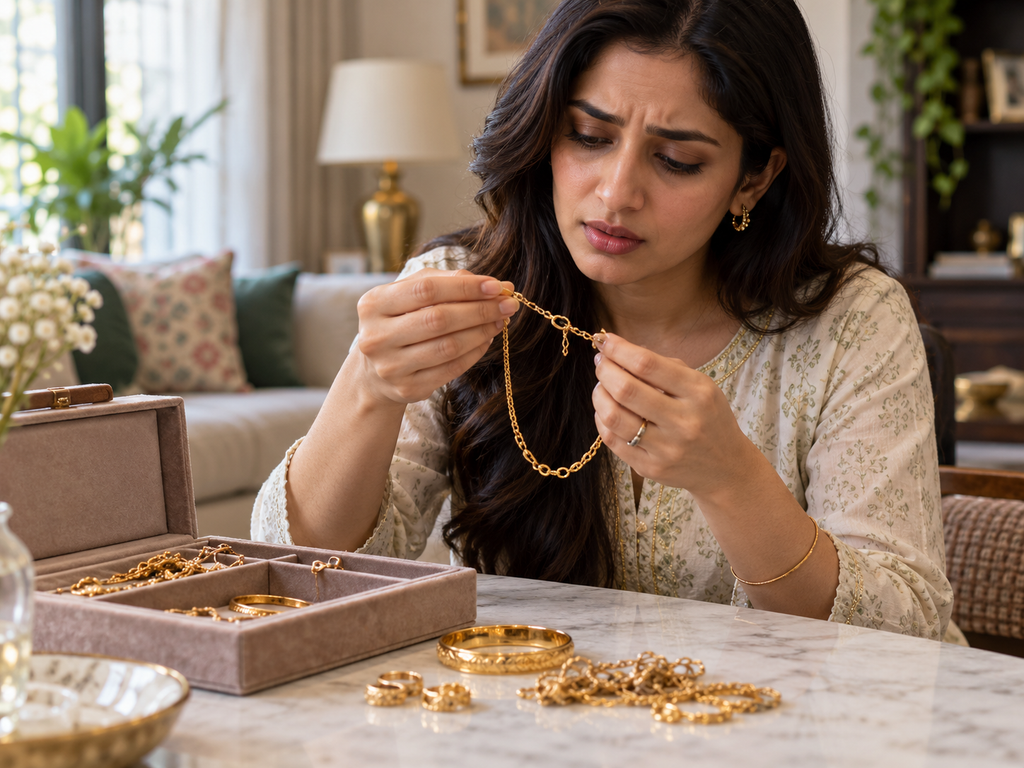
A gold chain can develop weak areas through repeated movement, accidental pulling or wear at high-stress points. Look for elongated links, permanent kinks, gaps, flattened sections or an area that no longer moves like the rest of the chain.
Lay the chain flat against a clean surface and compare neighbouring links. One link that looks noticeably different can deserve closer inspection.
Particular attention is useful around:
- the clasp;
- end links;
- pendant attachment points;
- frequently flexed sections;
- previous repair areas.
A chain does not necessarily need replacement because one section is damaged. Depending on its construction and condition, gold chain repair may involve repairing a link, rebuilding an end, replacing a clasp or strengthening a weak section.
Anu Jewellers provides chain repair services from its Craigieburn showroom, with the appropriate method determined by the chain’s metal, thickness, construction and damage.
5. Can you see a crack, split or sharp edge?
A visible crack, split or sharp edge is a structural warning rather than ordinary cosmetic wear. If a gold ring, bangle, pendant or other piece develops a fracture or rough break, stop wearing it until a jeweller has assessed the damage.
Pay particular attention to:
- hairline cracks;
- split sections;
- sharp metal points;
- rough repaired joins;
- areas that suddenly catch clothing;
- visible gaps in the metal.
Do not squeeze, bend or press the damaged section back into position. Home reshaping can increase stress in already weakened metal.
Illustrative scenario: An inherited gold bangle develops a small split near a previous join. Bending it back into a circle at home may make the damage worse. A professional assessment can determine whether the bangle can be rebuilt, reinforced or restored.
6. Has the jewellery bent or changed shape?
A ring, bangle, pendant or other gold piece that has changed shape may have experienced an impact or gradual structural wear. A ring that is no longer round or a bangle that no longer sits evenly should be assessed before continued use.
You may notice:
- a ring looks oval instead of round;
- a bangle has developed a flat or distorted section;
- a pendant hangs at an unusual angle;
- an earring no longer sits symmetrically;
- a clasp or connector appears misaligned.
Do not try to straighten the piece yourself. Repeated bending can weaken metal, disturb settings or place pressure on gemstones.
Anu Jewellers specifically notes that bangle repair and reshaping depend on the design and construction of the individual piece.
7. Are deep dents or scratches changing the metal?
Minor scratches are a normal part of wearing gold, but deep dents, grooves, gouges or visible thinning deserve a closer look. The concern is not simply that the jewellery looks less polished; substantial surface damage can affect the metal’s usable thickness or shape.
The Jewellers Association of Australia notes that small nicks and scratches can be normal signs of wear, while regular professional assessment can identify worn settings and other problems.
Professional polishing is also not a universal solution. Repeated polishing removes some surface metal, so it should be appropriate to the jewellery and its condition.
If the piece has only light surface marks, cleaning or polishing may be enough. If the damage is deep, a jeweller may recommend repair, reshaping or reinforcement instead.
8. Has the fit or comfort suddenly changed?
A sudden change in fit can indicate resizing needs, distortion, a rough edge or another structural issue. A ring that spins excessively, a bangle that moves differently or an earring that no longer feels secure should not simply be tolerated.
For rings, watch for:
- slipping more easily than before;
- difficulty removing the ring;
- new pressure points;
- a ring that no longer sits straight;
- discomfort that was not previously present.
For bangles and bracelets, a change in movement or balance can indicate altered shape or worn components.
For earrings, loose backs, bent posts or unstable fittings can increase the chance of loss.
Anu Jewellers provides ring resizing and jewellery repair services from its Craigieburn showroom, with suitability determined by the individual piece.
When Should You Stop Wearing Damaged Gold Jewellery?
When damage appears, stop wearing the piece if continued movement could worsen it or cause a stone or component to fall away. Loose stones, broken clasps, cracked metal, severe bends and sharp edges are reasons to store the jewellery safely until assessed.
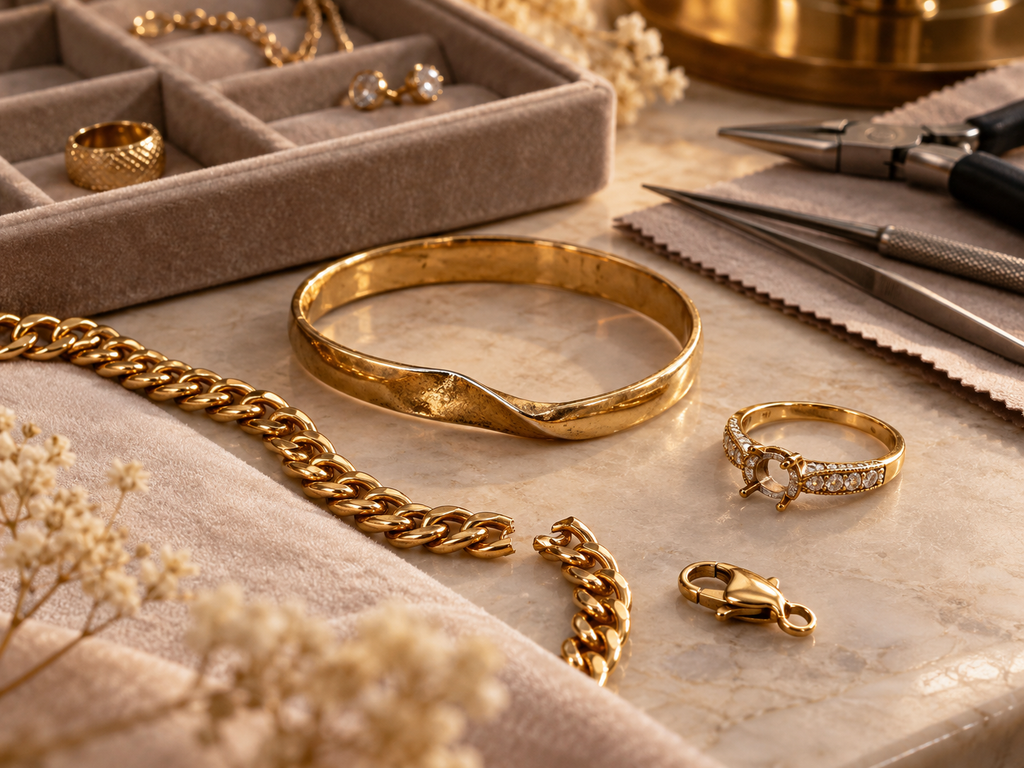
The simplest rule is: if the jewellery has become less secure than it was before, do not keep testing it through normal wear.
Stop wearing it immediately when:
- a gemstone moves;
- a prong is visibly broken or lifted;
- a chain has separated;
- a clasp does not secure;
- the metal has cracked;
- a ring has become badly distorted;
- a sharp edge is catching skin or clothing;
- an important setting has shifted after impact.
The Jewellers Association of Australia similarly advises removing jewellery during activities that may scratch, knock or damage it and seeking professional advice when you are unsure about care or repair.
Place the item in a soft, separate pouch or jewellery box. Do not put a damaged chain loosely into a drawer where it can tangle or catch on other pieces.
If the jewellery contains a loose gemstone, avoid aggressive cleaning as well. GIA notes that some cleaning methods can loosen gemstones, which is why professionals inspect settings before using specialised cleaning equipment.
Can Normal Scratches or Dullness Mean Your Jewellery Needs Repair?
Normal hairline scratches can be part of everyday wear, but deep grooves, dents, sharp edges, exposed thinning or distortion deserve assessment. A dull finish alone may only need cleaning; white-gold colour change can be rhodium wear rather than structural damage.
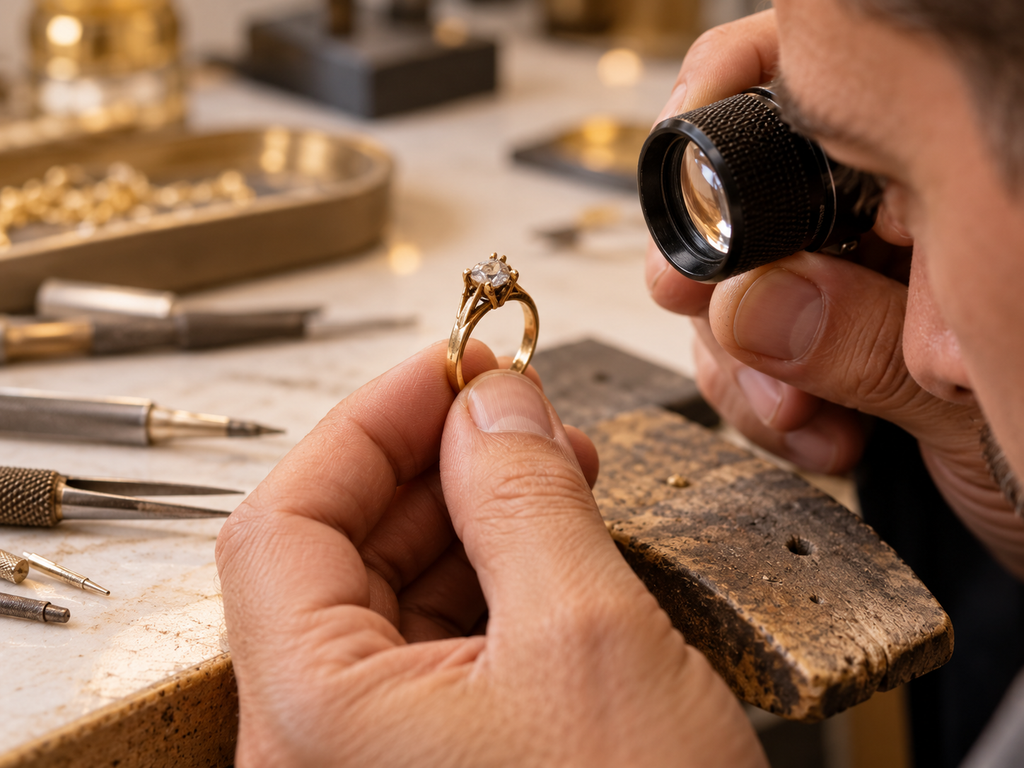
This distinction matters because not every imperfect-looking piece needs a repair.
Normal wear that may not require structural repair
A frequently worn gold ring can develop:
- fine surface scratches;
- light rubbing marks;
- reduced surface shine;
- small signs of everyday contact.
These can often be addressed through suitable cleaning or professional polishing.
Damage that deserves assessment
A different response is appropriate when you notice:
- deep scratches that create a groove;
- dents that change the shape;
- visible cracks;
- thinning metal;
- rough or sharp areas;
- damaged settings;
- loose stones.
White gold also needs separate consideration. The Jewellers Association of Australia explains that yellowing can occur when rhodium plating wears away; this is a maintenance issue rather than automatically a structural failure.
So if a white-gold ring looks slightly yellow but remains structurally sound, it may need cleaning and rhodium plating rather than a metal repair.
What Professional Repair Might Each Warning Sign Need?
Professional repair can range from tightening a setting or replacing a clasp to soldering a chain, reshaping a bangle, rebuilding worn metal or resetting a gemstone. The correct method depends on the jewellery’s metal, construction, stones and extent of damage.
| Problem | Possible Professional Service | Why Assessment Matters |
| Loose gemstone | Stone tightening or resetting | The setting may also be worn |
| Worn prong | Retipping or rebuilding | The surrounding setting may need checking |
| Broken clasp | Clasp repair or replacement | The connecting ring may also be weakened |
| Weak chain link | Link repair or section rebuilding | Adjacent links may also show wear |
| Cracked metal | Soldering, rebuilding or reinforcement | Further bending can enlarge the damage |
| Bent bangle | Reshaping or structural repair | Some designs cannot safely be reshaped repeatedly |
| Deep dent | Metal repair and refinishing | Excessive polishing alone may remove too much material |
| Poor ring fit | Resizing or structural assessment | Distortion may be causing the fit problem |
Anu Jewellers lists ring resizing, broken chain repair, clasp repair, bangle repair, earring repair, loose-stone assessment, stone resetting, prong repair, cleaning, polishing and restoration among its repair requirements.
Repair is not always the same as restoration
Repair normally addresses a specific fault, such as a broken chain or loose stone.
Restoration can involve broader work on an older, heavily worn or inherited piece where preserving its original character matters.
For traditional Indian and South Asian jewellery, restoration may require additional care because detailed patterns, cultural motifs and family history can be part of the piece’s significance.
If your jewellery has sentimental or cultural importance, do not approve major alterations before discussing what should be preserved.
How Often Should Gold Jewellery Be Professionally Checked?
Frequently worn gold jewellery should be checked when you notice any change and professionally inspected periodically. The Jewellers Association of Australia recommends professional checking, cleaning and polishing at least annually, while high-risk or heavily worn pieces may need attention sooner.
There is no single schedule that suits every piece. A delicate diamond ring worn every day has different inspection needs from a plain gold pendant worn twice a year.
| Jewellery Use | Practical Check |
| Daily-wear rings | Check settings, fit and surface regularly; consider annual professional inspection |
| Daily-wear chains | Check clasps, end links and stretched sections |
| Gold bangles | Watch for distortion, cracks and changes in movement |
| Diamond jewellery | Check stone security and settings regularly |
| Bridal jewellery | Inspect before important events and after heavy use |
| Heirloom jewellery | Assess condition before returning it to regular wear |
| Occasionally worn pieces | Inspect before wearing after long storage |
The most important trigger is not the calendar. It is a change in the jewellery.
If a stone moves in March, do not wait until an annual appointment in December.
That makes regular checks useful even when no obvious signs gold jewellery needs repair are visible.
How Much Does Gold Jewellery Repair Cost in Australia?
Jewellery repair prices vary widely by metal, construction, damage and whether stones or replacement components are involved. Published Australian price lists show simple work can start around A35–A75, while resizing, clasp replacement, structural work and stone services can reach several hundred dollars.
These figures are illustrative published price examples, not a national price guide. A repair quote should be based on the actual piece.
One Australian jeweller currently publishes examples including cleaning and checking from A40,crackanddentrepairsfromA75, stone tightening from A17.50andselectedgoldringresizingfromA60, with more complex work costing substantially more.
Another Australian repair provider publishes services such as chain repair, clasp replacement and ring resizing with prices varying by the type of jewellery and work required.
| Repair Type | Illustrative Australian Price Level | Main Cost Factors |
| Cleaning/checking | Around A35–A80+ | Jewellery type, stones and finish |
| Stone tightening | Around A20–A90+ | Stone size and setting |
| Clasp repair/replacement | Around A75–A250+ | Clasp type and chain construction |
| Chain repair | Around A40–A150+ | Link size, metal and damage |
| Ring resizing | Around A60–A225+ | Gold purity, width and size change |
| Structural rebuilding | A$200+ | Amount of metal and workmanship required |
| Stone replacement | Highly variable | Stone type, size and quality |
The final quote can change significantly if the jeweller discovers hidden wear during cleaning or inspection.
For valuable pieces, ask for the quote before work starts. The JAA recommends that customers receive a cost and time estimate and that no work proceed without approval.
What Should You Do When Signs of Gold Jewellery Needs Repair Appear?
Before handing over gold jewellery for repair, document its condition, confirm the requested work, ask for a written quote and keep the take-in record. This is especially important for valuable, inherited or culturally significant pieces with distinctive stones or hallmarks.
Prepare the jewellery properly
- Photograph the jewellery from several angles: clear before-repair images create a useful record of the piece’s condition and distinctive features.
- Record visible hallmarks and identifying details: markings, stone arrangements, engraving and unusual design elements can help identify the item during intake.
- Describe the exact problem: explain whether the issue is a loose stone, weak clasp, broken link, changed fit or another concern rather than simply asking for a “general repair”.
- Ask for a written quote and scope: knowing what work is proposed prevents confusion about additional services or costs.
- Keep the take-in document: the record should identify the jewellery, requested work, condition and agreed arrangements.
The JAA recommends documenting jewellery at intake with details such as metal, stones, hallmarks, size, setting style and, for chains, style, weight, length and clasp information. It also recommends photographs or sketches and customer acknowledgement.
What if the jewellery is culturally important?
Tell the jeweller.
An Indian gold bangle, inherited necklace, bridal set or family pendant may have details that should not be removed, polished aggressively or redesigned without discussion.
At Anu Jewellers, traditional and sentimental jewellery can be assessed with its design, materials, construction and condition taken into account.
For customers in Melbourne’s northern suburbs, you can visit Anu Jewellers’ Craigieburn showroom for jewellery repairs Craigieburn and discuss the condition of the piece before approving work.
How Do You Choose a Professional Jewellery Repair Service?
Choosing a repair jeweller should be based on inspection, documentation, transparent pricing and technical skill, not simply the lowest quote. Ask where the work is completed, how stones are protected, what is recorded at intake and when you will receive it back.
Ask these questions before approving repair
- What exactly is damaged?
- Is the problem cosmetic or structural?
- What repair method do you recommend?
- Could the repair affect any gemstone?
- Is any stone removal necessary?
- What is the estimated cost?
- What is the expected timeframe?
- Will the piece be cleaned or polished as part of the repair?
- Will the condition be documented before work begins?
- What happens if additional damage is discovered?
The Jewellers Association of Australia recommends choosing a skilled jeweller, documenting the item at intake and agreeing on the cost and timeline before work proceeds.
Repair, restore or replace?
Repair is often worth considering when the jewellery has sentimental, cultural or family significance and the core piece remains suitable for restoration.
Replacement may make more sense when damage is extensive, the construction cannot be safely repaired or the jewellery no longer suits the owner.
Anu Jewellers also explains the repair-versus-replacement decision in its jewellery repair service information, where the condition, construction, repair requirements, sentimental value, material value and expected future use are considered.
For older jewellery, customers can also explore antique and vintage jewellery Melbourne options and discuss repair or restoration suitability before making a decision.
Conclusion
The signs gold jewellery needs repair are easier to act on when you know what to inspect and when to stop wearing the piece. Early assessment can protect stones, clasps, links and worn metal while preserving jewellery that carries family or cultural meaning.
If your gold jewellery has developed a loose stone, damaged clasp, weak chain, crack, distortion or significant change in fit, arrange a professional assessment rather than attempting a structural repair at home.
For Melbourne and Craigieburn customers, visit Anu Jewellers to have your jewellery assessed and discuss the most suitable repair, restoration or aftercare option.