

Written by Anu Jewellers Team
Reviewed by Anu & Henry, Anu Jewellers
How should a gold bangle fit? It should pass over your hand without painful force, then rest loosely on your wrist without slipping off. Closed bangles need hand measurements; hinged bangles need wrist measurements and secure fastenings.
A gold bangle can look perfectly sized on a display but feel uncomfortable within minutes. It may catch at your knuckles, slide towards your fingers whenever you move, or press against your wrist bone when you type or lift a bag.
Getting the fit right is particularly important for rigid Indian bangles, 22K gold designs, wider kadas and pieces bought as gifts. This guide explains the tests, measurements and size conversions Melbourne buyers can use before purchasing or altering a valuable bangle.
How Should a Gold Bangle Fit on Your Wrist?
A well-fitting gold bangle moves comfortably around the wrist but stays secure when your arm hangs down. For a closed design, it should slide over the knuckles with controlled, gentle pressure, without scraping skin or requiring force.
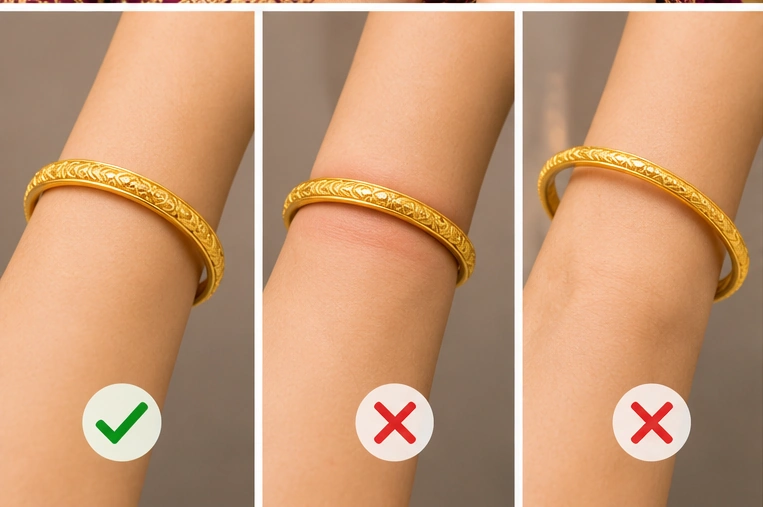
The exact feel depends on the bangle’s construction. A slim, round bangle can rotate and slide more than a wide kada, while an oval hinged bangle may stay relatively close to the wrist. The goal is comfortable movement, not a completely fixed position.
The Five-Point Gold Bangle Fit Test
Before choosing a size, try the piece on and check five everyday movements. This simple framework works better than deciding from an online photograph or a size label alone.
| Test | Comfortable fit | Warning sign |
| Put it on | Passes the hand with gentle, controlled pressure | Painful force or twisting needed |
| Let your arm hang | Stays above the hand rather than slipping away | Slides dangerously towards or off the hand |
| Bend your wrist | Allows full, natural movement | Digs into the wrist bone or pinches skin |
| Rest your hand on a desk | Moves without repeated hard impact | Constant banging, catching or pressure |
| Remove it | Comes off with patience and the correct hand position | Cannot be removed safely or leaves significant pain |
A small movement difference is normal. If a bangle looks secure while you stand still but slides towards your fingertips as soon as you lower your arm, it may be too large for the intended wear.
For an in-person comparison, Anu Jewellers offers gold bangles Melbourne shoppers can examine at its Craigieburn showroom.
How Tight Should a Gold Bangle Be?
A bangle should be snug only as it crosses the broadest part of the hand, then feel noticeably freer at the wrist. It is too tight if it causes pain, numbness, persistent pressure marks or restricted movement.
A closed bangle and a fitted bracelet are not meant to feel identical. Because a closed bangle cannot open, it needs enough internal space to get past the hand. Once there, the extra room permits movement that would be excessive in a closely fitted chain bracelet.
Watch for Tight-Fit Warning Signs
Do not force a bangle when the knuckles catch sharply at the opening. This can hurt the hand and may distort a delicate, hollow or heavily decorated piece. Likewise, a bangle that presses into the skin whenever you bend your wrist is not made comfortable simply by wearing it longer.
An illustrative example: someone tries a bangle that passes the hand only after repeated pushing and twisting. Even if it rests neatly at the wrist, that is not a practical fit for a piece they plan to remove each evening.
Avoid the Opposite Problem
A very loose bangle can slide over the lower thumb joint, hit furniture repeatedly or feel insecure when carrying bags. The question is not whether you can fit two fingers under it; it is whether it behaves safely during normal movement.
If you are unsure, compare adjacent sizes rather than deliberately buying an uncomfortable smaller one.
How Do You Measure Your Hand for a Closed Gold Bangle?
For a closed gold bangle, measure an existing comfortable bangle’s inner diameter first. If none is available, bring your thumb towards your little finger, measure around the broadest knuckle area and compare that circumference with the maker’s size chart.
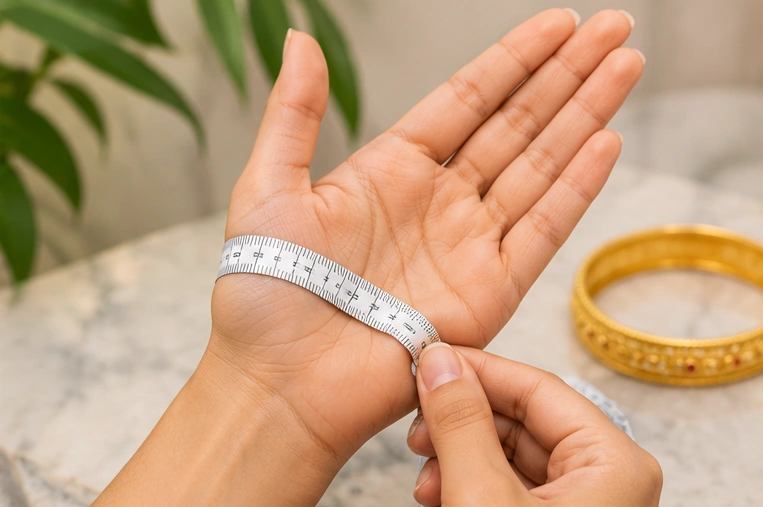
This is the core of how to measure bangle size: the opening must pass over the hand. Wrist circumference alone can be misleading, particularly for a person with slim wrists and prominent knuckles.
Method 1: Measure a Bangle You Already Own
- Place a comfortable, round bangle on a flat surface: a piece that already fits gives a more useful reference than a guessed small, medium or large label.
- Measure straight across the inside opening in millimetres: record the inner-edge-to-inner-edge diameter and exclude the thickness of the gold.
- Measure twice across the centre: a second reading helps detect whether the piece is slightly oval or has been bent out of shape.
- Record how that bangle feels during removal: tell the jeweller if the reference is too snug at the knuckles or too loose on the wrist.
According to NAJO’s Australian bangle sizing guide, a round closed bangle must be sized to pass over the hand; its example method uses a knuckle measurement to estimate the required diameter.
Method 2: Measure Around the Hand
- Bring your fingers together and tuck the thumb towards the little finger: use approximately the same position you take when sliding on a closed bangle.
- Wrap a flexible tape around the broadest knuckle area: keep it firm enough to follow the hand without squeezing the joints or skin.
- Record the complete hand circumference in millimetres: repeat the measurement once to check consistency before using any conversion.
- Divide the circumference by approximately 3.14 for a rough circular diameter: treat the result as a starting point, then check the jewellery maker’s chart and the exact piece.
- Confirm the bangle over the hand before paying: hand shape, bangle width and a non-circular opening can change the fit beyond the simple calculation.
For example, an illustrative hand circumference of 190 mm gives a theoretical circular diameter of roughly 60.5 mm (190 ÷ 3.14). That suggests looking near a 60–61 mm inner-diameter option, not ordering blindly without confirming the fit.
Is Wrist Measurement for Bangles Ever Useful?
Yes, but mostly for hinged bangles, open cuffs and bracelet-like designs that do not have to pass over the knuckles. For those, measure the wrist at the intended position and check the product’s internal shape, closure and required comfort allowance. A wrist measurement for bangles cannot replace the hand measurement for a rigid closed ring.
How Do Australian and Indian Gold Bangle Sizes Compare?
Australian retailers often list gold bangles by inner diameter in millimetres, while Indian and South Asian designs may use traditional labels such as 2.4, 2.6 or 2.8. Compare actual inside measurements before ordering because names and manufacturing tolerances vary.
For buyers searching bangle size Australia, the most dependable reference is the maker’s millimetre measurement. Traditional Indian labels can still be useful, but they must be interpreted correctly: 2.4 means 2 inches plus 4 sixteenths of an inch, not 2.4 decimal inches.
Approximate Indian-to-Australian Gold Bangle Size Guide
| Indian size label | Approximate inner diameter | Diameter in centimetres | Approximate inner circumference |
| 2.2 | 54.0 mm | 5.40 cm | 169.6 mm |
| 2.4 | 57.2 mm | 5.72 cm | 179.5 mm |
| 2.6 | 60.3 mm | 6.03 cm | 189.5 mm |
| 2.8 | 63.5 mm | 6.35 cm | 199.5 mm |
| 2.10 | 66.7 mm | 6.67 cm | 209.5 mm |
| 2.12 | 69.9 mm | 6.99 cm | 219.5 mm |
These values are mathematical conversions for approximately round inner openings, not a universal Anu Jewellers size chart or a guarantee that a hand of the stated circumference will fit. Handmade, oval, broad and stone-set designs can feel different; ask for the exact item’s internal dimensions.
An Australian retailer’s independent gold jewellery sizing reference also lists traditional bangle sizes against the corresponding internal diameters. Use it for comparison, then confirm the specific supplier’s measurements.
How do I know my bangle size? Start with the inner diameter of a comfortable existing bangle. If you do not have one, use the hand-measuring method and ask to try the nearest sizes. When between sizes, neither the tighter nor looser option should be chosen automatically without a wear test.
How Do Hinged Bangles, Kadas and Open Cuffs Fit Differently?
Hinged bangles are fitted around the wrist because the clasp opens, while closed kadas must still clear the hand. Open cuffs enter from the side of the wrist and depend on a stable, correctly designed gap rather than repeated bending.
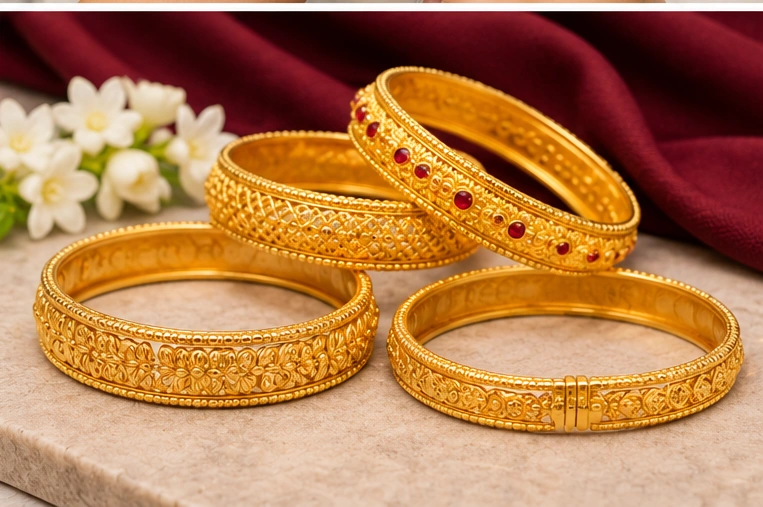
For customers asking, “how should a gold bangle fit when it has a hinge?”, the internal oval and secure fastening matter more than knuckle clearance. The phrase gold bangle fitting covers different methods; identify the mechanism before relying on a chart for another construction.
| Style | Measurement to prioritise | Fitting check |
| Closed round gold bangle | Inner diameter and widest hand measurement | Passes knuckles without force; stays on wrist |
| Hinged oval bangle | Wrist measurement plus internal length and width | Clasp shuts securely; no pressure at wrist bone |
| Traditional closed kada | Hand clearance, inner diameter, width | Wide edges do not pinch or catch |
| Open cuff or openable kada | Wrist shape, opening width and maker’s specification | Holds position without repeated bending |
| Stone-set hinged bangle | Internal dimensions and fastening security | Settings clear the skin; catch lies flat |
A wide kada may feel more restrictive than a slim bangle with a similar diameter, especially when the hand is angled during removal. An oval bangle may also sit closer to the wrist while still having enough clearance where it needs to pass.
For traditional and everyday designs, compare Anu Jewellers’ 22K gold bangles and men’s kadas. The collection description is only a starting point; the actual piece, weight and shape determine comfort.
Should a Gold Bangle Move on Your Wrist or Stay in Place?
A closed gold bangle should move naturally along the wrist and lower forearm, but not slide off when your hand points downward. Some rotation is normal; repeated slipping over the thumb or hard impacts during routine movement suggest excessive looseness.
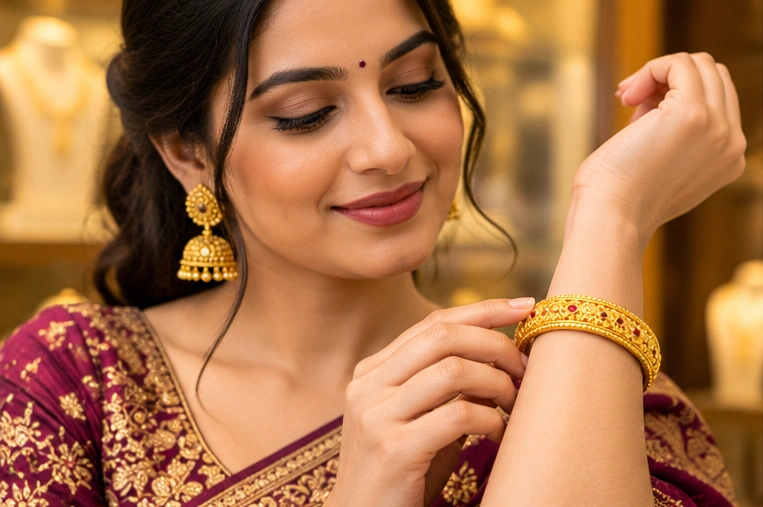
How much movement feels comfortable depends on where and how the bangle is worn. A person using a keyboard all day may prefer a slightly more controlled fit, whereas someone wearing slim traditional bangles as a stack may expect gentle movement and sound.
Practical Movement Check by Wearing Situation
| Wearing situation | Movement to expect | Recheck the fit if… |
| Single smooth bangle for daily wear | Gentle sliding and rotation | It repeatedly reaches the fingers or hits hard surfaces |
| Two or three slim bangles | A little shared movement | Pieces trap skin or strike each other sharply |
| Broad ceremonial kada | More controlled movement | Edges press at the wrist during sitting or bending |
| Hinged stone-set bangle | Limited sliding with secure closure | The clasp pulls, opens or rotates under the wrist |
| Bridal stack worn for several hours | Some movement across the stack | Weight creates soreness or catches sleeves and embroidery |
These are observation-based checks, not fixed millimetre allowances. A useful test is to wear the proposed stack while bending the wrist, holding a phone and moving a sleeve over the jewellery.
Do not judge one bangle’s fit while wearing several others unless that is how you will use it. Neighbouring pieces can temporarily stop an oversized bangle sliding and hide a sizing problem.
What Can You Do If a Gold Bangle Is Too Tight or Too Loose?
If a gold bangle is too tight, stop forcing it over the hand and ask whether a larger size or openable design is available. If it is too loose, confirm the dimensions before exploring professional adjustment or replacement.
A bangle too loose to stay securely on your wrist is more than a styling inconvenience. It can slide towards your fingers, strike surfaces or become difficult to wear during work. A bangle that is too tight may catch at the knuckles or press against the wrist bone.
Start With the Safer Options
- A new closed bangle is too small: exchange for the correct inner diameter if the retailer’s policy and product conditions permit it.
- A new bangle is too large: compare a smaller size in person rather than squeezing or bending the ring at home.
- A hinged bangle feels loose: check whether the internal oval and fastening are intended to fit closer, and whether professional adjustment is possible.
- An inherited or handmade piece no longer fits: have the construction inspected before deciding whether resizing is technically safe.
- A bangle is painfully stuck: do not keep pulling or use damaging home tools. Seek appropriate help promptly, especially if swelling, numbness or colour changes occur.
Gold purity alone does not tell you whether resizing is possible. According to the Jewellers Association of Australia, gold fineness varies by caratage; the construction, thickness, soldered joins, stones and finish must also be considered before altering a specific piece.
A hollow design, intricate engraving, enamel, gemstone settings or a complex hinge may limit repairs or create a risk of visible changes. Anu Jewellers provides jewellery repairs Melbourne customers can enquire about, including bangle assessments and adjustments where suitable.
What Does Gold Bangle Resizing Cost in Melbourne?
There is no responsible fixed price for every bangle adjustment. The quote depends on the metal, gold weight, whether material must be added or removed, the design, stones, finish and repair method. Ask for a written assessment and Australian-dollar estimate before work starts.
According to the ACCC’s consumer guarantee guidance, purchases in Australia come with statutory consumer guarantees. These are different from a retailer’s voluntary change-of-mind exchange or alteration policy, which you should check separately when buying the wrong size.
How Do You Fit Bridal Gold Bangles or Choose the Right Size as a Gift?
For bridal bangles or a surprise gift, use a correctly fitting existing piece as your reference and confirm the intended wearing arrangement. Wide stacks, heirloom pieces and unknown hand sizes can complicate fitting, so avoid guessing from clothing size.
An illustrative Melbourne bridal fitting may involve a bride wearing several slim 22K bangles beside one broad kada. Each slim bangle passes the hand easily when tried alone, but the combined stack becomes uncomfortable against the blouse sleeve. Testing the entire arrangement before the wedding reveals the problem.
A Bridal and Gift-Sizing Checklist
- Bring a comfortable existing bangle or its inner-diameter measurement: this provides a real reference rather than guessing from photographs or dress size.
- Try the full bridal stack together for at least 20–30 minutes: the combined weight and interaction between pieces can feel different from a one-minute fitting.
- Test with a sleeve, phone and seated posture: check embroidery, cuff clearance and pressure against the wrist during a realistic sequence of movements.
- Ask about the exact design’s alteration limits before gifting: hollow sections, gemstones and hinged mechanisms can make later resizing difficult or costly.
- Record the selected internal dimensions in millimetres: this helps an interstate family member or online buyer avoid relying on ambiguous size names.
For coordinated wedding jewellery, Anu Jewellers also offers Indian bridal jewellery in Melbourne. If a family wants a custom-size heirloom piece, the custom jewellery Melbourne service may be a useful discussion point.
A surprise gift is sometimes better presented as a design selection followed by a sizing appointment. That preserves the meaning of the gift without risking a valuable, unwearable item.
When Should You Ask a Melbourne Jeweller for Fitting Help?
Ask for professional fitting when a gold bangle is valuable, custom-made, damaged, oval, hinged, heavily decorated or intended for daily wear. A jeweller can compare the hand and wrist measurements with the actual piece and explain alteration limits.
Bring the jewellery you already wear, any product size details and a description of the discomfort. If buying for another person, bring a clearly measured existing bangle rather than relying on a photograph of their hand alone.
At Anu Jewellers’ Craigieburn showroom, customers from Epping, Greenvale, Roxburgh Park and Melbourne’s northern suburbs can discuss gold bangles, kadas and suitable repair or custom-sizing options. The business is located at Shop 6, 3 Highlander Drive, Craigieburn VIC 3064.
If you are buying a new piece, compare it in person with a familiar bangle. For a repair, ask whether the intended work changes the structure, visible design, final weight or future serviceability.
What Should You Check Before Buying a Gold Bangle?
Before purchasing, confirm the internal dimensions, how the bangle passes over the hand, how it moves on the wrist and whether its construction suits your routine. A comfortable fit is more useful than any size label alone.
Keep the written size, purity, weight and alteration policy with the invoice. The gold bangle size guide above can help you narrow the options, but the final decision should be based on the exact piece and your hand shape.
If you are still asking how should a gold bangle fit, arrange a comparison between a known comfortable size and your preferred design. Contact Anu Jewellers to discuss gold bangle sizing, custom options or a fitting assessment at the Craigieburn showroom.