

Written by Anu Jewellers Team
Reviewed by Anu & Henry, Anu Jewellers
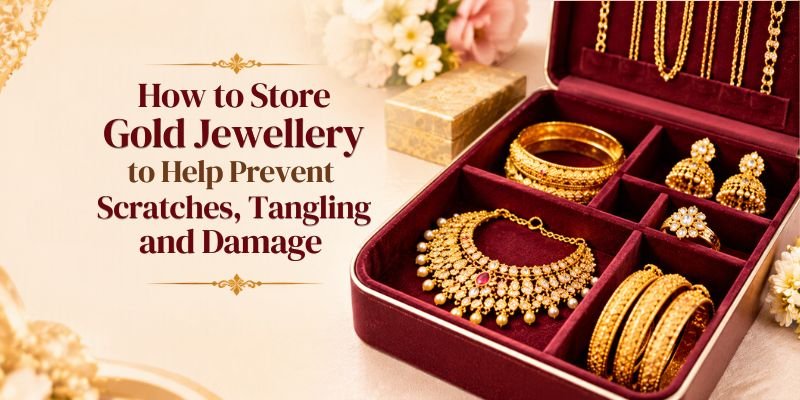
How to store gold jewellery safely starts with separation: fasten chains, protect each piece in a soft-lined compartment and keep the box clean and dry. Avoid direct sunlight, bathroom humidity and contact between diamonds, clasps and delicate gold surfaces.
A gold chain does not have to be worn every day to become damaged. It can be pulled into a knot while sitting in a drawer. A bangle can pick up scratches from a ring beside it. A bridal necklace can lose its shape when a heavy pendant hangs from unsupported links for months.
Good storage is less about buying the most expensive case and more about preventing jewellery from touching, pulling, getting damp or being forgotten. This guide is designed for everyday gold, diamond pieces and Indian or South Asian heirlooms kept in Melbourne homes, including collections worn only for weddings and festivals.
How to Store Gold Jewellery Safely at Home
The safest everyday approach is to give each gold piece its own clean, padded space, close chain clasps and support heavier designs. A well-organised box prevents pieces from sliding into one another and makes damage easier to spot before wearing them.
The Five-S Storage Check
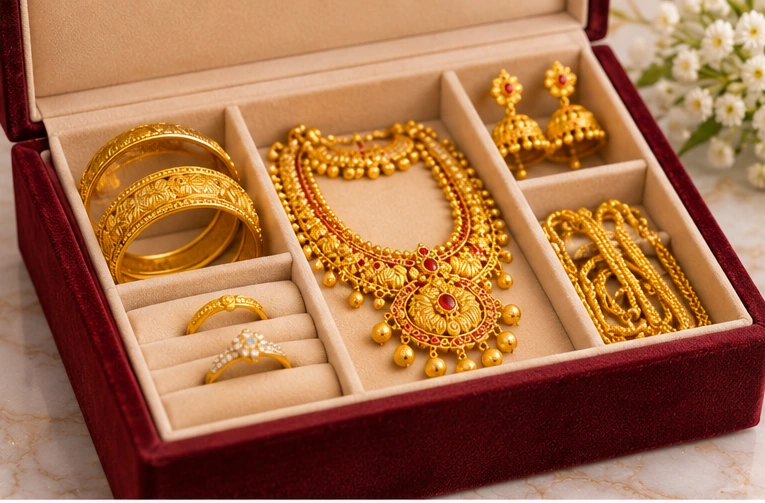
Use this original five-point framework whenever you reorganise a jewellery collection: separate, support, surface, surroundings and security. It turns a vague instruction such as “put it somewhere safe” into checks you can repeat.
| Check | What to do | Problem it helps avoid |
| Separate | Give each necklace, ring or bangle its own slot or soft pouch | Scratches, knots and stones rubbing against gold |
| Support | Lay heavy pendants flat; cushion wide bangles and structured sets | Stretched links, bent shapes and pressure on clasps |
| Surface | Use clean, smooth, non-abrasive lining | Abrasion from timber, metal trays or rough box interiors |
| Surroundings | Choose a stable indoor location away from damp, heat and sunlight | Unnecessary exposure affecting finishes and sensitive stones |
| Security | Put sentimental and valuable items in a controlled, discreet location | Loss, accidental disposal and unauthorised access |
According to the Jewellers Association of Australia, pieces should be kept apart in a soft-lined case, with necklaces fastened and storage kept away from excessive heat, damp and direct light. The association also recommends periodic professional inspection.
Imagine a family setting aside a heavy wedding necklace after a celebration. Leaving it with loose bangles in its presentation tray invites rubbing and pressure. Supporting the pendant flat and separating its matching earrings protects the set without requiring an elaborate organiser.
These gold jewellery storage tips work just as well for a single chain as for a multi-generational collection. The best way to store gold jewellery is the method that keeps every piece supported and easy to find.
Can Gold Jewellery Be Stored Together?
Yes — different pieces can share one jewellery box, but they should not share an unprotected compartment. Keep each item from touching the others, especially where diamonds, sharp clasps, stone settings, heavy bangles or delicate links could cause scratches or distortion.
A box containing several gold items is not the problem; uncontrolled contact is. To prevent gold jewellery scratches, give a plain chain its own channel, place rings in separate padded slots and avoid dropping a heavy kada across lightweight earrings.
Why Gold Purity and Gemstones Matter
According to the World Gold Council, 22-carat jewellery contains approximately 91.7% gold and 18-carat jewellery contains 75%. The alloy affects the jewellery’s working properties, but neither purity nor price makes a piece scratch-proof. Shape, weight and attached stones matter too.
A diamond-set ring can mark a plain gold bangle if both move around in the same compartment. Even two smooth pieces can rub and leave visible wear. Separating them avoids relying on assumptions about which metal is harder.
What About Plated Pieces and Delicate Gemstones?
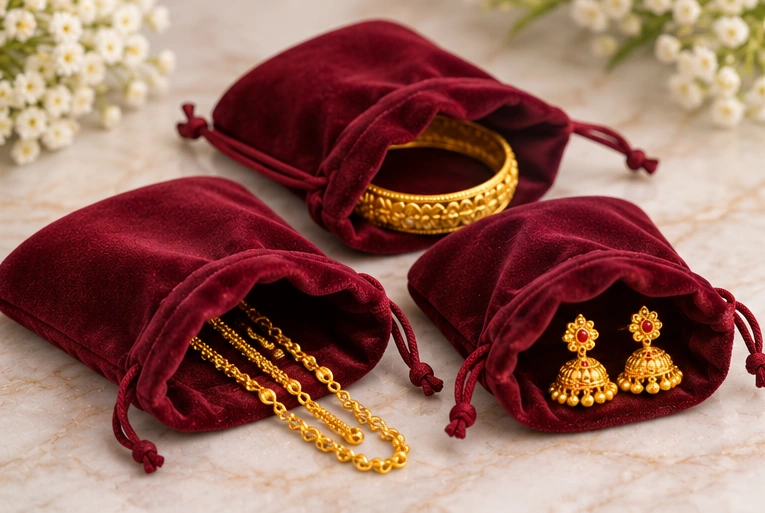
Gold-plated items need their own padded space because repeated friction can wear their thin surface finish. Pearls should not touch diamond jewellery, metal edges or pointed earring posts. Antique-finish pieces, enamel and intricate temple motifs can also be damaged by rubbing.
You can keep related items together for convenience, such as a necklace and matching earrings, provided each component has its own protection. Treat a matching set as a group of individual pieces rather than a single item to drop into one pouch.
What Is the Best Jewellery Storage Box for Gold?
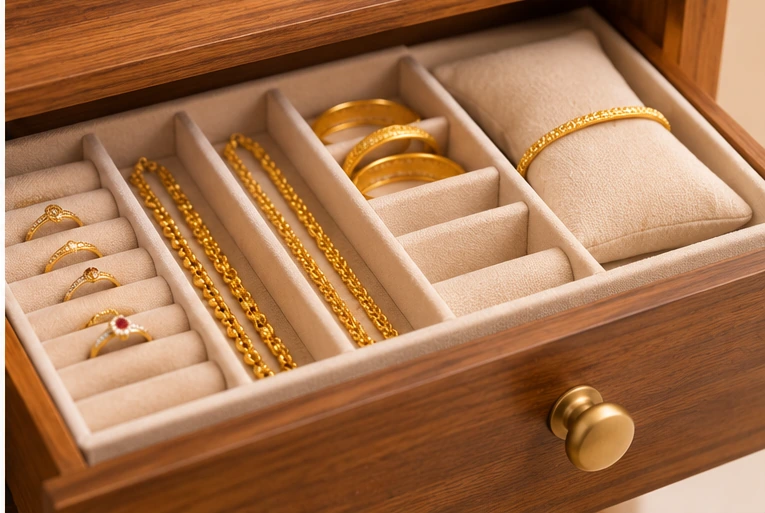
The best jewellery storage box has soft lining, enough separate compartments, secure closures and space for different shapes. Choose dedicated ring slots, chain sections and wider areas for bangles or bridal sets instead of relying on one large, undivided tray.
Compare Storage Options by Use
| Storage Option | Best for | Main limitation |
| Soft-lined box with dividers | Mixed everyday jewellery | Large pendants may need additional support |
| Individual fabric pouches | Single bangles, earrings and occasional pieces | Chains may still knot if left loose inside |
| Ring rolls or padded slots | Gold and diamond rings | Oversized rings may not fit comfortably |
| Separate hooks in an enclosed organiser | Light chains worn frequently | Heavy necklaces can strain under long-term hanging |
| Flat padded tray with individual spaces | Bridal haar, large pendants and structured necklaces | Needs protected, secure storage space |
| Compartmented travel case | A few pieces carried between locations | Not a substitute for secure long-term storage |
A lined box does not need to be costly, and the most decorative design is not always the most protective. Inspect the lining for rough seams or exposed hardware. Check that the lid closes without pressing on raised settings and that dividers are tall enough to keep contents apart.
Choose a Box for the Collection You Actually Own
A small set of daily earrings and rings needs shallow, accessible slots. Several long chains require individual hanging positions or flat channels. Traditional bangles need enough width that they are not compressed against one another, while a full bridal set may require a separate case altogether.
For households buying additional gold jewellery Melbourne pieces, consider where those purchases will go before adding another item to an already crowded box. An organiser should expand usable space without sacrificing separation.
How Do You Store Gold Necklaces and Chains Without Tangling?
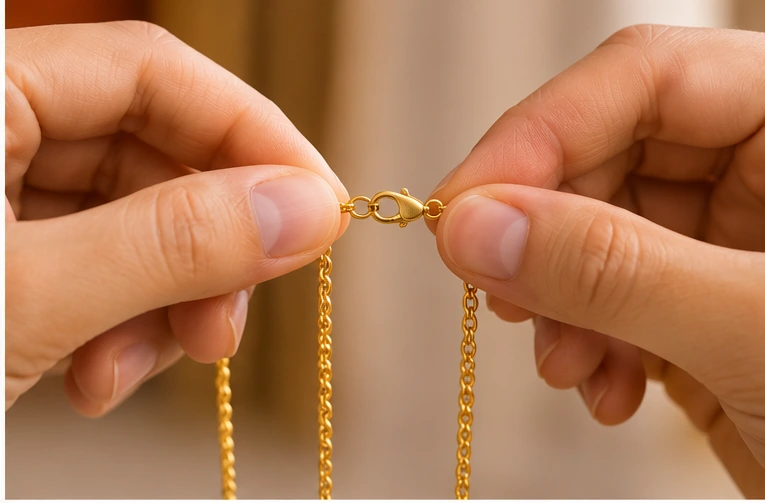
For storing gold necklaces, close each clasp and give every chain its own hook or flat, padded channel. Hang light chains only when they are fully supported, while heavy necklaces and large pendants should rest flat to avoid long-term strain.
Choose Hanging or Flat Storage
A lightweight chain can hang individually inside an enclosed organiser when it does not touch neighbouring hooks or chains. This keeps its length visible and reduces the chance of intertwined links. However, not every chain belongs on a hook.
A thick gold chain, a delicate woven design or a necklace with a substantial pendant may be better laid flat. The goal is to support its weight, protect the clasp and avoid a sharp bend where the chain enters the pendant.
A Simple Chain-Storage Method
- Close the clasp first: an open chain can slip through neighbouring links and form a knot.
- Straighten it gently on a padded surface: do not pull a kink tight or drag a chain across a rough tabletop.
- Choose one channel or hook per chain: two chains in one pouch can still twist together even if the pouch is soft.
- Support any heavy pendant separately: the pendant should not pull continuously on a fine chain or clasp.
- Check the chain before closing the organiser: make sure the end rings and fastening are not trapped by the lid.
A practical example is a household keeping a fine everyday chain beside a heavy occasion necklace. The fine chain can hang in its own enclosed slot, while the heavier piece lies flat in a lined tray. Using different methods is more effective than forcing both into the same format.
When comparing different gold chains Melbourne styles, ask whether a particular weave, pendant or clasp needs additional support during storage. Delicate and hollow construction can change the advice.
How Should You Store Bangles, Rings, Earrings and Bridal Sets?
Different jewellery shapes need different protection. Cushion bangles separately, hold rings in individual padded slots, keep earrings paired with their backs secured, and lay heavy bridal necklaces flat. Stone settings, hinges and decorative surfaces should never carry the weight of other pieces.
Gold Bangles and Kadas
Avoid stacking unwrapped bangles in one pile. Plain gold can still acquire surface marks, and raised motifs or stones can catch the next bangle. Use separate sleeves or padded spaces; a wide hollow design should not have another heavy piece resting on it.
For a family collection of gold bangles, store pairs near each other for easy selection but without direct contact. Leave hinged bangles closed when the manufacturer’s instructions permit, and never force a clasp to fit inside a narrow compartment.
Rings and Diamond Jewellery
Give every ring a padded slot so the stone or setting does not strike another ring. A diamond is very hard, but that does not protect its setting from impact. Raised prongs should not catch the box lining when you remove the ring.
Keep diamond jewellery apart from plain gold and softer gemstones. A ring roll should hold the piece firmly without bending thin bands or pressing on a decorative top.
Earrings and Small Components
Keep earring pairs together, but prevent sharp posts from touching the decorative face of the other earring. Fasten backs securely where appropriate and use small separated pockets for detachable parts. Check whether jhumkas, drops or heavy earrings need to lie flat rather than hang from their hooks.
Indian Bridal and Heirloom Sets
A silk saree or lehenga may be packed away for months after a wedding, but the matching jewellery should not be wrapped loosely inside its fabric. A substantial rani haar needs support beneath its pendant; a choker should follow its intended curve; and delicate temple details or stone strings should not be crushed under bangles.
For Indian bridal jewellery in Melbourne, keep each component labelled and individually protected within the larger set. This is especially helpful when families bring out the same jewellery for weddings, Diwali, milestone celebrations or another relative’s ceremony.
Where Should You Keep Gold Jewellery in a Melbourne Home?
Choose a discreet, secure indoor cupboard or drawer with reasonably stable conditions. Avoid bathrooms, sunny windowsills, hot cars, damp storage areas and spaces near sprays or cleaning chemicals. Everyday pieces can remain accessible, while expensive heirlooms need stronger security.
Avoid Heat, Moisture and Household Products
Melbourne homes can experience hot summer afternoons and damp winter periods. A window-facing dressing table, an uninsulated garage or a bathroom cabinet may expose jewellery to more changing conditions than a bedroom cupboard.
Keep perfume, hairspray, sunscreen, chlorine-containing products and household cleaners away from the storage area. Gold alloys and many gemstones can be affected by chemicals, even if the metal itself appears unchanged at first.
According to the Gemological Institute of America, excess heat, sudden temperature changes and chemicals can damage jewellery, while pearls and opals need particular care with overly dry environments. Do not automatically place moisture-absorbing packets next to every gemstone or organic material.
Separate Convenience from Security
It can help to have a small lined case for daily jewellery and a more secure, discreet location for valuable pieces worn only occasionally. For high-value collections, consider appropriate home security, insurer conditions and whether the chosen storage location is suitable for the piece’s materials.
No box can guarantee protection against burglary, fire or flooding. Keep a documented inventory and speak to your insurer about valuables cover rather than assuming ordinary household contents insurance covers every jewellery item in full.
What Should You Do Before Putting Gold Jewellery Away?
Before storage, remove surface residue with an appropriate soft cloth, make sure the piece is dry and look for loose stones, damaged links or weak fastenings. Do not place a wet, tangled or broken item into the box and forget it.
A Five-Step After-Wear Routine
- Place the jewellery on a clean, soft cloth immediately after removal: a controlled surface helps prevent rings rolling away, earring backs disappearing and chains catching on clothing.
- Wipe suitable metal surfaces gently with a clean, lint-free cloth: this removes ordinary fingerprints and surface residue without rubbing abrasive dust into the finish.
- Allow the piece to dry fully before closing its compartment: trapped moisture is undesirable, particularly around joins, strings and materials needing specialist care.
- Inspect the clasp, links, hinges and stone settings in good light: a weakness found before storage is easier to address than a missing stone after the next occasion.
- Fasten, separate and support the jewellery in its assigned space: using the same location each time reduces tangling, contact damage and accidental loss.
Cleaning Is Different from Storage
Jewellery care at home should be material-specific. A gentle wipe is not the same as deep cleaning, and old jewellery with pearls, enamel, foil, porous stones or loose settings should not be soaked simply because an online tip says gold tolerates water.
For straightforward gold pieces that need cleaning rather than just storage, follow Anu Jewellers’ guide to how to clean gold jewellery at home. Stop if a stone moves or a clasp feels insecure.
How Do You Pack Gold Jewellery for Travel or Long-Term Storage?
For travel, use a firm case with individual padded compartments and carry valuable pieces securely rather than loose among clothing. For long-term storage, support heavy designs flat, protect every component separately and check the collection periodically for damage or changing conditions.
Travelling Between Melbourne, Interstate Events and Family Weddings
According to Tiffany & Co.’s jewellery storage guidance, separate compartments help prevent tangles during travel and valuable pieces are better carried with you rather than placed in checked luggage.
A wedding set going from Craigieburn to a venue or airport should be packed according to shape: earrings in secured compartments, light chains in individual channels and a large pendant flat with padding. Avoid letting the box move freely inside a bag or sit where heavy luggage can crush it.
Long-Term Storage and a Simple Checking Schedule
Use a clean, assigned space and keep a record of what is stored. When deciding how to store gold jewellery for several months, build in occasional checks, particularly for clasps, silk strings, plated surfaces and unusual gemstones.
| When | Suggested storage check | Why it helps |
| After each wear | Wipe appropriately, dry, inspect and return to a separate space | Limits residue and prevents overlooked damage |
| Monthly for everyday pieces | Look at chain closures, ring settings and frequently used compartments | Finds early wear or a crowded organiser |
| Every few months for stored occasion pieces | Check packaging, condition and completeness | Reduces the chance of discovering problems on the event day |
| Before a wedding or major celebration | Lay out the full set and test clasps and fit | Allows time for repair rather than last-minute improvisation |
| About annually, or sooner if damage is noticed | Discuss a professional inspection for valuable or frequently worn pieces | Helps assess settings, links, hinges and repair needs |
These are practical suggested intervals, not guarantees or universal maintenance requirements. A fragile heirloom or frequently worn stone-set ring may need more attention than a plain pendant kept in good condition.
When Should You Ask a Jeweller About Scratches or Storage Damage?
Ask a jeweller when jewellery has deep scratches, a kinked chain, loose stones, bent metal, failed clasps or damaged plating. Home storage can prevent additional friction, but it cannot repair structural weakness or determine whether polishing and restoration are safe.
Look for warning signs before returning a piece to its box:
- A gold chain catches on fabric, has a kink or shows an opening at a link.
- A bangle is no longer round, a hinge moves excessively or a clasp fails to lock.
- A ring stone clicks, shifts or catches on soft material.
- An earring post is bent or its back no longer grips securely.
- A plated or antique-finish surface is peeling, cracking or becoming uneven.
- A necklace string looks stretched or frayed, or its pendant pulls awkwardly on the chain.
Is Professional Repair or Polishing Worth the Cost?
It depends on construction and sentimental value. A light surface mark may be cosmetic, while a cracked solder joint or loose setting may put the whole piece at risk. Polishing removes a small amount of metal, so repeated polishing is not automatically the best approach for delicate gold or detailed heirlooms.
Ask for an item-specific Australian-dollar quote before approving cleaning, link repair, stone resetting or restoration. A generic price list cannot accurately cover a hollow bangle, a fine chain and an intricate bridal necklace.
Anu Jewellers provides jewellery repairs Melbourne customers can enquire about from its Craigieburn showroom, including chain and bangle repair, stone resetting, polishing and restoration. An assessment can establish what work is suitable for the actual piece.
What Is the Simplest Gold Jewellery Storage Routine to Maintain?
Keep one designated padded space for each piece, return it clean and dry, and check its condition before storing. A workable system should suit everyday jewellery and protect heavier occasion pieces without forcing you to reorganise the box every week.
The best answer to how to store gold jewellery is consistent separation and appropriate support, not a complicated collection of organisers. Start with the pieces you wear most, then give bridal sets, heirlooms and valuable designs dedicated protection.
For help assessing a worn clasp, damaged chain or delicate family piece, contact Anu Jewellers in Craigieburn before attempting repairs at home.