By Anu Jewellers Team, Melbourne gold, diamond and Indian jewellery specialists
Published: 21 August 2026
Choosing a gold necklace Australia buyers will genuinely wear comes down to five checks: length, purity, construction, occasion and fit. For everyday wear, prioritise comfort and secure links; for gifting, verify length; for weddings, balance cultural style, weight and neckline.
A necklace can look perfect in a display case and feel completely different once it is worn. A 45 cm chain may sit at the collarbone on one person and higher on another, while the same pendant can change the finished drop, balance and movement.
When people search for a gold necklace Australia, they are often comparing more than design. They also need to know what the gold marking means, whether the necklace is solid or plated, how the length works with clothing, and whether the piece suits daily wear, gifting or a wedding.
What Should Gold Necklace Australia Buyers Check First?
Gold necklace Australia buyers should compare five factors before style: intended use, finished length, purity, construction and fit. Those checks reveal whether a necklace is suitable for everyday clothing, gifting, cultural wear or a long wedding event before price influences the decision.
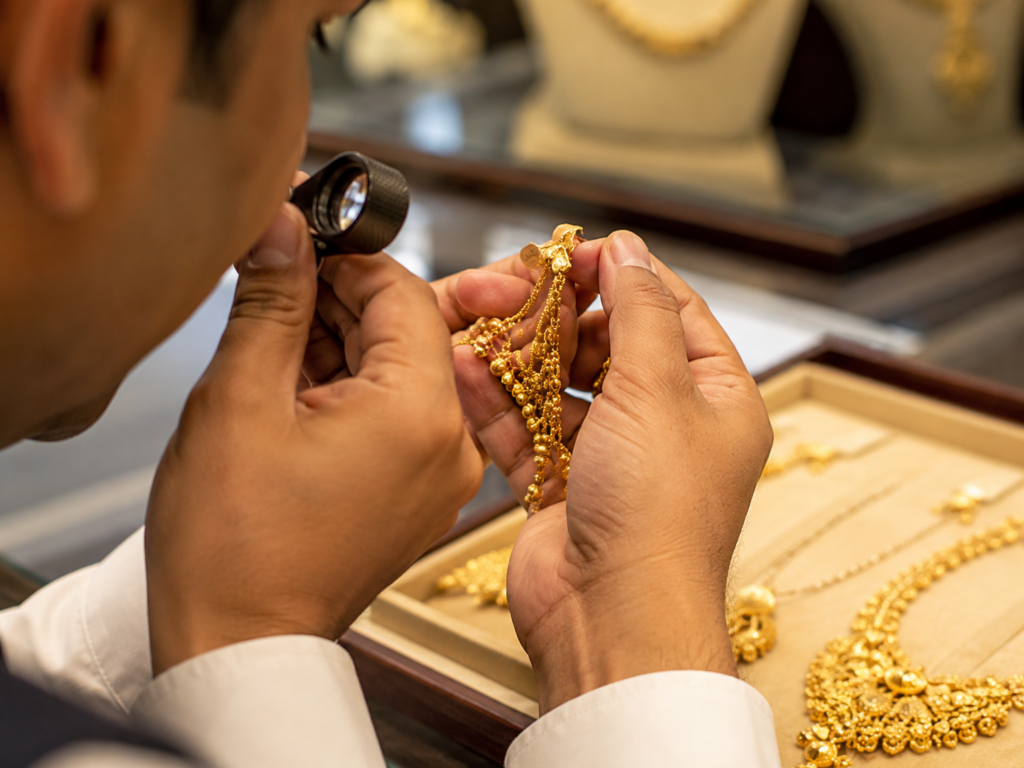
The Length-Purity-Construction-Occasion-Fit Framework
| Check | What to Confirm | Why It Matters |
| Length | Where the complete necklace should finish, including any pendant | The same centimetre length sits differently on different bodies and necklines |
| Purity | Carat/fineness marking and stated gold content | Purity affects colour, gold content and material properties |
| Construction | Solid gold, hollow, vermeil, plated, chain, articulated or rigid elements | Construction changes weight, care, repairability and price |
| Occasion | Daily, office, gift, wedding, festival or occasional statement wear | Wear frequency changes the level of comfort and practicality required |
| Fit | Neck circumference, neckline, pendant drop and movement | A necklace should remain comfortable while sitting where you intend |
Start with purpose. A necklace for daily commuting needs smooth movement, a secure clasp and a position that works with regular tops. A bridal necklace can be heavier and more elaborate, but it still needs to remain comfortable through photography, ceremonies, meals and several hours of movement.
A useful in-store test is to wear the necklace for five to ten minutes rather than judging it only on a tray. Turn your head, sit down, raise your arms and put on a similar neckline. Watch whether the centrepiece rotates, the clasp travels forward or the necklace catches on fabric.
How Do You Choose the Right Gold Necklace Length?
Choose necklace length by deciding where the finished piece should sit, then measure that position in centimetres. Neck circumference, body proportions, pendant height and clothing can shift the result, so a standard length chart should guide your fitting rather than replace it.
Because Anu Jewellers already has a detailed gold necklace length guide, this section focuses on the buying decision rather than repeating the full sizing topic.
Common Necklace Lengths as a Starting Point
| Approximate Length | Approximate Inches | Where It Often Sits | Typical Use |
| 35–40 cm | 14–16 in | Close to the neck | Chokers, short statement styles |
| 45 cm | 18 in | Around the collarbone | Versatile everyday pieces and many pendants |
| 50 cm | 20 in | Just below the collarbone | Pendants, open necklines and layering |
| 55–60 cm | 22–24 in | Upper chest | Larger pendants, high necklines and statement wear |
| 70–90 cm | 28–36 in | Mid-chest or lower | Long necklaces, haar styles and layering |
These positions are approximate. A broader neck can make a 45 cm necklace sit higher, while a smaller neck may make the same piece fall lower. A substantial chain can also appear shorter because its width changes the curve around the neck.
If you are comparing gold necklace length for women, measure a necklace already worn comfortably whenever possible. That reference tells you more than height or clothing size because it captures the wearer’s neck circumference and preferred position.
How to Measure Before Buying
- Wear the intended neckline: use the blouse, dress, shirt, saree blouse or a similar neckline because fabric height changes which necklace positions remain visible.
- Position a soft tape or non-stretch cord: place it where you want the chain to sit because a rigid ruler cannot follow the neck’s natural curve.
- Add the pendant drop: mark the bottom of the pendant as well as the chain position because the visual endpoint may sit several centimetres lower.
- Move for at least one minute: turn your head, sit and stand because a comfortable static position can still rub or catch during movement.
- Record the measurement in centimetres: compare that measurement with the seller’s listed length and extender range because product labels such as “short” or “medium” are not standardised.
Which Gold Purity Is Best for a Necklace in Australia?
The best gold purity for necklace wear depends on design, gold content and how often the piece will be used. Higher-carat gold contains more gold and has a richer natural colour, while alloying can increase hardness and change colour or working properties.
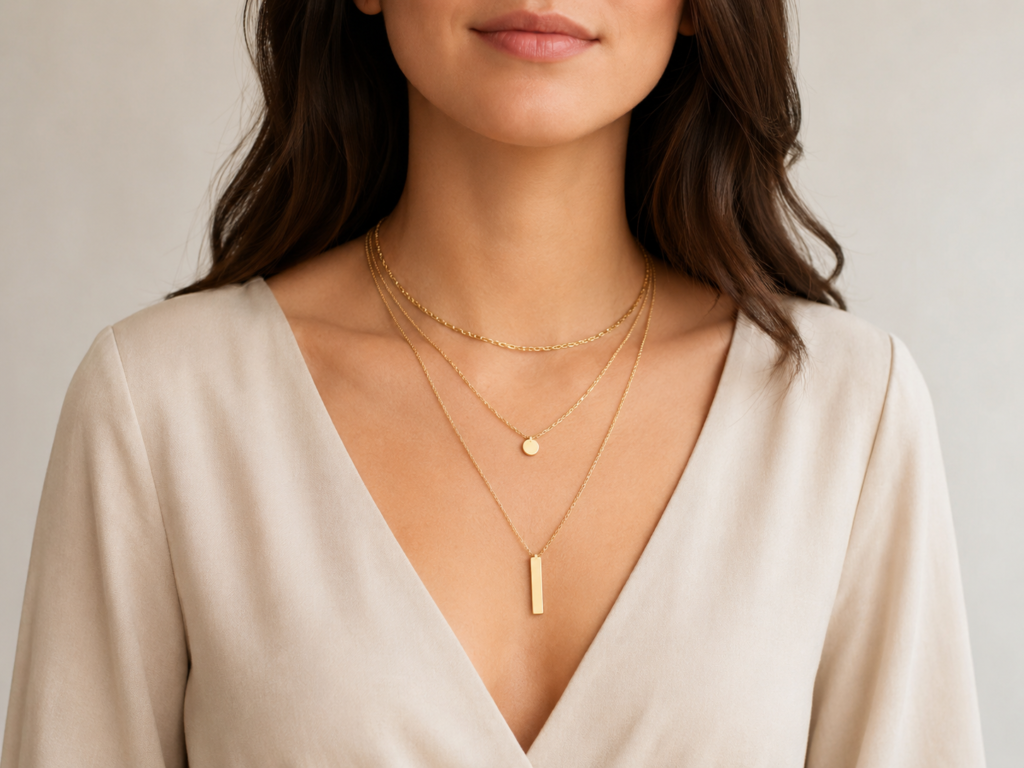
According to the World Gold Council, 24 carat is pure gold and 18 carat contains 75 per cent gold. Fineness expresses precious-metal content in parts per thousand, which is why jewellery may carry markings such as 750.
According to the Gemological Institute of America, pure gold is too soft for many jewellery applications and is commonly alloyed with metals such as copper, silver and zinc to increase hardness and alter colour.
| Marking | Approximate Gold Content | Practical Buying Consideration |
| 999 / 24K | 99.9% | Very high purity; softer, so the exact construction and intended use matter greatly |
| 916 / 22K | 91.6–91.7% | Rich yellow colour and high gold content; common in Indian and South Asian jewellery |
| 750 / 18K | 75% | High gold content with more alloy than 22K, allowing different colours and added hardness |
| 585 / 14K | 58.5% | More alloy content; common in international jewellery |
| 375 / 9K | 37.5% | Lower gold content; commonly encountered in parts of the Australian jewellery market |
A 22K gold necklace can be a practical choice when its thickness, links, clasp and overall construction suit the wear pattern. The purity number alone does not tell you whether a piece is delicate, hollow, stone-set, heavy or appropriate for daily use.
Before comparing two pieces, look at the complete specification. Anu Jewellers’ gold hallmark identification guide explains common fineness markings and why a stamp should be considered alongside the seller’s written description and testing information.
What Is the Difference Between Solid Gold, Vermeil and Gold-Plated Necklaces?
Solid gold, vermeil and gold-plated necklaces differ in what lies beneath the surface. Solid-gold jewellery uses a gold alloy throughout; vermeil places gold over sterling silver; plated jewellery applies a gold layer over another base material, so care and longevity differ.
The solid gold vs gold plated necklace decision matters because photographs can make both look similar. The product description should tell you whether you are buying gold throughout the metal structure or a gold-coloured surface layer over another material.
| Construction | What It Means | Main Advantage | Main Limitation |
| Solid gold alloy | Gold alloy is used throughout the metal component | Gold content remains through normal surface wear and the piece is often more repairable | Higher material cost; higher-purity designs can require more care |
| Hollow gold | Gold alloy forms a hollow structure | Larger visual volume at lower weight than a similar solid construction | Can dent or crush; some repairs are difficult to disguise |
| Gold vermeil | Gold layer over sterling silver | Precious-metal base with a gold appearance | Gold surface can wear and may eventually need refinishing |
| Gold plated | Gold layer over another base metal | Lower entry price and wide design choice | Plating can wear, especially at friction points |
| Gold-tone/PVD fashion jewellery | A coloured or deposited surface over another material | Often affordable and designed for fashion use | It is not solid gold; care depends on the exact coating and base metal |
“Solid gold” and “solid construction” are not the same question. A necklace can be made from a genuine gold alloy yet still use hollow links. Ask both what the metal is and how the necklace is physically constructed.
Also check pendants and clasps separately. A necklace can contain components of different construction, and gemstones, enamel or pearls can change the appropriate cleaning method even when the chain itself is gold.
Which Gold Necklace Is Best for Daily Wear?
A gold necklace for daily wear should have smooth edges, balanced weight, movement and a secure clasp. Choose a length that clears common necklines and construction that suits your routine, then inspect links and pendant contact points rather than judging thickness alone.

A fine chain can be comfortable but may not suit a heavy pendant. A thicker necklace can be durable yet annoying if it repeatedly catches on a collar. The goal is not maximum weight; it is a design whose weight, link pattern and fastening work together.
Daily-Wear Features to Check
| Feature | Better Starting Point for Frequent Wear | Risk to Avoid |
| Surface | Smooth links and finished edges | Sharp motifs that catch hair or fabric |
| Clasp | Positive, easy-to-check closure | Loose spring action or a clasp that opens under light pressure |
| Pendant | Proportionate to the chain | Heavy pendant pulling on a very fine chain |
| Length | Clear of the neckline you wear most | Chain ending exactly on a collar edge |
| Movement | Flexible without kinks | Stiff links or a centrepiece that constantly flips |
| Construction | Clearly disclosed and suitable for intended wear | Buying only by apparent size or visual weight |
For simple chains that can be worn alone or paired with pendants, compare Anu Jewellers’ gold chains and check the available length, weight, purity and construction before choosing.
In practice, one of the easiest tests is to wear the piece with your most common top. If you spend the day in collared shirts, scrubs, office wear or high-neck clothing, a necklace that looks perfect with a low showroom neckline may be irritating in normal life.
Remove fine necklaces for contact sport, heavy lifting, machinery and situations where the chain can snag. If a link develops a kink, a clasp stops closing positively or a pendant begins wearing a visible groove, stop wearing the piece until it is assessed.
How Should You Choose a Necklace for Gifting or a Wedding?
For gifting, choose a versatile length and use the recipient’s existing jewellery as your reference. For weddings, coordinate the necklace with the outfit, ceremony, other jewellery and hours of wear. Cultural meaning matters, but comfort and secure construction still deserve equal attention.
Choosing a Gold Necklace as a Gift
A necklace is often easier to gift than a fitted ring or closed bangle because small length differences may be managed with an extender or adjustment. Even so, do not guess from a photograph.
Measure a necklace the recipient already wears. Note its metal colour, pendant size, chain thickness and where it sits. If the gift will be engraved, customised or altered, confirm the exchange and alteration conditions first.
For broader occasion ideas, Anu Jewellers’ jewellery gifts page can help you compare necklaces with other gift categories.
Choosing a Gold Necklace for Women
When choosing a gold necklace for women, look at the pieces she reaches for without prompting. A buyer who wears a delicate chain five days a week may value versatility more than a heavy necklace that only suits formal occasions.
Anu Jewellers already has a dedicated style guide covering timeless women’s necklace designs, so use that resource for design inspiration and this guide for buying factors such as length, purity, construction and occasion.
Choosing a Gold Necklace for a Wedding
A gold necklace for wedding wear should be tested with the complete outfit. For Indian and South Asian brides, necklace decisions may involve chokers, rani haar, Punjabi haar, mangalsutra, Kundan-inspired designs or layered sets, depending on family tradition and ceremony.
Do not assume one “Indian bridal” rule fits every family. Punjabi, South Indian, Nepali, Pakistani and other South Asian traditions can differ in preferred forms, symbolism and styling. The bride’s own preference and family context should guide the final combination.
Brides and families can compare coordinated Indian bridal jewellery through Anu Jewellers’ Craigieburn showroom and test necklace placement with reference photos or the actual blouse where possible.
The 30-Minute Wedding Test
Wear the planned necklace or full stack for around 30 minutes before the event. Sit, stand, turn, bend and handle the dupatta or veil. Check whether edges catch embroidery, weight becomes uncomfortable or layered pendants collide.
That small trial can reveal problems that are invisible during a two-minute fitting.
How Do Necklines, Pendants and Layering Change the Best Length?
Necklines and pendants change where a necklace looks balanced. Aim for clear separation from the clothing edge, include pendant height in the finished drop, and space layered pieces by their final visual endpoints rather than chain measurements alone.
Use the table below as a styling starting point rather than a fixed rule.
| Outfit or Neckline | Useful Necklace Direction | Main Check |
| V-neck | Pendant following or sitting within the V | Pendant should not collide with the neckline edge |
| Crew neck | Short piece above the fabric or longer piece below | Avoid finishing directly on the collar line |
| Scoop neck | Collarbone or medium length | Let the necklace follow the open space |
| High neck | Longer necklace over the fabric | Check embroidery, buttons and pendant movement |
| Strapless | Choker or short necklace can frame the neck | Confirm comfort and centre alignment |
| Saree or lehenga with deep blouse | Short-to-medium piece or layered combination | Test against blouse embroidery and dupatta placement |
| Heavily embroidered high blouse | Choker with clear separation or a longer haar | Prevent the necklace from disappearing into dense detail |
A pendant changes more than the visual length. Its weight can pull a flexible chain into a deeper V, while its bail must be large enough for the chain and end fittings to pass through safely.
When layering, compare finished drops. A 40 cm chain with a long pendant can end at the same point as a 50 cm chain with a small pendant, creating tangles despite a ten-centimetre difference in chain length.
If necklace length is the main problem you are trying to solve, use the site’s dedicated length article rather than treating this broader buying guide as a substitute.
What Should You Check Before Buying Gold Jewellery in Australia?
Before buying, confirm the necklace’s written description, purity, weight, length, construction, clasp, stones, price components and aftercare. Australian buyers should also understand the retailer’s voluntary policies separately from automatic consumer guarantees, especially before engraving, resizing or commissioning custom jewellery.
According to the Australian Competition and Consumer Commission, consumer guarantees apply automatically to products sold to consumers. Products must be of acceptable quality, and these statutory rights are different from voluntary warranties offered by a business.
For a gold necklace Australia purchase, use this eight-point check before paying:
- Read the full product description: confirm whether the item is solid gold, hollow, vermeil or plated because “gold necklace” can describe materially different constructions.
- Confirm the purity marking: compare the stated carat or fineness with the invoice because markings such as 916 and 750 describe different gold content.
- Ask for the total weight: weight affects feel and material value, but interpret it together with construction, stones and pendant components.
- Measure the wearable length: confirm whether the listed measurement includes an extender, pendant or only the chain because finished drop can differ from the headline length.
- Operate the clasp yourself: open and close it several times because the fastening is one of the most frequently handled parts of a necklace.
- Inspect joins and settings: look for rough edges, uneven links, loose stones or visible damage because presentation lighting can hide small issues.
- Check the written sales terms: ask about change-of-mind, custom, alteration and exchange policies because these are separate from statutory consumer guarantees.
- Keep the documentation: retain the invoice, purity details, stone certificates and valuation information because they can help with insurance, repair and future assessment.
Buyers comparing wider gold jewellery Australia options can use the same checklist for bangles, chains and other high-value pieces rather than relying on appearance alone.
When Should You Ask a Jeweller About Adjustment, Repair or Price?
Ask a jeweller when length needs changing, a clasp feels weak, links are damaged, an heirloom is being redesigned or two necklaces seem difficult to compare by price. Professional assessment matters because construction, gold purity, stones and workmanship can limit safe alterations.
When Length Adjustment Needs Professional Advice
Simple chains can often be shortened, but decorative stations, fixed pendants and symmetrical necklace sets may become unbalanced if links are removed. Lengthening can require matching components, and some hollow or intricate constructions are harder to modify cleanly.
Before buying, ask whether the exact necklace can be adjusted later and what will happen to its weight, symmetry, hallmarking and invoice details.
How to Compare Price Without Guessing
Gold-necklace pricing can change with the gold market, purity, weight, workmanship, stones and construction. A fixed “good price” is therefore misleading without the specification.
Consider a clearly illustrative example: one necklace is A2,000andanotherisA3,500. The higher price does not automatically mean better value, and the lower price is not automatically a bargain. Compare purity, gold weight, construction, gemstones, workmanship and aftercare before interpreting the difference.
| Price Factor | What to Ask |
| Purity | What carat/fineness is stated? |
| Gold weight | What is the total weight, and does it include non-gold components? |
| Construction | Solid, hollow, vermeil, plated or mixed construction? |
| Workmanship | Are making or customisation charges included? |
| Stones | What type, quantity and documentation are supplied? |
| Alteration | Can the necklace be shortened, lengthened or repaired? |
| Aftercare | What cleaning, inspection and repair support is available? |
If an existing necklace has a broken link, damaged clasp or inherited components, Anu Jewellers can assess repair options through its Craigieburn jewellery service. Do not use household pliers or glue on fine links; an improvised repair can create new weak points.
Which Gold Necklace Should You Choose?
Choose the necklace that fits your real use first: where it sits, how often it will be worn, what it is made from and how it works with your clothing. Then compare design, gold content and price within those practical boundaries.
The strongest gold necklace Australia choice is not automatically the highest purity, longest chain or heaviest piece. It is the necklace whose length, construction, finish and occasion match the wearer, with specifications clear enough to understand before buying.
For personalised help, visit Anu Jewellers in Craigieburn to compare necklace lengths, high-purity gold options, bridal styles and gifting choices in person, or arrange a virtual consultation when shopping elsewhere in Australia.