

By Anu Jewellers Team, Melbourne gold, diamond and Indian jewellery specialists
Published: 31 August 2026
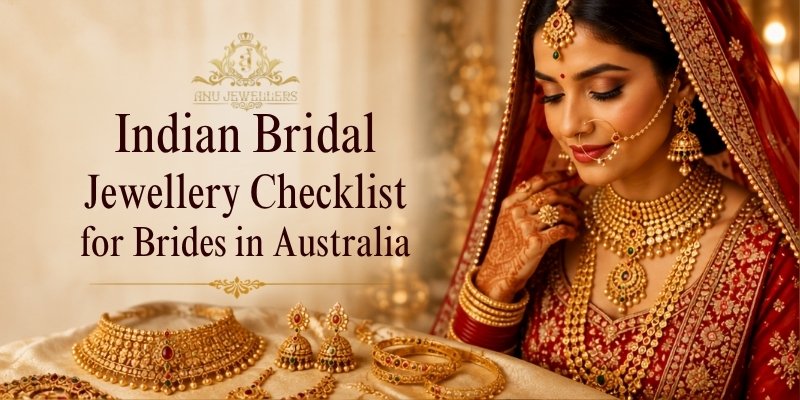
An Indian bridal jewellery checklist helps brides plan every important piece before the wedding, from necklaces, earrings and bangles to maang tikka, nath, rings and waist jewellery. The right checklist also considers each ceremony, outfit, cultural tradition, comfort, sizing and long-term wear.
Indian weddings rarely involve just one outfit or one jewellery look. There may be an engagement, mehendi, haldi, sangeet, wedding ceremony and reception, each with a different outfit, hairstyle and level of formality.
That is why buying everything as one large matching set can create problems. Some pieces may be too heavy for a smaller function, clash with another outfit or remain unworn after the wedding.
The better approach is to build your jewellery around the function, outfit, tradition and wearer.
What Should Be on an Indian Bridal Jewellery Checklist?
An Indian bridal jewellery checklist should cover the head, ears, neck, hands, waist and feet, while allowing pieces to change between ceremonies. The essentials are usually a necklace, earrings, bangles and one or more personal or culturally significant pieces.
There is no single jewellery list that applies to every Indian bride. Jewellery traditions differ across regions, communities and families.
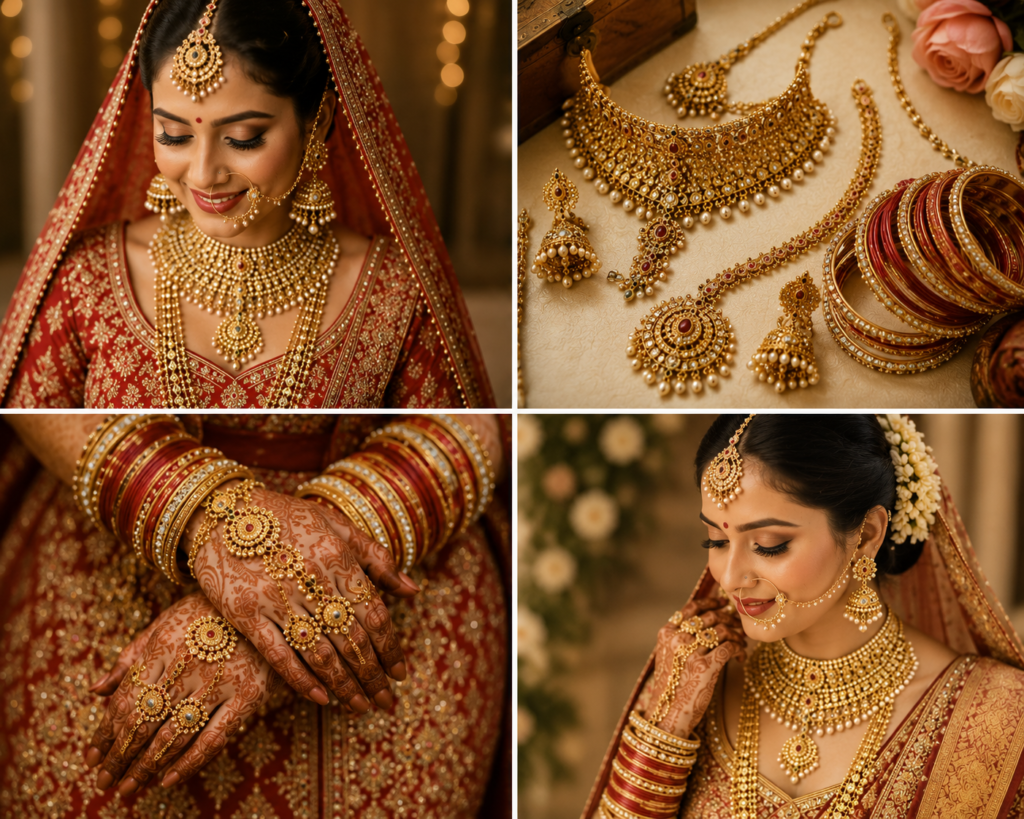
A Punjabi bride may prioritise a chooda, kaleere, nath and elaborate necklace combination. A South Indian bride may favour temple-inspired gold jewellery, long harams, vaddanam and traditional bangles. A bride from a Gujarati, Bengali, Marathi, Rajasthani, Tamil, Telugu, Kannada, Malayali, Nepali or other South Asian family may have a completely different set of customs.
Use this checklist as a planning framework rather than a compulsory shopping list.
Complete Head-to-Toe Checklist
| Body Area | Jewellery | Priority | Planning Note |
| Head | Maang tikka | Essential for many traditional looks | Match with hairstyle and necklace |
| Head | Matha patti | Optional | Works for more elaborate bridal styling |
| Side of head | Passa | Regional/optional | Particularly associated with North Indian and Mughal-inspired styling |
| Ears | Jhumkas, chandbalis or statement earrings | Essential | Balance with necklace size |
| Nose | Nath or nose ring | Cultural/optional | Check whether piercing or clip-on style is preferred |
| Neck | Choker | Common bridal choice | Works well with many traditional necklines |
| Neck | Long necklace, haar or rani haar | Common | Creates length and layering |
| Neck | Mangalsutra | Ceremony-dependent | Follow family and regional tradition |
| Hands | Gold bangles or kadas | Essential for many brides | Plan quantity and comfort |
| Hands | Chooda | Regional | Commonly associated with Punjabi bridal traditions |
| Hands | Kaleere | Regional/optional | Often paired with Punjabi bridal styling |
| Hands | Hathphool | Optional | Highlights mehendi and hands |
| Fingers | Bridal or statement rings | Common | Check fit before the wedding |
| Waist | Kamarbandh or vaddanam | Regional/optional | Particularly effective with sarees and lehengas |
| Feet | Payal or anklets | Optional | Consider footwear and ceremony length |
| Toes | Toe rings | Cultural/optional | Traditionally associated with married status in some communities |
| Hair | Juda pins, hair chains or ornaments | Optional | Coordinate with hairstyle |
| Outfit | Saree pin or brooch | Optional | Useful for heavily styled sarees |
Anu Jewellers’ current bridal collection includes choker sets, rani haar, mangalsutra, gold bangles, jumki earrings, ladies rings and diamond bridal pieces, giving Melbourne brides several categories to compare when building a complete look.
For a broader range of traditional styles, explore Anu Jewellers’ Indian bridal jewellery collection.
Which Jewellery Is Essential for the Main Wedding Day?
For the main wedding day, most brides need a coordinated necklace, earrings, hand jewellery and at least one signature bridal piece. Additional items such as a maang tikka, nath, kamarbandh or hathphool should be chosen according to the ceremony, regional tradition and personal comfort.
Think of wedding-day jewellery as a visual hierarchy.
You need a focal point, supporting pieces and finishing details.
The Main Bridal Foundation
A practical main-day combination can include:
- Bridal necklace or choker: establishes the centre of the look and should complement the neckline.
- Long necklace or rani haar: adds length and works particularly well with sarees and lehengas where the outfit allows layered jewellery.
- Earrings: frame the face and should balance the necklace rather than compete with it.
- Bangles or kada: complete the hands and can provide traditional texture and movement.
- Maang tikka: draws attention towards the face and hairstyle.
- Rings: connect the hand jewellery with the rest of the bridal styling.
Other pieces can be added after these core elements are settled.
Essential Does Not Mean “Wear Everything”
One of the easiest bridal styling mistakes is treating the checklist as a requirement to wear every piece simultaneously.
A bride wearing a heavily embroidered lehenga, layered necklace, large earrings, maang tikka, matha patti, nath, hathphool, bangles and kamarbandh may end up with a visually crowded look.
Instead, choose two or three major focal points.
For example:
Statement necklace + earrings + maang tikka
or
Choker + rani haar + earrings + bangles
Then use smaller pieces to complete the look.
What Necklace Should an Indian Bride Choose?
The right bridal necklace depends on the outfit neckline, embroidery, hairstyle and desired visual weight. Chokers suit close or structured necklines, while long harams and rani haar create length. Layered combinations work when each necklace has enough space to remain visible.
The necklace is often the centrepiece of Indian bridal jewellery, so choose it before finalising smaller accessories.
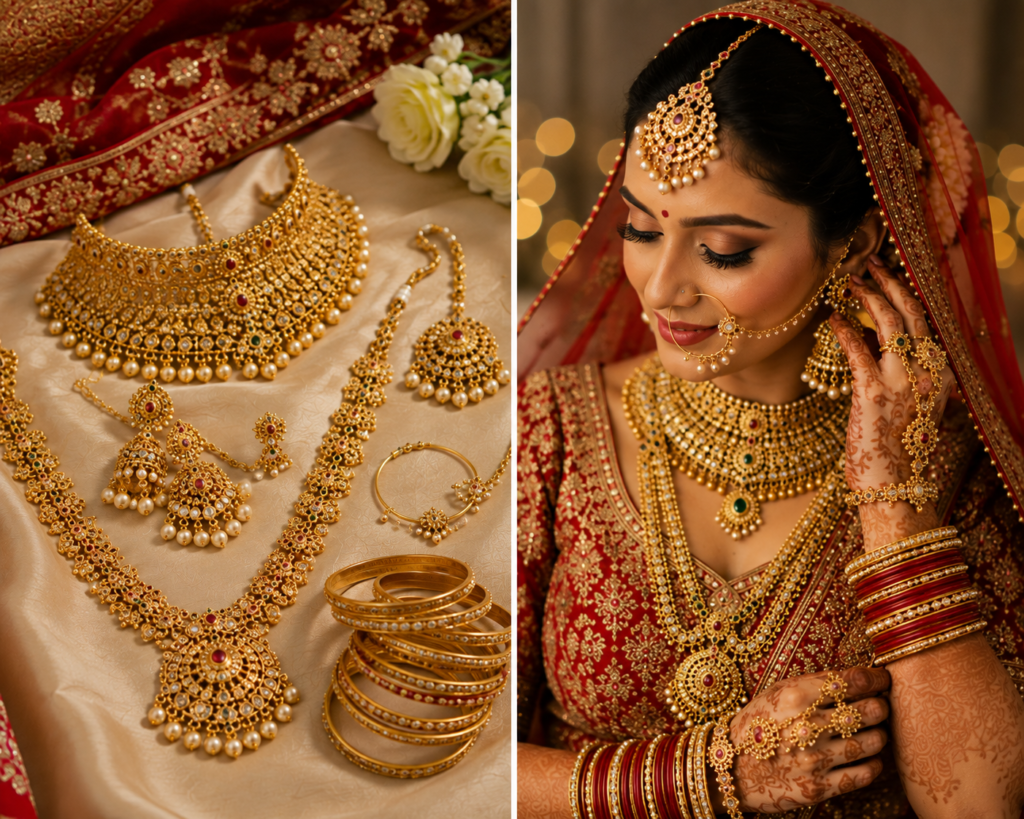
Choker Sets
A choker sits close to the neck and creates a strong bridal frame around the face.
It can work particularly well with:
- open necklines;
- sweetheart necklines;
- traditional saree blouses;
- lehengas;
- heavily embroidered bridal outfits.
A choker does not always need a second necklace. A statement choker with matching earrings can be enough for a sophisticated bridal look.
Rani Haar and Long Necklaces
A rani haar creates a longer vertical line and can make a layered bridal look feel more regal.
Kalyan Jewellers identifies rani haar as one of the traditional statement pieces used by Indian brides, while Anu Jewellers currently offers rani haar and layered bridal necklace options for Melbourne customers.
When wearing a rani haar, leave enough visual space between the shorter necklace and the longer piece. If both necklaces are equally elaborate and sit directly over each other, the details can disappear.
Match the Necklace to the Neckline
| Outfit Neckline | Jewellery Direction |
| Sweetheart | Choker plus shorter layered necklace |
| Deep V | Pendant or longer necklace |
| High neckline | Short necklace or statement earrings |
| Square neckline | Choker or structured necklace |
| Traditional saree blouse | Choker, haar or layered gold necklaces |
| Heavily embroidered neckline | Simpler necklace with stronger silhouette |
| Minimal blouse | More detailed necklace can become the focal point |
The neckline does not dictate the jewellery completely. Cultural tradition and personal preference should always have the final say.
Which Earrings, Maang Tikka and Face Jewellery Should You Wear?
Earrings and head jewellery should frame the face without creating excessive weight. Jhumkas, chandbalis, studs and drops each create a different effect, while maang tikka, matha patti and nath should be coordinated with the hairstyle, face framing and necklace.
Jhumkas
Jhumkas are a versatile choice for Indian bridal and traditional styling. Their bell-shaped silhouette can work with sarees, lehengas and many regional bridal outfits.
If the necklace is already large, choose earrings with enough detail to complement it without creating a second competing focal point.
Chandbalis
Chandbalis create a wider silhouette around the face and can work particularly well when the hairstyle exposes the ears.
They are often effective for reception or engagement looks where the bride wants statement earrings without wearing her heaviest wedding necklace.
Maang Tikka
The maang tikka sits along the central hair parting and draws attention towards the forehead.
Choose its scale according to:
- hairstyle;
- forehead proportions;
- necklace design;
- embroidery;
- overall bridal style.
A very delicate tikka can disappear beside a heavily embroidered lehenga, while an oversized design can dominate a minimalist outfit.
Matha Patti
A matha patti adds chains or decorative elements across the forehead and sides of the head.
It creates a more elaborate effect than a simple maang tikka, making it suitable when the bride wants a regal or traditional look.
Do not automatically wear both. If the matha patti is heavily detailed, a simpler tikka or coordinated central element may create better balance.
Nath
A nath can become one of the strongest facial features in a bridal look.
Before choosing one, confirm:
- whether the bride wants a pierced or non-pierced style;
- whether the chain will attach comfortably to the hair;
- whether it interferes with earrings;
- whether it suits the bride’s regional or family tradition.
Some modern brides prefer lightweight or clip-on alternatives so they can achieve the look without committing to a new piercing.
How Should You Choose Bangles, Rings and Hand Jewellery?
Choose bridal hand jewellery by considering tradition, mehendi, sleeve length and comfort. Bangles or a kada provide the foundation, while rings, hathphool, chooda and kaleere can be added according to regional customs and the bride’s preferred level of detail.
Hands appear frequently in wedding photography, especially during ring ceremonies, mehendi, rituals and close-up portraits.
That makes hand jewellery worth planning carefully.
Bangles and Kadas
Gold bangles are common across many Indian bridal traditions, although the style and quantity vary.
A bride can choose:
- slim stacked bangles;
- wider kadas;
- engraved gold bangles;
- stone-set bangles;
- coordinated bridal sets;
- a combination of plain and decorative pieces.
Anu Jewellers’ bridal collection specifically includes gold bangles alongside necklaces, earrings and rings for brides building coordinated looks.
Chooda
Chooda is particularly associated with Punjabi bridal traditions. If it forms part of the bride’s ceremony, plan the rest of the hand jewellery around it rather than adding unrelated bangles until the wrists become overcrowded.
Kaleere
Kaleere are another Punjabi bridal accessory that can dramatically change the visual weight around the hands.
If the kaleere are large or elaborate, keep other wrist and hand pieces controlled so they remain the focal detail.
Hathphool
A hathphool connects a bracelet or wrist piece to one or more finger rings.
It works especially well with mehendi because it creates a decorative frame around the hands.
However, test it before the wedding. The chain or connecting element should not pull against the fingers during normal movement.
Rings
Bridal rings should be checked with the engagement and wedding rings before the ceremony.
A wide additional ring can make an existing ring feel tighter. A high setting can also catch on fabric or interfere with neighbouring rings.
Do You Need Kamarbandh, Anklets and Toe Rings?
Kamarbandh, anklets and toe rings are optional for many brides and culturally important for others. Include them when they suit the bride’s tradition and outfit, then check footwear, movement and comfort before committing to wearing them throughout a long celebration.
Kamarbandh or Vaddanam
A kamarbandh sits around the waist and can add definition to a saree or lehenga.
It is especially effective when:
- the waist area is visible;
- the outfit has a traditional silhouette;
- the bride wants additional gold detailing;
- the piece complements rather than competes with the necklace.
Anu Jewellers’ bridal collections include traditional wedding jewellery categories that can be coordinated around saree and lehenga styling.
Anklets
Payal or anklets can complete the traditional bridal look, but footwear matters.
If the bride is wearing structured heels or footwear with straps around the ankle, a large anklet may become uncomfortable or visually crowded.
Toe Rings
Toe rings have cultural significance in several Indian traditions and are commonly associated with married status.
They should be selected according to family and regional customs rather than treated as a universal bridal requirement.
How Should You Plan Jewellery for Each Wedding Function?
Plan wedding jewellery by function rather than wearing the same heavy set throughout the celebration. Mehendi and haldi usually benefit from lighter pieces, while the main wedding can carry traditional statement jewellery and the reception can move towards diamonds or contemporary styling.
A multi-function wedding deserves a multi-look jewellery plan.
Jewellery Planning Table
| Function | Jewellery Direction | Comfort Priority |
| Engagement | Diamond or refined gold set | Medium |
| Haldi | Lightweight earrings, simple necklace or bracelet | High |
| Mehendi | Statement earrings, light necklace, selected hand jewellery | High |
| Sangeet | Contemporary statement pieces | Medium |
| Wedding ceremony | Traditional bridal necklace, earrings, bangles and cultural pieces | High |
| Reception | Diamond, refined gold or modern bridal set | Medium |
| Post-wedding family event | Reusable lighter pieces | High |
Engagement
The engagement is an opportunity to introduce the bridal jewellery style without using the entire wedding-day collection.
Diamond earrings, a pendant, elegant necklace or statement ring can create a refined look.
Haldi
Haldi is usually a poor occasion for extremely delicate or difficult-to-clean jewellery.
Choose pieces that are comfortable and easy to remove when required. Lightweight earrings and simpler gold pieces can work better than elaborate layered sets.
Mehendi
Hands become the visual focus during mehendi, so plan hand jewellery around the mehendi design.
Avoid placing a heavy bracelet or hathphool where it will interfere with the mehendi application or drying process.
Sangeet
The sangeet allows more fashion-led styling.
A contemporary necklace, chandbali earrings or statement diamond piece can create a different look from the traditional wedding jewellery.
Wedding Ceremony
This is where the most culturally significant pieces usually belong.
The exact combination should follow family and regional tradition. For many brides, this is the time for the principal necklace, earrings, bangles and ceremony-specific jewellery such as a mangalsutra or chooda.
Reception
The reception is a useful opportunity to reduce weight and change the overall style.
A bride might replace a heavy traditional necklace with a diamond necklace, change earrings or remove some layered pieces while keeping the wedding bangles.
How Do You Choose Gold Purity, Weight and Quality?
Choose bridal gold by comparing purity, weight, construction, workmanship and intended use together. Higher purity means greater gold content, but the best bridal piece also needs appropriate construction, secure settings, accurate documentation and a design that can be worn comfortably.
Gold purity is commonly expressed through karatage.
According to the Jewellers Association of Australia, 24K represents the highest gold purity, while lower karatages contain additional metals that influence properties such as hardness and colour.
For many Indian and South Asian buyers, 22K gold is particularly familiar because of its traditional use in bridal and cultural jewellery. Anu Jewellers currently focuses heavily on 22K gold across its Indian and bridal collections.
Compare More Than the Karat Number
| Quality Factor | What to Check |
| Purity | 22K, 18K or other stated fineness |
| Weight | Total jewellery weight and gold weight where applicable |
| Construction | Solid, hollow, hinged or articulated |
| Stones | Type, quantity, setting and documentation |
| Finish | Smoothness, symmetry and workmanship |
| Fastening | Clasp, hinge or safety mechanism |
| Documentation | Invoice, purity information and relevant certificates |
| Alterations | Whether resizing or modification is possible |
Why Weight Matters
A heavy necklace may create the luxurious bridal appearance you want, but it can become tiring during a long ceremony.
The same applies to earrings. Kalyan Jewellers specifically notes that bridal earrings should be comfortable enough for prolonged wear.
Try the complete set before the wedding if possible.
Wear it for at least 30 minutes while sitting, standing and moving. If your neck, ears or wrists already feel uncomfortable, the piece is unlikely to become easier after several hours.
How Can Brides Avoid Common Jewellery Mistakes?
Brides can avoid most jewellery problems by finalising pieces alongside their outfits, checking sizes early and wearing the complete combination before the wedding. The biggest mistakes are buying too many competing pieces, ignoring weight and leaving alterations or repairs until the final week.
Mistake 1: Buying Jewellery Before the Outfit
Your jewellery should respond to the outfit, not force the outfit to accommodate it.
Take photographs or fabric samples when comparing jewellery. Pay attention to:
- neckline;
- embroidery;
- sleeve length;
- outfit colour;
- blouse detailing;
- hairstyle;
- veil or dupatta placement.
Mistake 2: Choosing Everything From One Matching Set
A completely matching set can look polished, but it can also make every outfit look the same.
Mixing a traditional necklace with contemporary earrings, or changing from gold to diamond-led reception jewellery, can give the wedding week more variety.
Mistake 3: Ignoring Jewellery Weight
A necklace can look manageable in a showroom but become tiring after several hours.
The same is true of earrings.
If the wedding ceremony is long, comfort should be part of the selection process rather than an afterthought.
Mistake 4: Forgetting the Hairstyle
A maang tikka, matha patti and earrings all occupy the same visual area.
Finalise the hairstyle before the final jewellery trial. A piece that works with open hair may look completely different with a bun, braid or dupatta.
Mistake 5: Not Checking Sizing
Measure rings, bangles and bracelets before the wedding.
Do not rely on a friend’s or family member’s estimate.
A closed bangle must clear the widest part of the hand, while a bracelet or hinged piece is fitted differently.
Mistake 6: Leaving Repairs Until the Wedding Week
If an heirloom necklace needs a new clasp or a bangle needs adjustment, arrange it well before the event.
A last-minute repair can create unnecessary stress, particularly when jewellery needs to travel between Australia and another country.
When Should You Buy Indian Bridal Jewellery in Australia?
Start bridal jewellery planning several months before the wedding, especially for custom, high-value or culturally specific pieces. Early planning allows time for design selection, sizing, alterations, repairs, documentation, outfit trials and changes between wedding functions.
A practical timeline looks like this:
| Timing | Bridal Jewellery Task |
| 6–9 months before | Set budget and identify cultural/family requirements |
| 4–6 months before | Finalise major necklace, earrings and bridal set |
| 3–4 months before | Confirm bangles, rings, tikka and function-specific pieces |
| 2–3 months before | Complete outfit and jewellery coordination |
| 4–6 weeks before | Full jewellery trial with hairstyle and outfits |
| 2–3 weeks before | Complete repairs, resizing and final checks |
| Wedding week | Pack, organise and photograph each function’s jewellery |
These timeframes are planning recommendations rather than mandatory rules. Custom or imported pieces may require additional time.
For Melbourne brides, shopping locally can also make physical fitting easier. Anu Jewellers’ Craigieburn showroom supports customers across Melbourne and Australia with personalised bridal jewellery guidance and secure delivery.
For brides comparing bridal jewellery Australia options, Anu Jewellers provides access to traditional Indian bridal sets, gold bridal jewellery and culturally inspired designs from its Melbourne showroom.
When Should You Get Professional Bridal Jewellery Advice?
Professional advice is valuable when you are building a complete bridal set, combining heirloom jewellery with new pieces, uncertain about sizing or choosing high-value gold and diamond jewellery. A jeweller can assess proportion, construction, comfort, alterations and coordination before the wedding.
Bring These Items to Your Appointment
Bring:
- photographs of each wedding outfit;
- blouse or neckline details;
- hairstyle references;
- engagement and wedding rings;
- existing family jewellery;
- your preferred gold colour;
- a list of each wedding function;
- your approximate budget.
This turns a general jewellery appointment into a practical bridal planning session.
When Custom Jewellery Makes Sense
Custom jewellery can be useful when you want:
- a particular regional design;
- a matching family set;
- a specific necklace length;
- a unique bridal bangle;
- a custom mangalsutra;
- an heirloom redesign;
- a piece combining old and new jewellery.
Anu Jewellers offers custom jewellery services in Melbourne for wedding, bridal, cultural and heirloom projects, including bespoke gold and diamond designs.
When to Repair Existing Jewellery
If your family already owns an important necklace, bangle or pair of earrings, consider restoring it before buying another replacement piece.
A sentimental heirloom can become one of the most meaningful elements of the wedding look.
Have the piece inspected before polishing, resizing or resetting stones, because not every construction can be safely modified.