

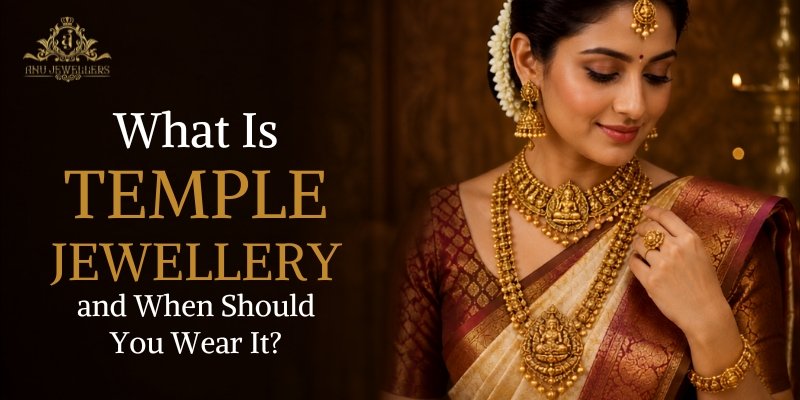
What is temple jewellery? It is a South Indian jewellery ornaments made for deities and by sacred temple art. Today, it is worn for weddings, classical dance, festivals and cultural occasions, from bridal sets to single statement pieces.
Temple jewellery is instantly recognisable, yet the label is often used too loosely. A matte-gold necklace with a peacock may be advertised as temple jewellery even when its construction, motifs and cultural references differ from the traditional style.
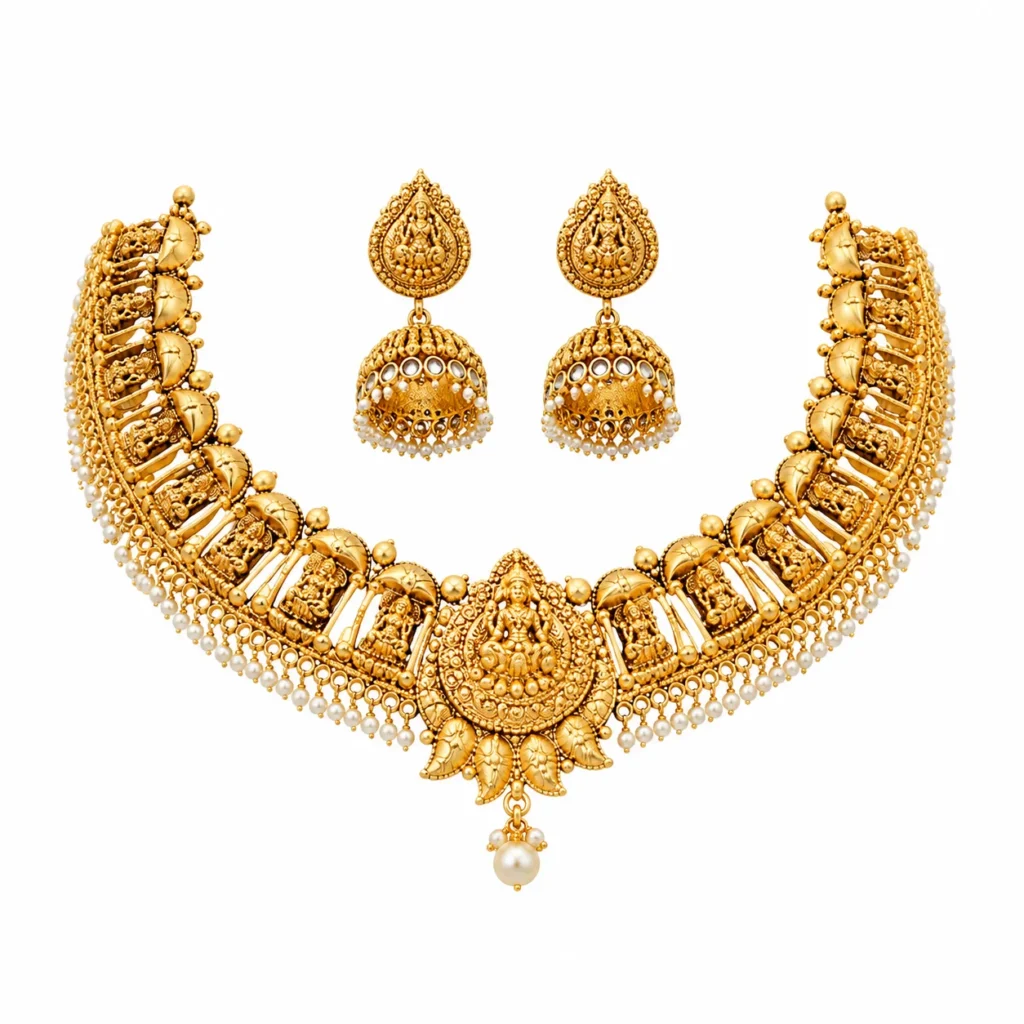
The most useful way to understand it is to look beyond colour and weight. Its identity comes from South Indian sacred art, deity and nature motifs, sculptural detailing, ceremonial scale and the way individual pieces are combined for a complete look.
What Is Temple Jewellery and Where Did It Begin?
Temple jewellery is a South Indian ornament tradition inspired by jewellery created for deities, temple sculpture and sacred visual language. It later became associated with classical dancers, bridal dressing and ceremonial wear while continuing to evolve through modern materials and lighter designs.
According to Vogue India, histories of the style commonly associate it with the Chola and Pandya periods, when precious ornaments were used for deities and royalty. Dancers and devotees later wore related designs inspired by temple architecture and divine figures.
The National Museum of India describes its jewellery gallery as a record of Indian ornament across periods, including pieces decorated with images of gods and goddesses. That wider history helps explain why jewellery in India can carry devotional, ceremonial and artistic meaning at the same time.
Temple jewellery did not move from sacred use to bridal fashion in one simple step. Different regions, artisan communities, dance traditions and families adapted the visual language in their own ways. Today, the term can describe several categories:
- fine gold jewellery with deity or temple-inspired motifs;
- silver jewellery finished with gold foil or plating;
- classical-dance jewellery using traditional forms and coloured stones;
- modern bridal jewellery inspired by South Indian temple art;
- lighter occasion pieces that use one recognisable motif rather than a full ceremonial design.
This distinction matters when buying. “Temple jewellery” describes a design tradition, not one guaranteed material, purity or production method.
What Makes Temple Jewellery Recognisable?
Temple jewellery is recognised by sculptural motifs, an ornate ceremonial presence, antique-style gold tones and references to South Indian sacred art. Deity figures, peacocks, lotus forms, coins, bells and architectural shapes often appear across necklaces, earrings, bangles and bridal accessories.
The following features help separate temple styling from a generic gold-coloured set:
| Feature | Traditional Temple-Jewellery Direction | What to Check Before Buying |
| Design source | Deities, temple sculpture, nature and ceremonial symbols | Whether the motifs are clearly described rather than used as a vague marketing label |
| Surface | Sculptural relief, embossed or carved appearance | Whether details are crisp, balanced and comfortable against the skin |
| Colour | Rich yellow-gold or antique-gold appearance | Actual metal, purity, plating and finish |
| Stones | Red and green stones, pearls, rubies, emeralds or modern alternatives | Whether stones are precious, semi-precious, glass, synthetic or simulated |
| Scale | Often bold, layered and visually substantial | Total weight and whether the piece can be worn for several hours |
| Structure | Chokers, long haar designs, jhumkas, bangles and coordinated sets | Fastenings, joins, flexibility and alteration options |
| Meaning | Cultural, devotional, bridal or family significance | Whether the symbolism suits the wearer’s beliefs and occasion |
The finish alone is not enough. A newly made necklace can have an antique-gold colour without being temple jewellery, while a polished gold piece can still follow temple traditions through its deity motifs, sculptural forms and composition.
In showroom styling, the most common mismatch is choosing every piece because it looks grand individually. A heavy choker, long haar, oversized jhumkas and highly detailed blouse can compete for attention. Temple jewellery looks strongest when the outfit and jewellery share a clear hierarchy.
Which Temple Jewellery Pieces and Motifs Are Common?
Common temple-jewellery pieces include chokers, long haar necklaces, jhumkas, bangles, armlets, waist belts, rings and hair ornaments. Their motifs frequently draw from deities, animals, flowers, coins and temple architecture, although meaning and usage vary between communities and designs.
Necklaces and Chokers
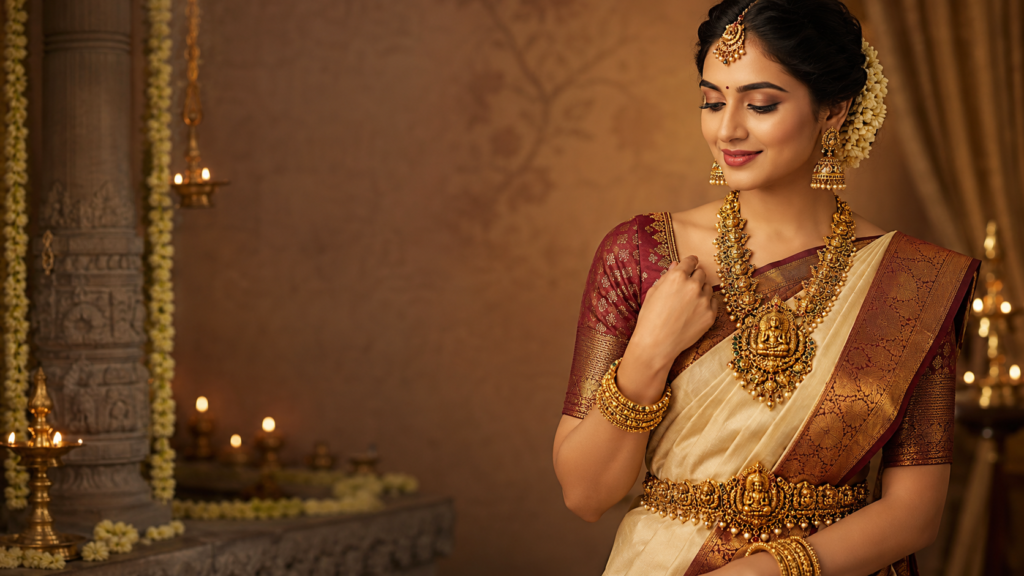
The necklace usually becomes the visual centre of the look. A close-fitting choker frames the neckline, while a long haar adds vertical length and ceremonial presence. Brides may wear one or layer both, provided the pendants and motifs remain visible rather than overlapping awkwardly.
A choker set suits a higher blouse neckline or a bride who wants the face and earrings to remain prominent. A rani haar creates a longer line and can balance a broad silk-saree border or a fuller bridal drape.
Jhumkas and Ear Ornaments
Temple-style jhumkas often use bell forms, deity details, pearls or red-and-green accents. Their scale should be checked with the hairstyle and necklace. Heavy earrings may need a support chain or altered fastening for comfort during a long event.
Traditional jumki earrings can also be worn without a matching necklace when the outfit already has strong zari, embroidery or blouse detail.
Bangles, Kadas and Armlets
Temple bangles may use deity panels, peacocks, elephants, flowers or raised geometric forms. A wider kada can act as the anchor of a wrist stack, while slimmer bangles provide rhythm and movement. Armlets or vankis create a more complete bridal or classical-dance silhouette.
Waist Belts and Hair Jewellery
A waist belt or vaddanam helps define a saree drape and can repeat the necklace motif. Hair ornaments may follow the plait, frame a bun or sit along the centre parting. These pieces are visually powerful, so they should be planned with hairstyle, veil placement and ceremony movement.
What Do the Motifs Mean?
Motif interpretations vary by region, family and religious context. The following associations are common design readings rather than universal rules:
| Motif | Common Association | Styling Effect |
| Lakshmi | Prosperity, abundance and auspiciousness | Strong devotional and bridal focal point |
| Peacock | Beauty, grace and ceremonial splendour | Adds curved movement and detailed colour |
| Lotus | Purity, renewal and sacred beauty | Works well in pendants, borders and repeating links |
| Elephant | Strength, dignity, abundance and royal presence | Creates a bold sculptural form |
| Coin forms | Prosperity, continuity and traditional wealth symbolism | Builds rhythm in long necklaces and waist belts |
| Bell and temple-top forms | Sacred architecture and ritual sound | Creates a clearly temple-inspired silhouette |
| Mango or paisley forms | Fertility, growth and abundance in many Indian design traditions | Softens geometric jewellery with organic curves |
Ask the jeweller to explain the design rather than assigning meaning from appearance alone. A motif can be decorative, devotional, regional or personal, and the wearer should be comfortable with what it represents.
When Should You Wear Temple Jewellery?
Temple jewellery is most naturally worn for weddings, classical dance, festivals, religious ceremonies and important family celebrations. Smaller earrings, pendants or bangles can also suit engagement functions, anniversaries, cultural events and modern outfits when one statement piece remains the focus.
Use the occasion to decide scale rather than assuming temple jewellery always needs a complete set.
| Occasion | Suitable Temple-Jewellery Scale | Practical Styling Direction |
| Wedding ceremony | Full or layered set | Choker, long haar, jhumkas and bangles coordinated with the saree |
| Reception | One major necklace or refined layered look | Reduce the number of accessories if the outfit is heavily embellished |
| Engagement or pre-wedding function | Medium statement set | One necklace with matching earrings or a statement bangle |
| Festival or puja | Small to medium | Jhumkas, pendant, bangles or one shorter necklace |
| Classical dance | Complete performance arrangement | Follow the requirements of the dance form, teacher and costume |
| Religious ceremony | Respectful, culturally suitable pieces | Choose motifs and scale appropriate to the family and setting |
| Wedding guest | One focal piece | Avoid reproducing the bride’s full jewellery scale |
| Anniversary or milestone | Heirloom, pendant, bangle or earrings | Choose a piece with repeat-wear value |
| Fusion or contemporary outfit | One temple-inspired element | Pair a pendant, earrings or cuff with a simple silhouette |
Temple jewellery is not restricted to South Indian brides. People from different Indian and South Asian backgrounds may choose it because they appreciate its craftsmanship, meaning or visual style. Cultural appreciation works best when the wearer understands the motif and avoids presenting a sacred symbol as a disposable trend.
For traditional wedding planning, Anu Jewellers’ Indian bridal jewellery collection provides a broader comparison across temple-inspired, Kundan-inspired, antique-style and contemporary bridal directions.
How Should Brides Choose Bridal Temple Jewellery?
Bridal temple jewellery should be selected as one coordinated system rather than separate attractive pieces. Begin with the saree, blouse neckline and ceremony, then balance necklace layers, earring weight, wrist styling and hair ornaments against the hours the bride will wear them.
A bride may need the jewellery through preparation photographs, the ceremony, family greetings and a reception. Comfort is therefore part of the design, not an afterthought.
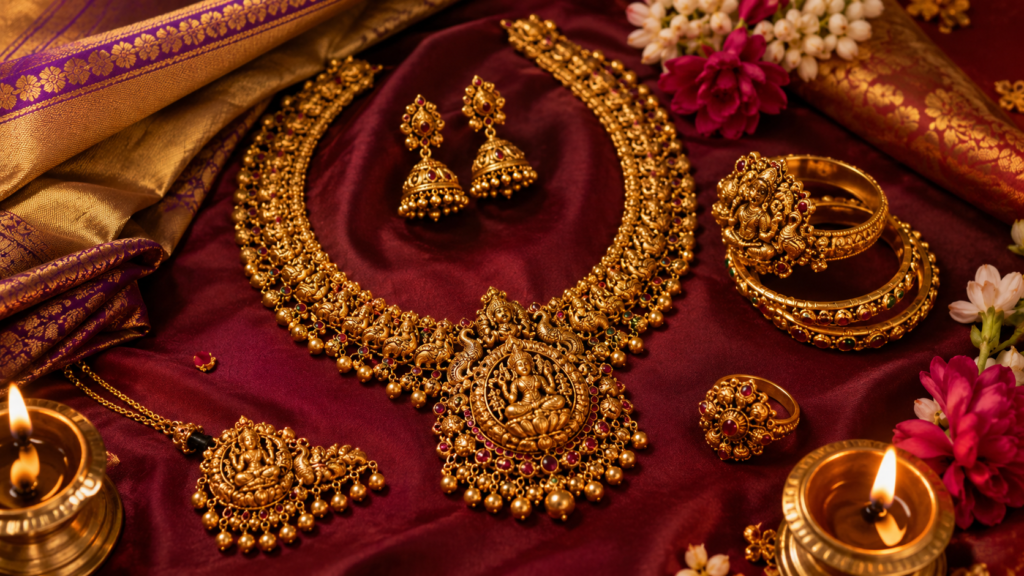
Use the Occasion–Outfit–Scale–Comfort–Meaning Framework
- Choose the ceremony and outfit first: the saree colour, zari, blouse neckline and draping style determine how much visual space the jewellery can occupy.
- Select one primary focal piece: a choker, long Lakshmi haar or statement pendant gives the remaining pieces a clear direction instead of creating several competing centres.
- Build the scale gradually: add earrings, bangles and a second necklace only when each piece improves the overall balance rather than simply making the set larger.
- Test comfort for at least 30 minutes: necklace edges, earring pull, bangle movement and hair accessories can become uncomfortable long before the ceremony ends.
- Confirm cultural and personal meaning: deity motifs, family heirlooms and ceremonial pieces should suit the bride’s beliefs, family preferences and intended future use.
Plan the Necklace Layers
A choker should sit cleanly without hiding the blouse border. A long haar should begin below it with enough space for both pendants to remain readable. If the blouse has a high or highly embroidered neckline, one longer piece may be more effective than two crowded necklaces.
Balance the Earrings
Large jhumkas can look proportionate beside a heavy choker but may become tiring. Test the fastening and ask whether a support chain can distribute weight. When the necklace is highly detailed, a more restrained earring can frame the face without making the look top-heavy.
Design for Repeat Wear
Bridal jewellery has greater long-term value when its pieces can separate. A long necklace that works with a simple silk saree, a choker that suits a family function and jhumkas that can be worn alone will usually be used more often than an inseparable set designed for one photograph.
How Can You Style Temple Jewellery Without Overdoing It?
Style temple jewellery by choosing one focal area and simplifying everything around it. Match the jewellery’s scale to the fabric, neckline and occasion, leave visible space between layered pieces, and repeat only one or two colours or motifs across the complete look.
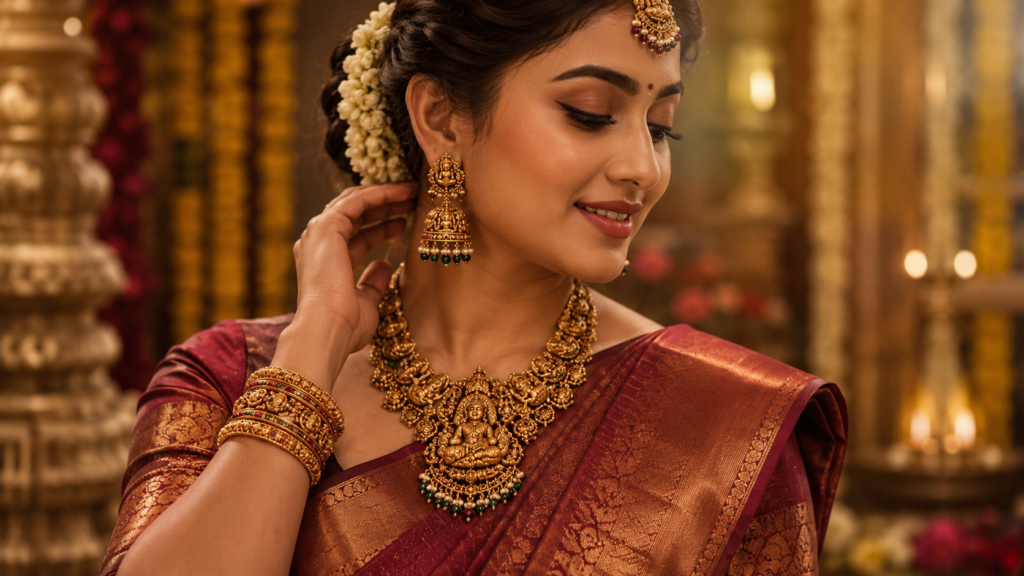
With Kanjeevaram and Other Silk Sarees
Silk sarees can support substantial jewellery because their zari, structure and colour have visual weight. A plain silk saree may carry a highly detailed necklace, while a heavily woven saree often looks better with fewer, clearer pieces.
With Lehengas and Half Sarees
Temple jewellery can work with lehengas and half sarees when the gold tone and motifs relate to the embroidery. Avoid mixing too many unrelated traditions in equal strength. For example, a temple choker, oversized Polki necklace, heavy chandelier earrings and ornate matha patti may create confusion rather than richness.
With Modern or Western Clothing
Use one element. A small Lakshmi pendant can sit over a plain high-neck blouse, temple-style jhumkas can sharpen a simple black dress, and one sculptural bangle can add heritage detail to a tailored outfit. The modern garment should act as negative space.
With Other Jewellery Traditions
Mixing is possible when the pieces share metal colour, stone palette or scale. Temple and diamond jewellery can work together if one remains dominant. Temple and pearl jewellery can feel softer. Temple and Kundan pieces need more care because both can be visually elaborate.
A useful rule is 60–30–10: let the primary temple piece carry about 60 per cent of the visual attention, supporting jewellery 30 per cent, and small accents such as rings or hair details the final 10 per cent. This is a styling framework, not a mathematical requirement.
Is Temple Jewellery the Same as Antique Jewellery?
No, temple jewellery describes a design tradition, while antique jewellery describes age. A new piece can be temple-inspired and have an antique finish without being antique. Conversely, an old jewel may be antique without using temple motifs or South Indian ceremonial forms.
| Term | What It Describes | Important Buying Question |
| Temple jewellery | Design source, motifs and cultural style | What materials, motifs and construction does this piece use? |
| Antique jewellery | An older item with historical age and provenance | How old is it, and what documentation or history supports the description? |
| Vintage jewellery | Jewellery from an earlier period, usually younger than an antique | What period is it from, and has it been repaired or altered? |
| Antique-finish jewellery | A newly made piece with a darkened, matte or aged appearance | Is it new, plated, solid gold or another material? |
| Temple-inspired jewellery | Modern jewellery using selected temple motifs or forms | How closely does the design follow the traditional style? |
This distinction protects buyers from paying for age or material that has not been established. “Antique look,” “heritage style” and “temple design” can all describe newly manufactured jewellery.
Anu Jewellers’ South Indian jewellery page provides broader regional context, including the difference between newly made traditional styles and genuine older pieces.
How Do Traditional, Dance and Modern Temple Jewellery Differ?
Traditional fine temple jewellery, classical-dance jewellery and modern temple-inspired pieces can share motifs while differing in metal, construction, weight and purpose. Identifying the category helps you judge authenticity, comfort, care needs and whether the piece suits performance, bridal or everyday wear.
Traditional Fine Temple Jewellery
Fine temple jewellery may use high-carat gold, sculptural relief work, deity or nature motifs, pearls and gemstones. These pieces are often chosen for weddings, religious occasions, family collections and long-term ownership. Their value depends on the actual metal, purity, weight, stones and workmanship not the temple label alone.
Traditional does not necessarily mean old. A newly made gold necklace can follow established South Indian forms, while a genuinely old piece may require provenance and specialist assessment before it is described as antique.
Classical-Dance Jewellery
Classical-dance jewellery is designed to remain visible under stage lighting and complete the costume from head to waist. According to India’s Centre for Cultural Resources and Training, Bharatanatyam developed in close relationship with temple performance traditions and South Indian sacred art.
Dance sets may use silver, gold-coloured finishes, red-and-green stones, pearls, ties and adjustable components rather than the same construction as fine bridal jewellery. A performance set should be assessed for costume accuracy, secure movement and stage visibility not only precious-metal content.
Modern Temple-Inspired Jewellery
Modern temple-inspired jewellery uses selected motifs or proportions in lighter, simpler forms. A small Lakshmi pendant, peacock jhumka, coin necklace or sculptural bangle can retain the visual language without recreating a full ceremonial set.
These pieces may be made in 22K or 18K gold, silver, gold-plated silver, brass or other materials. Some are designed for repeat wear with sarees, lehengas, workwear or contemporary clothing; others are fashion pieces intended for occasional styling.
| Category | Main Purpose | Typical Construction Direction | Most Important Check |
| Fine temple jewellery | Weddings, ceremonies, heirloom ownership | Precious metal, detailed relief work, gemstones or pearls | Purity, weight, workmanship and documentation |
| Classical-dance jewellery | Stage performance and costume completeness | Lightweight or adjustable components with high visual contrast | Secure fit, costume accuracy and movement |
| Modern temple-inspired jewellery | Festivals, events and repeat styling | Simplified motifs in fine or fashion-jewellery materials | Base metal, plating, comfort and care |
| Antique temple jewellery | Collecting, inheritance or historical ownership | Older construction with age-related wear or repairs | Provenance, condition and specialist assessment |
What Should You Verify Before Choosing a Piece?
The words “temple”, “traditional” and “antique finish” do not confirm material or age. Ask for:
- stated purity or fineness, such as 22K/916 or 18K/750;
- total weight and whether stones or non-gold parts are included;
- solid, hollow, plated, filled or silver-based construction;
- the identity of natural, laboratory-grown, synthetic or simulated stones;
- clasp, hinge, thread and fastening details;
- repair, resizing, polishing and replating limitations;
- an invoice that clearly describes the item.
According to the World Gold Council, 24-carat gold is pure gold, while 18-carat gold contains 75 per cent gold and 25 per cent other metals. Anu Jewellers’ gold hallmark identification guide explains common fineness numbers and why a stamp should be considered with the invoice and product information.
How Should You Care for Temple Jewellery?
Care depends on the metal, finish and stones, but temple-jewellery pieces benefit from dry storage, separation and handling. Keep perfume, hairspray and harsh cleaners away, wipe the piece after wear, and seek professional help for loose stones, damaged plating or weak fastenings.
Before Wearing
Apply perfume, hairspray, cosmetics and moisturiser before putting the jewellery on. Allow products to dry so they do not settle into sculptural recesses, pearl strands or porous stones.
After Wearing
Use a clean, soft cloth to remove surface oils and moisture. Do not aggressively rub antique finishes or gold foil. Avoid home ultrasonic cleaning unless a jeweller confirms that every stone, adhesive, plating and component is suitable.
During Storage
Store each major piece separately in a soft pouch or lined box. Support long necklaces so their pendants do not bend the links. Keep earrings paired, and close clasps without placing tension on the chain.
When to Seek Professional Help
Arrange an inspection when:
- a stone moves or produces a clicking sound;
- a necklace link stretches or twists;
- a screw, clasp, hinge or thread feels loose;
- gold plating or foil lifts from the base;
- a bangle becomes misshapen;
- an heirloom needs cleaning, restringing or redesign;
- the piece feels unsafe or uncomfortable to wear.
Do not reshape a bent bangle or tighten a stone with household tools. Sculptural details can crack, plating can lift and soldered areas can weaken. A professional jewellery repair assessment can determine whether cleaning, restringing, reshaping or restoration is safe.
Is Temple Jewellery Right for You?
Temple jewellery is right for you when its motifs, scale and cultural meaning suit the occasion and your style. It can create a complete South Indian bridal look, support a classical-dance costume or add one heritage-led focal point to a modern outfit.
Understanding what is temple jewellery also prevents common buying mistakes. Check the material rather than assuming every piece is gold, distinguish temple-inspired work from genuine antiques, and test weight and comfort before committing to a full set.
After identifying the style, material and scale that suit your occasion, explore Anu Jewellers’ temple jewellery in Melbourne collection for necklaces, chokers, long haar designs, jhumkas, bangles and coordinated bridal pieces.