

There’s a particular disappointment that comes with pulling out a gold chain you haven’t worn in a while and finding it looking dull, cloudy, or a little grimy around the links. The good news? Nine times out of ten, you don’t need a jeweller to fix it. You can safely clean gold jewellery at home with things already sitting in your kitchen, and it takes about fifteen minutes.
The catch is doing it gently. At our Craigieburn showroom we see beautiful pieces come in scratched or dulled not by wear, but by well-meaning owners who reached for toothpaste, baking soda, or a stiff brush because a video told them to. Gold is a soft metal, and the higher the karat, the softer it gets , so the wrong method can leave permanent marks on the very piece you were trying to rescue.
This guide walks you through exactly how to clean gold jewellery at home the safe way: the right method, the products to avoid, how to handle 22K and 24K gold and traditional pieces, and when it’s genuinely worth bringing it in to a professional. It’s written for gold jewellery lovers across Australia, whether you’re caring for an everyday wedding band or a family heirloom.
Why Gold Jewellery Loses Its Shine
Gold itself is remarkably stable , pure gold doesn’t rust or tarnish. So if your piece looks dull, the culprit is almost always a thin film of everyday life sitting on the surface rather than damage to the gold.
The usual suspects are body oils, hand cream, sunscreen, perfume, hairspray, makeup and sweat. In an Australian summer, sunscreen and perspiration are a big one , they build up fast on rings and chains and leave a greasy, light-scattering layer that reads as “dull.” Add soap scum from showering with your jewellery on, plus fine dust that clings to that oily film, and a bright piece can look tired within weeks.
A few more things worth knowing:
- “Tarnish” on gold usually isn’t gold. Most gold jewellery is an alloy , pure 24K gold is mixed with metals like copper and silver to make it harder and more wearable. Those added metals can react with sweat, chlorine or sulphur in the air and cause slight darkening, especially on lower-karat pieces. The gold is fine; the surface just needs cleaning.
- Chlorine and salt are harsh on gold. Pool chlorine and spa chemicals can react with the alloy metals and, over time, weaken solder joints and clasps. Ocean salt water and sandy beaches are abrasive and drying. This matters if you swim in your jewellery.
- A soft patina can form over time. On some gold, moisture creates a slightly darker, matte tone. Many people love it for the antique character it gives , but if you want the bright finish back, cleaning and light polishing will restore it.
Before You Start: Know What Kind of Gold You Have
This is the step almost every online guide skips, and it’s the one that saves your jewellery. The safest way to clean a piece depends entirely on what it’s made of.
Solid gold (9K, 14K, 18K, 22K, 24K)
Solid gold can be cleaned with the warm soapy water method below. But karat matters. The higher the karat, the purer , and softer , the gold. A 9K or 14K ring shrugs off gentle brushing, but the 22K and 24K gold favoured in Indian, Punjabi, Nepali and Sri Lankan jewellery is noticeably softer and scratches more easily. With high-karat gold, be extra gentle: light pressure, the softest brush you own, and never anything abrasive.
Gold-plated, gold-filled and gold vermeil
These have only a thin layer of gold over a base metal (or over silver, in the case of vermeil). That layer can wear through with rough handling, so treat plated pieces with real care: a quick, gentle soapy wash, no scrubbing, no soaking for long periods, and absolutely no abrasives or acidic cleaners, which strip plating fast. When plating wears off, it can’t be brushed back , it needs re-plating.
Gold set with gemstones, diamonds or pearls
Diamonds are tough and handle the standard soapy clean well. Coloured and softer stones are a different story. Pearls, opals, emeralds, turquoise and coral are porous or fragile , they can crack, cloud or discolour if soaked, exposed to acids, or hit with heat. For pearls in particular, never submerge them; just wipe with a soft, barely-damp cloth. If you’re unsure what a stone is, clean the gold around it minimally and ask a jeweller.
Traditional and antique pieces , please don’t soak these
If you own kundan, polki, jadau, meenakari or temple jewellery, this section is for you, because standard advice will ruin them. In these pieces the uncut stones are often foil-backed and set with natural lac or resin rather than metal prongs. Water gets behind the foil and under the setting, lifts the stones, dulls their backing, and dissolves the lac. The same goes for many antique and enamelled (meenakari) pieces.
Never soak traditional, kundan, polki or enamelled jewellery. Instead, wipe the metal gently with a dry or very slightly damp soft cloth, keep water away from the stones entirely, and let a specialist handle anything more. If you’re in Melbourne, our team offers professional jewellery cleaning and repair for exactly these kinds of delicate, high-value pieces.
How to Clean Gold Jewellery at Home: Step by Step
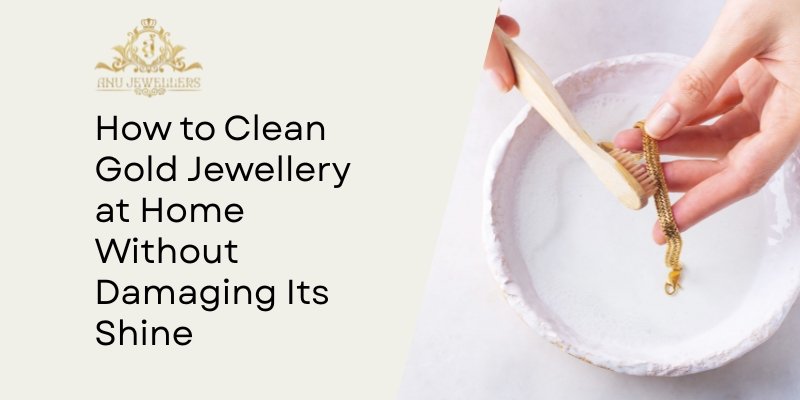
For solid gold, plain gold, and gold with diamonds, the warm soapy water method is all you need. It’s the method professional jewellers recommend precisely because it’s effective and almost impossible to get wrong.
What you’ll need:
- A small bowl
- Lukewarm water (never hot , heat can loosen stone settings)
- A few drops of mild dish soap, ideally fragrance-free
- A soft-bristled toothbrush (a baby toothbrush is perfect), kept just for jewellery
- A soft, lint-free or microfibre cloth
The steps:
- Mix your solution. Fill the bowl with lukewarm water and add a couple of drops of mild dish soap. Swirl gently to combine. Skip anything with added moisturisers, bleach or “antibacterial” chemicals.
- Soak. Place your gold pieces in the water, ideally not touching each other so they can’t rub. Let them sit for 10 to 15 minutes. For stubborn grime you can go to 20. (Remember: no soaking for plated pieces, and none at all for pearls or traditional stone-set jewellery.)
- Brush gently. Lift out one piece and use the soft toothbrush with light, circular strokes. Pay attention to the spots grime hides , chain links, ring backs, prong settings, and engraving. Let the bristles do the work; don’t press.
- Rinse thoroughly. Rinse under lukewarm running water until every trace of soap is gone. A quick tip: if you’re rinsing over a sink, put the plug in or use a small strainer so a slippery ring can’t disappear down the drain.
- Dry properly. Pat dry with a soft, lint-free cloth. Don’t use paper towels or tissues , they’re mildly abrasive and leave lint in settings.
- Let it finish air-drying. Leave pieces out for a few minutes before storing, so no moisture is trapped in crevices.
That’s it. Done every few weeks, this routine keeps most gold jewellery looking close to new.
How to Polish Gold Jewellery and Bring Back the Shine
Cleaning and polishing aren’t quite the same thing. Cleaning removes the dirt and film; polishing restores the reflective shine and buffs out the faint hazy scratches that dull the surface over time.
The safest way to polish gold jewellery at home is with a jewellery polishing cloth , a soft cloth (often two-layered) made specifically for precious metals. After your piece is clean and completely dry, buff it gently in long strokes rather than tight circles. You’ll see the lustre lift almost immediately. These clothes are inexpensive, reusable, and far kinder to gold than any paste.
What polishing won’t do is remove deep scratches or restore a worn finish , that’s a job for professional machine polishing, which removes a microscopic layer of metal to level the surface. For high-karat gold, plated pieces, or anything you’re precious about, leave deep polishing to a jeweller so no more metal is removed than necessary.
Cleaning Different Types of Gold Jewellery
The core method stays the same, but a few pieces have their quirks:
- Gold rings. Rings collect the most grime because we wear them constantly and they sit in soap, lotion and cooking oils. Clean them more often, and brush behind the setting where residue hides. If a stone feels loose while cleaning, stop and have it checked.
- Gold chains and necklaces. Dirt lodges between links, so a soft brush is essential. Lay the chain flat and work along it section by section. Browse styles in our gold chains and necklaces collections if a piece is beyond refreshing.
- Gold bangles and bracelets. These knock against surfaces all day, so they scratch and dull quickly. A regular clean and a buff with a polishing cloth keeps gold bangles looking bright.
- Gold earrings. Wipe posts and hooks with a soft, slightly damp cloth to remove skin oils. If they have pearls or delicate stones, keep water away from the stone.
- Mangalsutra and stone-set traditional pieces. Because many mangalsutra and bridal designs combine gold with black beads, pearls or foil-set stones, stick to gentle wiping and leave deep cleaning to a professional.
What NOT to Use on Gold Jewellery
This is where a lot of well-intentioned home cleaning goes wrong. The internet is full of “hacks” that quietly damage gold. Here’s a clear guide.
| Safe to use | Best to avoid |
| Lukewarm water | Hot or boiling water (loosens settings, cracks stones) |
| A few drops of mild dish soap | Bleach, chlorine and ammonia-based cleaners |
| A soft-bristled / baby toothbrush | Stiff brushes, scouring pads |
| Soft, lint-free or microfibre cloth | Paper towels and tissues (abrasive, leave lint) |
| A dedicated jewellery polishing cloth | Toothpaste, baking soda and other abrasives |
| Warm soapy soak (solid gold only) | Vinegar, lemon juice and other acids |
A few specifics worth spelling out:
- Toothpaste. It’s abrasive , that’s how it cleans teeth , and it will leave fine scratches on gold and can loosen stones. Skip it.
- Baking soda. Also abrasive and alkaline. It can scratch softer, higher-karat gold and dull gemstones. Leave it for the oven.
- Bleach and chlorine. These react with the alloy metals in gold and can cause discolouration and even structural damage over time. Never clean gold with them, and take rings off before using bleach-based household cleaners.
- Ultrasonic and steam cleaners. These are wonderful in professional hands but risky at home. The vibration can shake loose stones out of worn settings, and heat can crack softer gems. Don’t use them on plated pieces, pearls, emeralds, opals or anything foil-backed.
The vinegar and baking soda question, answered
You’ll find plenty of pages online swearing by a vinegar-and-baking-soda soak, and just as many saying never to touch it. Here’s the honest verdict from a jeweller’s perspective: for solid, high-quality gold with no soft stones, a brief diluted vinegar rinse won’t destroy it , but it offers no real advantage over mild soap and water, and it introduces genuine risk. On gold-plated, gold-filled or vermeil pieces, vinegar’s acidity accelerates wear on the thin gold layer. On pearls, opals and other porous or soft stones, acid can etch and permanently discolour them. Baking soda adds abrasion on top of that.
So while it’s not the disaster some make it out to be, there’s simply no good reason to reach for it. Mild dish soap and warm water do the same job with none of the downside. When in doubt, use soap and water.
How Often Should You Clean Gold Jewellery?
For everyday pieces , your wedding band, a daily chain, hoops you never take off , a gentle clean every two to four weeks keeps buildup from ever becoming a problem. Occasion pieces worn a few times a year really only need a wipe before storing and a clean before their next outing.
Good gold jewellery care is mostly about small, consistent habits rather than big rescue missions. A quick buff with a polishing cloth between proper cleans, and a wipe-down after a hot or sweaty day, goes a long way.
Storing Gold Jewellery to Keep It Shining
Half of keeping gold bright is stopping it from getting dirty and scratched in the first place. A few simple habits make a real difference:
- Store pieces separately. Gold scratches gold. Use a fabric-lined jewellery box with compartments, or individual soft pouches, so pieces don’t rub or tangle.
- Keep it dry. Store jewellery somewhere cool and dry , trapped moisture is what encourages that darker patina. Make sure pieces are fully dry before they go away.
- Follow the “last on, first off” rule. Put jewellery on after your moisturiser, perfume, sunscreen and hairspray, and take it off before showering, swimming, cleaning, exercising or sleeping. This one habit prevents most buildup.
- Remove it for the pool and beach. Chlorine and salt water are hard on gold and its settings.
These small routines protect both the everyday pieces and the heirlooms you want to pass on.
Jeweller’s tip: If a gold ring feels rough around the stone setting or a chain catches on fabric after cleaning, stop wearing it and have it inspected. Small setting issues are much easier to fix before a stone falls out.
When to See a Professional Jeweller
Home cleaning handles the day-to-day, but some situations really do call for expert hands:
- Tarnish or discolouration that won’t lift with gentle cleaning
- Intricate, antique, kundan, polki or enamelled pieces that shouldn’t be soaked
- Loose or missing stones, worn prongs, a clasp that no longer closes securely, or a chain that’s kinked or stretched
- Deep scratches or a finish that’s lost its shine and needs professional polishing
- White gold that’s turned yellowish and needs re-rhodium plating
A professional clean does more than restore sparkle. A good jeweller also inspects your piece under magnification and catches small problems , a thinning claw, a worn joint , before they become a lost stone or a snapped chain. It’s worth having valued pieces looked at once a year.
If you’re in Melbourne, Anu Jewellers offers professional cleaning, polishing and jewellery repairs at our Craigieburn showroom, including delicate traditional and bridal pieces that need specialist care. You’re always welcome to get in touch or drop in.
Keeping Your Gold Looking Its Best
Cleaning gold jewellery at home really does come down to a few gentle habits: warm water, mild soap, a soft brush, a careful dry, and knowing which pieces should never touch water at all. Do that, store your pieces with a little care, and skip the toothpaste-and-vinegar shortcuts, and your gold will keep its shine for decades.
And when a treasured piece needs more than a home refresh , a proper polish, a repair, or the specialist touch that antique and traditional jewellery deserves , that’s exactly what a jeweller is for. Explore our handcrafted gold jewellery collections or visit us in Craigieburn to keep every piece looking as radiant as the day you first wore it.
Faq's
Can I clean gold jewellery with toothpaste?
No. Toothpaste is abrasive and will leave fine scratches on the gold’s surface, and it can loosen stones and damage pearls. Despite being a popular “hack,” it’s one of the fastest ways to dull a piece. Stick to mild soap and warm water.
Is vinegar safe for cleaning gold jewellery?
For solid gold with no soft stones, a brief diluted rinse is unlikely to cause harm , but it offers no benefit over soap and water and can damage gold-plated pieces and porous stones like pearls and opals. There’s no real reason to use it; mild dish soap and water are safer and just as effective.
Does 22K or 24K gold need to be cleaned differently?
The method is the same , warm water and mild soap , but you need to be gentler. Higher-karat gold is much softer and scratches more easily, so use the softest brush, light pressure, and never any abrasive product.
How do I clean gold jewellery with diamonds?
Diamonds handle the standard soapy-water soak well. Soak, brush gently behind the stone where oils collect, rinse and dry. If a diamond looks loose or moves during cleaning, stop and have the setting checked before wearing it again.
Can I clean gold-plated jewellery the same way as solid gold?
Be more careful. Gold plating is a thin layer, so give plated pieces only a quick, gentle wash with no soaking, no scrubbing and no acidic or abrasive cleaners. Rough handling wears the plating through, and once it’s gone it needs re-plating to restore.
Why has my gold jewellery gone dull or slightly dark?
Usually it’s just a film of oils, sunscreen, sweat and dust rather than damage. A gentle clean fixes it. Slight darkening on lower-karat gold can come from the alloy metals reacting with chlorine or sweat, which cleaning also resolves. If it persists, have it professionally cleaned and inspected.
Can I use an ultrasonic cleaner at home?
It’s best avoided. Ultrasonic cleaners can shake loose stones out of worn settings and damage softer gems, pearls, plated pieces and foil-backed traditional jewellery. Leave ultrasonic and steam cleaning to a professional who can assess the piece first.
How often should I clean my gold jewellery?
Clean everyday pieces every two to four weeks and give them a quick buff with a polishing cloth in between. Occasion jewellery only needs cleaning before and after it’s worn.