
How to choose a gold chain for men starts with five checks: length, width, link construction, gold purity and daily routine. Most buyers should test the chain with their usual shirt collar, confirm the clasp, and balance its weight with any pendant.
A men’s gold chain can be understated enough for work, visible enough for a wedding and meaningful enough to become a family piece. The challenge is that two chains with the same length can look completely different when their width, link pattern, weight and wearer’s build change.
When buyers search how to choose gold chains for men, they are usually trying to avoid one of four mistakes: choosing a chain that sits too high, buying a width that feels out of proportion, pairing a heavy pendant with a delicate chain or selecting a design that does not suit daily wear.
This guide explains how to compare those details in Australia, including practical advice for Indian and South Asian men who may want a chain for everyday clothing, a kurta or sherwani, a wedding, a religious pendant, a milestone gift or long-term family use.
What Should You Decide Before Choosing a Men’s Gold Chain?
Choose the chain’s purpose before comparing designs. Decide whether it will be worn alone, with a pendant, under a shirt, over traditional clothing or only at celebrations. That decision determines the most suitable length, width, weight, link and clasp.
A chain bought for daily commuting needs different qualities from one chosen for a wedding or festival. The daily piece should feel comfortable under collars, resist snagging and remain balanced during movement. A ceremonial chain can be heavier or more decorative because it will not face the same routine exposure.
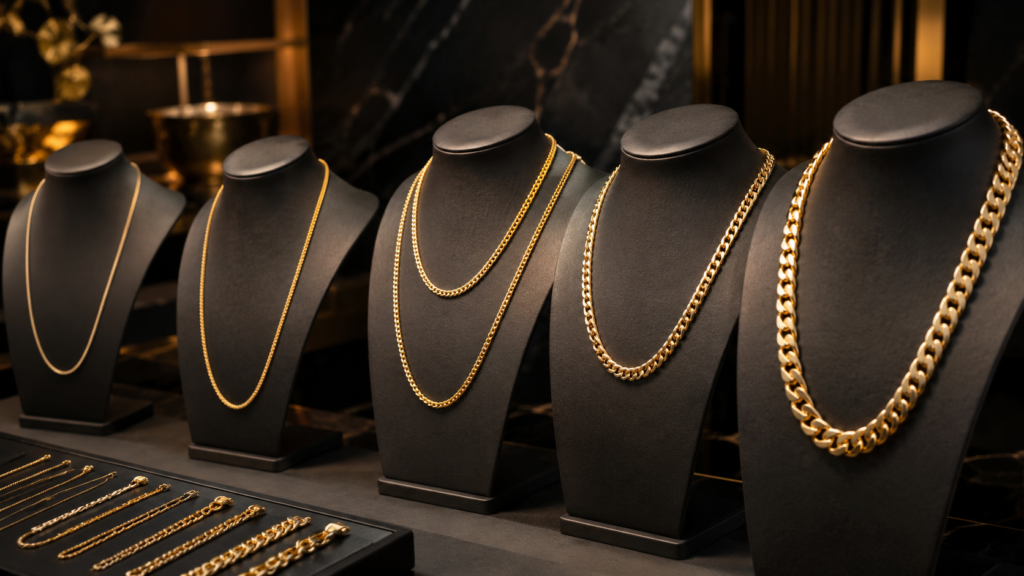
Use this decision table as a starting point:
| Intended Use | Useful Starting Direction | Main Risk to Avoid |
| First gold chain | Medium length, moderate width, simple link | Buying an extreme style before knowing what feels comfortable |
| Office or professional wear | Lower-profile link that can sit inside a shirt | Thick chain rubbing against collars or drawing unwanted attention |
| Daily casual wear | Smooth, flexible link with a secure clasp | Very delicate links, sharp edges or excessive movement |
| Pendant chain | Length and width proportionate to the pendant | Heavy pendant stretching a fine chain or not fitting through the bail |
| Wedding or cultural event | Richer visual weight, traditional link or layered styling | Choosing size and weight based only on photographs |
| Milestone gift | Versatile design with confirmed length and return terms | Guessing neck size or personal style |
| Long-term family piece | Clear purity, solid workmanship and repairable design | Paying for visual size without understanding construction |
For a local showroom comparison, explore Anu Jewellers’ gold chain for men Melbourne collection, which includes different lengths, weights and traditional or contemporary styles.
The Five-Point Chain Test
- Choose the finished position: decide whether the chain should sit at the collarbone, below an open collar, at mid-chest or lower because position controls the required length.
- Set the visual strength: choose discreet, balanced or statement width because the same link can look completely different at 2 mm and 8 mm.
- Match the construction to use: compare solid, hollow and flexible link designs because weight alone does not explain strength or repairability.
- Test the clasp and movement: open, close and gently flex the chain because comfort depends on more than how it looks on a tray.
- Check the complete specification: confirm purity, weight, length, width and invoice details because one number never tells the full story.
How to Choose Gold Chain for Men by Length and Fit
The right gold chain length for men depends on neck size, build, clothing and whether a pendant is attached. Around 50–55 cm is a versatile starting range, but test the chain on the wearer rather than choosing from a chart.
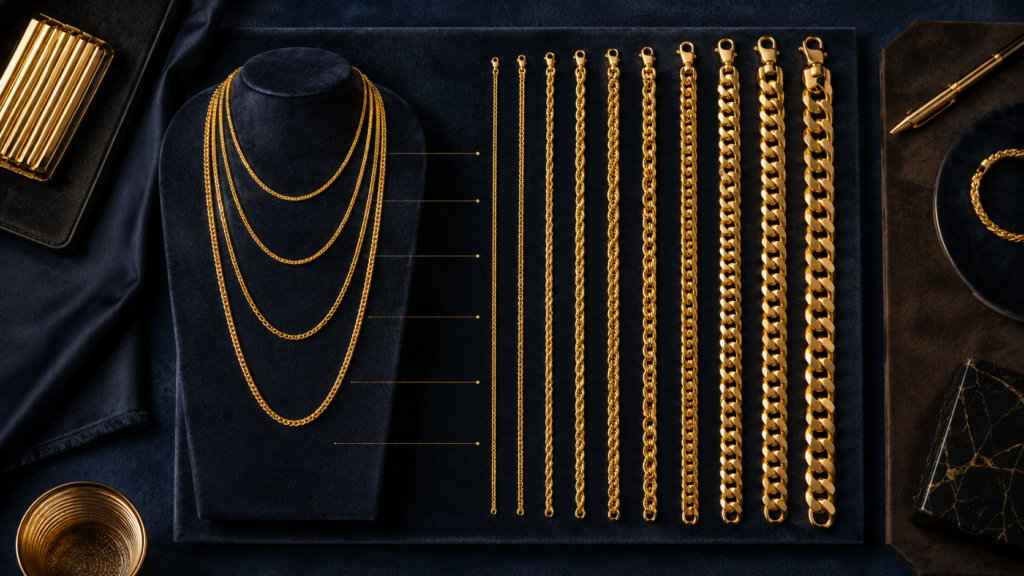
Common chain lengths are usually sold in centimetres or inches. The conversion matters when comparing Australian and international retailers.
| Approximate Length | Inches | Where It Often Sits | Common Use |
| 45 cm | 18 in | Close to the base of the neck | Slim, visible chain; open collar; smaller frame |
| 50 cm | 20 in | Around the collarbone | Versatile everyday position for many men |
| 55 cm | 22 in | Below the collarbone | Relaxed fit, open shirts and many pendants |
| 60 cm | 24 in | Upper to mid-chest | Larger pendant, over-shirt wear or stronger presence |
| 65–70 cm | 26–28 in | Lower chest | Statement styling, layering or ceremonial use |
These positions are guides, not promises. A 50 cm chain sits higher on a broad neck than on a narrow one. A thick chain can also appear shorter because it curves more widely around the neck.
Anu Jewellers’ broader guide on how to choose gold necklace length explains how body proportions, necklines and pendants change the finished drop. Use that page for general necklace sizing and this guide for the men’s chain-specific decision.
How to Measure the Length Before Buying
- Use a soft tape or non-stretch cord: place it around the neck at the intended chain position because a rigid ruler cannot follow the natural curve.
- Add space for comfort: leave enough room to turn the head and slide a finger beneath the measurement because a chain should not press into the neck.
- Test the measurement with normal clothing: wear the T-shirt, collared shirt, kurta or sherwani you expect to use because necklines change visibility.
- Include the pendant drop: measure to the bottom of the pendant, not only the chain, because the complete necklace may sit several centimetres lower.
- Compare two nearby lengths: try the preferred size and the next size up because the more flattering option is often clearer when viewed side by side.
How Body Build Changes the Result
A tall or broad-chested man may prefer extra length so the chain does not look tight or disappear near the collar. A slim man may find that a 50 cm chain already creates a relaxed drop. Facial hair, neck hair and shirt collars also affect comfort.
Do not use height alone. Two men of the same height can have different neck circumferences and chest proportions. Direct fitting or measuring a chain the recipient already wears is more reliable than estimating from photographs.
How Wide Should a Men’s Gold Chain Be?
Chain width controls how noticeable, heavy and visually dominant the piece feels. Fine widths suit discreet styling and small pendants, medium widths balance everyday visibility, and broad widths create a statement. Link pattern and body build can change the result.
Use these ranges as visual starting points rather than fixed rules:
| Approximate Width | Visual Effect | Practical Use |
| Under 2 mm | Very fine and understated | Lightweight pendants or discreet wear; construction must be checked carefully |
| 2–4 mm | Refined and easy to layer | First chain, office wear, daily styling and small pendants |
| 4–6 mm | Clearly visible without being extreme | Standalone daily chain or proportionate pendant use |
| 6–8 mm | Bold and substantial | Casual statement, wedding styling or traditional looks |
| Above 8 mm | Strong statement piece | Usually worn alone; weight, comfort and budget become major factors |
A 4 mm rope chain may look brighter and more textured than a 4 mm curb chain. A 6 mm hollow chain may look large but weigh less than a narrower solid chain. Width therefore needs to be read together with link shape, construction and total weight.
Match Width to the Wearer
A broad chest can carry a wider chain without it dominating the outfit. A slimmer frame can still wear a bold chain, but the result will look more deliberate. Personal preference matters more than body “rules”; the purpose of proportion is to predict the visual effect, not restrict the wearer.
For a first chain, a moderate width is often easier to live with because it works under a shirt, over a T-shirt and with many jackets. A very broad chain is less adaptable but can be the right choice for someone who already wears bold men’s jewellery.
Which Men’s Gold Chain Style Is Best for Daily Wear?
The best daily-wear chain has smooth movement, well-made links and a secure clasp. Curb and Figaro chains lie relatively flat, box chains create a clean geometric look, and rope chains add texture. No link style is durable without appropriate thickness and workmanship.

Curb and Cuban Links
Curb links are twisted and flattened so they sit more evenly against the chest. Cuban links are a closely related, often heavier style with a strong visual rhythm. Both can range from refined to very bold depending on width and weight.
These styles work well when you want the chain itself to be visible. Inspect every link for even alignment and check that the chain lies flat without twisting.
Figaro Links
A Figaro chain uses a repeated pattern of shorter links followed by a longer link. It adds detail without requiring gemstones or a pendant and is familiar in both contemporary and traditional men’s styling.
The pattern should remain consistent throughout the chain. Uneven or stretched links can interrupt the design and may indicate wear on an older piece.
Rope Chains
Rope chains use twisted strands or links to create a spiral effect that catches light from several angles. They can look substantial even at moderate widths and are often chosen as standalone chains.
Because rope construction is more complex, ask how the chain is made and repaired. Some hollow or very intricate rope chains can be difficult to restore invisibly after severe damage.
Box and Franco-Style Chains
Box chains use square links for a geometric appearance. Franco-style chains create a dense, V-shaped or interlocking pattern with a smooth, substantial feel. These designs often suit men who prefer a structured, contemporary chain.
Check flexibility. A dense chain should curve naturally rather than forming sharp angles. Stiffness or kinks can indicate damage or unsuitable handling.
Wheat, Cable and Other Links
Wheat chains use interwoven links for texture and flexibility. Cable chains use repeated oval or round links and can work well with pendants when the thickness is appropriate. Other regional and custom designs may use decorative or traditional link patterns.
The practical answer to how to choose gold chain for men by style is to compare the chain while it is hanging, not only lying flat. Movement reveals twisting, roughness, stiffness and how evenly the weight is distributed.
For broader styling inspiration, Anu Jewellers’ guide to gold jewellery trends for men covers chains, rings, kadas and coordinated men’s jewellery.
Which Gold Purity Should You Choose for a Men’s Chain?
Choose gold purity by balancing colour, gold content, design and intended wear. Higher-carat gold has richer gold content and is generally softer; lower-carat alloys are usually harder. A well-built chain can still outperform a poorly constructed piece with a different purity.
According to the World Gold Council, 24-carat gold is pure gold, 18-carat gold contains 75 per cent gold and 22-carat gold contains about 91.7 per cent gold. Alloying pure gold with other metals adds durability and can change its colour.
The Gemological Institute of America also explains that pure gold is commonly alloyed with metals such as copper and zinc to improve hardness. Purity therefore affects the material, but it does not replace the need to inspect link thickness, joins and clasp construction.
| Marking | Approximate Gold Content | General Buying Consideration |
| 999 / 24K | 99.9% | Very high purity and rich colour; softer and better suited to carefully chosen designs |
| 916 / 22K | 91.6–91.7% | Strong traditional appeal and rich yellow colour; construction is important for daily use |
| 750 / 18K | 75% | Balance of high gold content and increased alloy hardness |
| 585 / 14K | 58.5% | Harder alloy commonly used in international jewellery |
| 375 / 9K | 37.5% | Lower gold content and common in parts of the Australian jewellery market |
Anu Jewellers specialises in high-purity gold chains, so buyers comparing 22K and 24K pieces should ask how each exact design is intended to be worn. The company’s gold hallmark identification guide explains common fineness markings and why stamps should be considered alongside documentation and testing.
Should You Choose a Solid, Hollow or Gold-Plated Chain?
Solid, hollow and plated chains can look similar but behave differently. Solid-gold construction usually offers greater substance and repairability; hollow chains create a larger look at lower weight; plated chains use a gold surface layer over another metal.
| Construction | Main Advantage | Main Limitation | Best Suited To |
| Solid gold | Substantial feel, lasting gold content and generally stronger repair options | Higher weight and price | Regular wear, heirloom buying and long-term ownership |
| Hollow gold | Larger visual size with lower weight and cost than a comparable solid chain | More vulnerable to crushing or denting; some repairs remain visible | Occasional wear or buyers prioritising size with less weight |
| Semi-hollow or partially hollow | Middle ground in weight and appearance | Construction can be difficult to judge without clear disclosure | Buyers comparing a specific design with full specifications |
| Gold plated | Lower purchase price and gold appearance | Surface can wear, fade or require replating | Fashion-led or occasional use with realistic expectations |
| Gold filled | Thicker bonded gold layer than typical plating | Still not solid gold and varies by manufacturing standard | Lower-cost jewellery where clearly described |
“Solid gold” describes the metal composition, not whether every link is physically solid inside. Ask both questions: Is the chain solid gold rather than plated, and is the construction solid or hollow?
A very light chain is not automatically weak, and a heavy chain is not automatically well made. Look at how the links join, how the clasp is attached and whether the chain flexes evenly.
How Do You Match a Gold Chain With a Pendant?
Match the chain to the pendant’s weight, width, bail and intended position. The chain should look visually proportionate, pass through the bail easily and support the pendant without stretching, twisting or allowing the clasp to rotate constantly toward the front.
Check the Bail First
The bail is the loop or opening that connects the pendant to the chain. Measure its internal opening rather than the outer size. Decorative end caps and clasps may be wider than the chain, so confirm that the full chain can pass through.
Balance the Visual Weight
A small religious symbol, initial or lightweight pendant can sit on a fine or moderate chain. A heavy medallion, khanda, cross, Om pendant or custom piece usually needs more visual and structural support. The pendant should not make the chain look like a thin cord under load.
Choose the Finished Drop
Many men prefer a pendant at 55–60 cm because it sits below the collarbone, but the right result depends on neck size and pendant height. Measure to the bottom of the pendant when deciding whether it will sit inside a shirt, above a kurta neckline or over clothing.
Inspect the Wear Points
The pendant bail rubs against the same section of chain repeatedly. Check that contact area during regular inspections. A jeweller should assess any thinning, flattening, sharpness or change in colour.
What Should You Check Before Buying a Men’s Gold Chain?
Before buying, confirm the chain’s length, width, total weight, purity, construction, clasp and invoice description. Wear it for several minutes, move normally and inspect the links under ordinary light. A trustworthy comparison uses specifications and comfort, not appearance alone.
Inspect the Chain in Seven Steps
- Hang the chain vertically: check whether it falls straight because twisting or persistent kinks may reveal alignment or damage problems.
- Run it gently through your fingers: feel for sharp joins, rough areas and sudden stiffness because these can catch skin or clothing.
- Open and close the clasp several times: confirm a positive, secure action because the clasp is one of the most frequently handled components.
- Inspect the end connections: check the jump rings, end caps and soldered areas because weak attachment points can fail even when the main links look strong.
- Wear it with normal movement: turn your head, sit, bend and change shirts because a chain can feel different after several minutes.
- Confirm every specification in writing: check purity, weight, length, construction and stone or pendant details because verbal descriptions are difficult to verify later.
- Ask about adjustment and repair: learn whether the chain can be shortened, extended, polished or repaired because complex and hollow designs may have limitations.
According to the ACCC, products sold to Australian consumers must meet consumer guarantees, including acceptable quality, and descriptions must be accurate. Ask separately about the jeweller’s change-of-mind, exchange and custom-order policies because these are not the same as statutory rights.
How Much Should You Budget?
Gold-chain pricing changes with the gold market, purity, weight, craftsmanship, link complexity and whether the chain is solid or hollow. Avoid publishing or relying on a fixed “price per chain” without the full specification.
Use this comparison:
| Price Factor | What to Ask |
| Purity | Is the chain 22K/916, 18K/750 or another fineness? |
| Weight | What is the total weight in grams? |
| Construction | Is it physically solid, hollow, semi-hollow or plated? |
| Workmanship | Are making and customisation charges included? |
| Pendant or stones | Are they included in the displayed weight and price? |
| Adjustment | Can the length be changed, and what will that affect? |
| Documentation | What details will appear on the invoice? |
| Aftercare | Are cleaning, inspection or repairs available later? |
For gifts, also compare the recipient’s existing chain length and ask about exchange conditions before engraving or altering the piece.
How Should You Wear and Care for a Gold Chain Daily?
Daily-wear chains last better when protected from pulling, chemicals, sweat build-up and tangled storage. Remove the chain for heavy work, contact sport and situations where it may snag. Clean gently, inspect the clasp regularly and seek repair before a weak point breaks.
Daily and Periodic Care Schedule
| Frequency | Check or Action |
| Each time you wear it | Confirm the clasp closes fully and the chain is not kinked |
| After heavy sweating | Wipe with a clean, soft cloth and allow the chain to dry |
| Every few weeks | Inspect links, end rings, clasp and pendant contact points |
| When visibly dull | Use a gentle method suitable for the exact gold and any pendant materials |
| Before a wedding or major event | Arrange inspection early enough for any repair or adjustment |
| Whenever damage appears | Stop wearing the chain and have it professionally assessed |
Anu Jewellers’ guide on how to clean gold jewellery at home explains a gentle approach and warns against abrasive household products. If the chain includes pearls, enamel, porous stones or traditional components, follow care instructions for the complete piece rather than treating it as plain gold.
Activities That Increase Risk
Remove or secure the chain during:
- gym training and contact sport;
- machinery, trade or workshop tasks;
- gardening and heavy lifting;
- swimming in chlorinated pools;
- sleeping, when the chain is fine, long or easily caught;
- applying perfume, hair products or strong cleaning chemicals.
This advice is about snagging, impact and chemical exposure, not a claim that normal wear will automatically damage every chain. A strong chain can still fail if it is pulled sharply.
When Professional Help Is Worth It
Bring the chain to a jeweller if the clasp feels loose, a link looks stretched, the chain develops a kink or a pendant has worn a groove into the links. Do not squeeze links with household pliers or use glue.
Anu Jewellers offers jewellery repairs for chain and clasp problems, polishing and other assessments through its Craigieburn showroom.
Which Men’s Gold Chain Should You Choose?
Choose a length that sits correctly with your usual clothing, a width that matches your preferred visibility and a link construction suited to your routine. Then verify purity, weight, clasp security and aftercare before deciding whether the chain feels worth owning.
For many first-time buyers, a moderate-width chain around 50–55 cm offers a flexible starting point. A pendant may require extra length and a more substantial link. Weddings and traditional outfits may suit a heavier or longer chain, provided it remains comfortable for the full event.
Ultimately, how to choose a gold chain for men is not answered by one universal size or style. The right chain should look balanced on the wearer, feel secure during normal movement and have specifications that are clear enough to compare confidently.
Visit Anu Jewellers in Craigieburn to compare men’s gold-chain lengths, widths, links and high-purity gold options in person, or contact the team for a virtual consultation across Australia.